
Follow one order from request to receipt
Dexa connects the delivery request, rider assignment, progress, proof, payment and receipt. The order reference gives dispatch, customer service and finance a shared record to review.
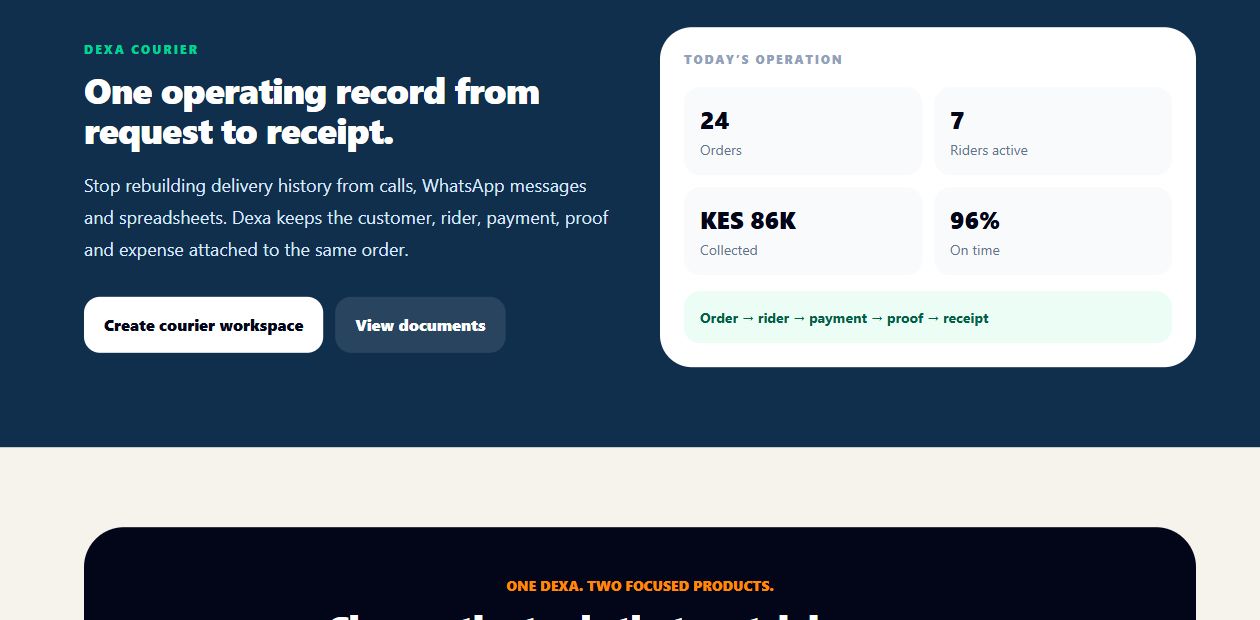
Coordinate orders, dispatch, riders, delivery status, proof of delivery, and collections from one operational workspace built for speed, visibility, and service consistency.
A courier management system runs one order from request to receipt: booking and pricing, dispatch and rider assignment, live status, proof of delivery, payment collection, and reporting. Instead of coordinating across phone calls, WhatsApp threads, and spreadsheets, the team works from a shared record that shows what must move, who is responsible, and what has been completed.
For a full breakdown of modules, integrations, payments, and rollout, read our complete guide to the courier management system in Kenya.
Compare your dispatch process with the Dexa product workflow: a customer request stays connected to the rider, delivery evidence and commercial close.
Dexa connects the delivery request, rider assignment, progress, proof, payment and receipt. The order reference gives dispatch, customer service and finance a shared record to review.
Start with an order your team recognises. Check who assigns the rider, where status changes appear, what evidence closes the delivery and how the payment reference reaches finance.
Agree the proof requirements, integration access and reporting needs for your operation before choosing a rollout scope.
Explore courier ePOD workflows and cash-on-delivery reconciliation for these stages.
Replace fragmented WhatsApp coordination and spreadsheets with structured dispatch operations and traceable delivery events.
Capture customer, pickup, destination, contact, items, and price once, with zone, weight, or service-based rates.
Assign or reassign jobs by zone, priority, or rider capacity to reduce delays and improve route efficiency.
Track status from pickup to proof of delivery with timestamps that support customer service and internal review. Explore ePOD for courier and last-mile delivery to capture recipient signatures, photos, failed attempts and returns against each order.
Capture recipient name, signature or code, photos, quantities, and exceptions, all attached to the order.
Record cash and M-Pesa collections, references, and receipts against the order, then reconcile per rider.
Monitor fulfillment time, delivery success rate, failed attempts, and cost-per-delivery across riders, routes, and customers.
Works for e-commerce fulfillment teams, third-party couriers, internal dispatch fleets, and branch distribution networks.
Every order keeps its reference, rider, status, and evidence so nothing depends on memory or a screenshot.
Customer service sees live status and proof, so questions are answered without calling the rider.
Cash and M-Pesa collected on delivery are recorded and compared to deliveries, closing revenue leaks.
A courier management system is software that manages an order from request to receipt: booking and pricing, dispatch and rider assignment, live delivery status, proof of delivery, payment or cash-on-delivery collection, and performance reporting. It replaces fragmented phone calls, WhatsApp threads, and spreadsheets with one traceable record.
Yes. The workflows are designed for centralised assignment and status monitoring across active riders and zones, with the ability to reassign work without losing the delivery record.
Yes. Delivery events can trigger email, SMS, or WhatsApp updates so customers stay informed without staff answering every status request manually.
Yes. Proof can include recipient name, signature or one-time code, photos, quantities, condition notes, and exception reasons, all attached to the order. See our electronic proof of delivery solution for the evidence workflow.
Yes. The system records the amount collected, the method, the reference, and the receipt against the order, then reconciles collections per rider to avoid end-of-day shortages.
Yes. We provide setup guidance, workflow design, data migration, training, and ongoing support through rollout and beyond.