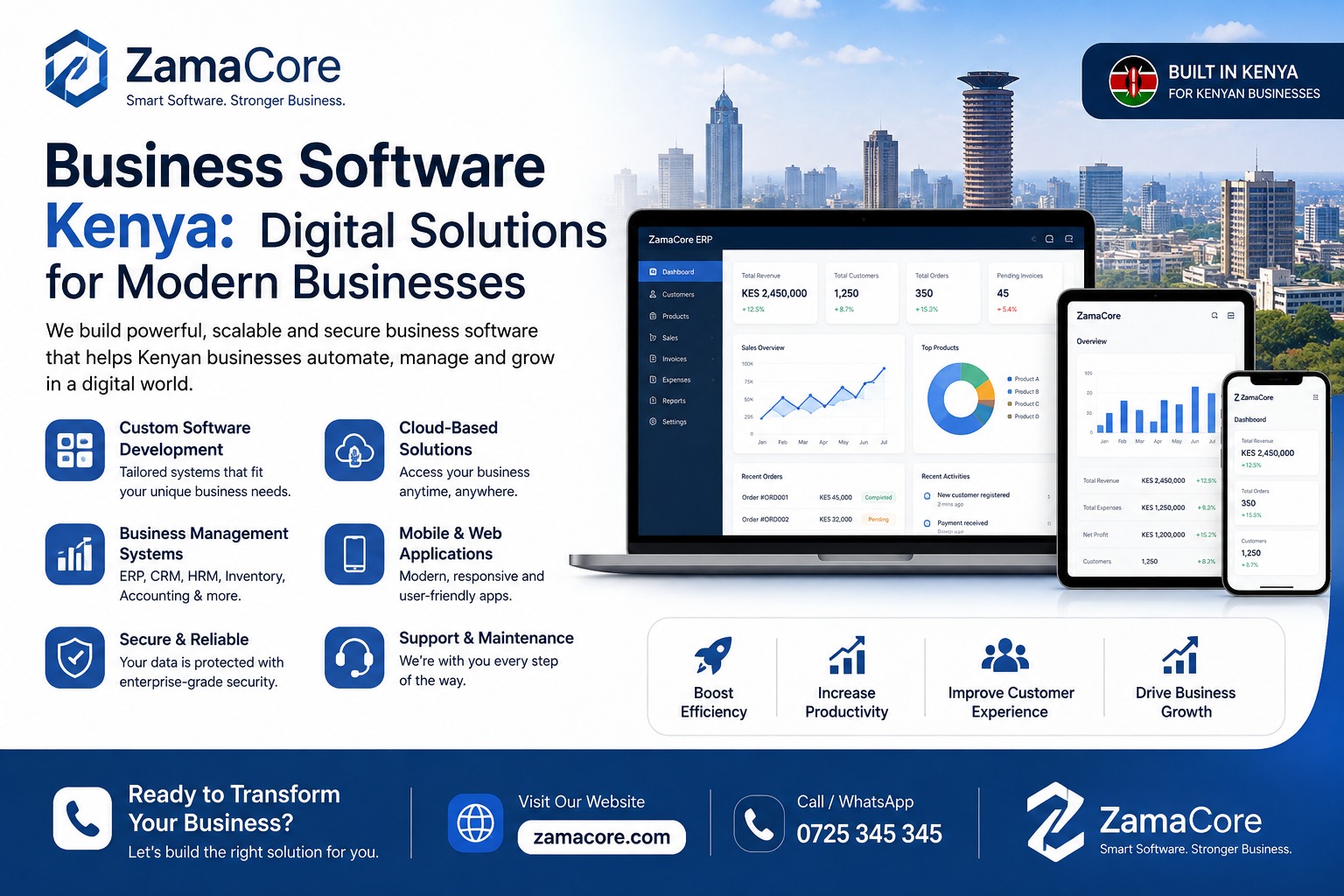
Business Software Kenya: Digital Solutions for Modern Businesses
Business Software Kenya is becoming increasingly important as businesses look for better ways to manage operations, automate repetitive tasks, improve customer service, and make informed decisions. From small and medium-sized enterprises to large organizations, businesses across Kenya are adopting digital solutions to improve efficiency and support growth.
As companies expand, relying on spreadsheets, paperwork, WhatsApp messages, and disconnected systems can make business operations more difficult to manage. Business software in Kenya provides a more efficient way to centralize information, automate workflows, manage customers, track payments, monitor inventory, and generate real-time reports.
Whether you operate a retail business, logistics company, property management firm, school, hospitality business, agricultural company, or professional services organization, the right business software can help simplify daily operations and improve productivity.
In this guide, we explore how Business Software Kenya can help businesses automate processes, manage information, integrate payments such as M-Pesa, improve reporting, and build scalable digital operations.
What Is Business Software?
Business software is a digital system designed to help organizations manage specific business processes.
Depending on the needs of a company, business software can manage:
- Sales
- Customers
- Inventory
- Payments
- Employees
- Accounting
- Procurement
- Orders
- Deliveries
- Property
- Reporting
- Communication
- Business workflows
Instead of relying on several disconnected tools, businesses can use an integrated platform to manage their operations more efficiently.
For example, a retail business may use software to manage sales, inventory, customers, suppliers, payments, and reports from a single system.
Why Businesses in Kenya Need Business Software
The Kenyan business environment is becoming increasingly digital. Customers expect faster service, businesses need accurate information, and management teams require real-time visibility into operations.
Manual processes can make it difficult to keep up.
A business using spreadsheets may struggle with:
- Duplicate records
- Data entry errors
- Missing information
- Delayed reports
- Manual reconciliation
- Poor customer tracking
- Limited visibility
- Time-consuming administrative tasks
A properly designed business software system can automate many of these activities.
Benefits of Business Software in Kenya
1. Automate Repetitive Tasks
One of the biggest advantages of business software is automation.
Instead of employees manually performing repetitive activities, software can automatically handle processes such as:
- Sending customer notifications
- Generating invoices
- Updating records
- Assigning tasks
- Creating reports
- Sending reminders
- Tracking payments
- Updating inventory
Automation saves time and allows employees to focus on more valuable tasks.
2. Centralize Business Information
Businesses often store information in different places.
Customer records may be in spreadsheets, payments in mobile phones, inventory in another application, and reports in separate documents.
Business software can bring this information together.
A centralized platform can provide authorized users with access to the information they need while maintaining appropriate user permissions.
3. Improve Customer Management
Customer relationships are essential to business growth.
A CRM or custom business management system can help businesses keep track of:
- Customer contacts
- Orders
- Payments
- Invoices
- Communication
- Support requests
- Purchase history
- Account balances
This gives employees a clearer picture of each customer and can improve customer service.
Business Management Software in Kenya
Business management software in Kenya can help companies manage multiple departments and processes from one platform.
Depending on the organization, a business management system may include:
- Sales management
- Inventory management
- Customer management
- Employee management
- Payment management
- Procurement
- Reporting
- Workflow automation
- Notifications
- User permissions
Custom business management software can be especially useful when a company’s processes are unique and cannot be effectively handled by an off-the-shelf application.
Custom Business Software Development in Kenya
Every business operates differently.
A logistics company does not have the same requirements as a property management company. A school has different workflows from a retail business.
This is why many organizations choose custom business software development in Kenya.
Custom software can be designed around the exact requirements of an organization.
For example, a property company could have software for:
- Property management
- Tenant records
- Lease management
- Rent collection
- Arrears tracking
- Statements
- Maintenance requests
- Property reports
A delivery company could require:
- Order management
- Driver assignment
- Delivery tracking
- Customer notifications
- Proof of delivery
- Payment tracking
- Delivery reports
The software is designed around the actual business workflow rather than forcing the business to change its operations to fit a generic application.
M-Pesa Integration for Kenyan Businesses
M-Pesa is an important part of the Kenyan business environment.
Businesses that collect payments through M-Pesa can integrate payment functionality directly into their software systems.
An M-Pesa integration in Kenya can help automate processes such as:
- Customer payments
- STK Push
- Payment confirmations
- Transaction recording
- Payment matching
- Receipts
- Reconciliation
- Payment reporting
For example, when a customer makes a payment, the transaction can automatically be linked to the relevant customer account, invoice, order, or service.
This reduces manual payment verification and improves financial visibility.
ERP Software for Kenyan Businesses
Growing organizations may need more than basic business management software.
An ERP system can connect multiple areas of a business through a centralized platform.
Depending on the company’s requirements, an ERP system can manage:
- Finance
- Inventory
- Sales
- Procurement
- Human resources
- Customers
- Operations
- Reporting
An ERP solution can provide management with a broader view of the organization and reduce the need to maintain multiple disconnected systems.
Business Automation in Kenya
Business automation is becoming increasingly important as organizations look for ways to improve productivity.
Automation can be used for workflows such as:
Customer order → Payment confirmation → Order processing → Task assignment → Notification → Completion → Reporting
Instead of employees manually moving information between different stages, software can automate the workflow.
This can reduce delays and improve accountability.
Cloud-Based Business Software
Cloud-based software allows businesses to access their systems through an internet connection.
This can be particularly useful for organizations with:
- Multiple branches
- Remote employees
- Field workers
- Sales teams
- Delivery teams
- Distributed management
Authorized users can access business information from computers, tablets, or mobile devices depending on the application’s design.
Cloud-based systems can also make it easier to implement centralized backups, updates, monitoring, and system maintenance.
Business Software for Different Industries in Kenya
The right software depends on the industry and business model.
Retail Business Software
Retail businesses can use software to manage:
- Sales
- Inventory
- Suppliers
- Customers
- Employees
- Payments
- Reports
Property Management Software
Property companies can manage:
- Properties
- Units
- Tenants
- Leases
- Rent
- Arrears
- Maintenance
- Statements
Courier and Delivery Software
Courier companies can manage:
- Orders
- Parcels
- Drivers
- Routes
- Deliveries
- Customers
- Payments
- Proof of delivery
School Management Software
Schools can use software to manage:
- Students
- Teachers
- Fees
- Attendance
- Classes
- Examinations
- Communication
- Reports
Hospitality Software
Hotels, restaurants, and hospitality businesses can use software for:
- Reservations
- Customers
- Payments
- Inventory
- Staff
- Reporting
- Operations
How Much Does Business Software Cost in Kenya?
The cost of business software in Kenya depends on the complexity and requirements of the project.
Factors that can affect the cost include:
- Number of users
- Number of features
- Custom workflows
- Mobile applications
- Web applications
- Payment integrations
- Third-party integrations
- Reporting requirements
- Security requirements
- Hosting
- Maintenance and support
A simple business application will generally require a different budget from a large enterprise platform.
Instead of choosing software based only on price, businesses should consider the long-term value, scalability, security, support, and ability of the system to solve their operational problems.
How to Choose Business Software in Kenya
Before selecting a business software solution, consider the following factors.
Understand Your Business Requirements
Start by identifying the problems you want the software to solve.
Ask:
- What processes are currently manual?
- What information needs to be centralized?
- Which tasks should be automated?
- Who will use the system?
- What reports are required?
- Are payment integrations necessary?
- Does the system need to connect to other applications?
Consider Scalability
Your software should be capable of supporting your business as it grows.
Consider whether the system can support:
- More users
- More customers
- More transactions
- Additional branches
- New features
- Additional integrations
Check Security
Business systems often contain sensitive information.
Make sure the software solution includes appropriate measures for:
- Authentication
- User permissions
- Data protection
- Backups
- Secure APIs
- Activity monitoring
Consider Ongoing Support
Software requires maintenance after launch.
Choose a development partner that can provide:
- Bug fixes
- Updates
- Monitoring
- Backups
- Security improvements
- Technical support
- Future development
Why Choose Zamacore for Business Software in Kenya?
Zamacore provides custom software development in Kenya for businesses looking to improve their operations through technology.
The company develops business systems, SaaS platforms, dashboards, automation solutions, payment integrations, and other custom digital products.
Zamacore’s approach focuses on understanding business workflows before developing the software. This helps ensure that the resulting platform addresses actual operational requirements.
For businesses that have outgrown spreadsheets, manual processes, or disconnected applications, a custom digital system can provide a more structured way to manage operations.
The Future of Business Software in Kenya
Technology will continue to play an important role in how Kenyan businesses operate.
Businesses are increasingly looking for systems that can connect customers, employees, payments, inventory, reporting, and operations.
The future of business software in Kenya is therefore moving beyond simple record keeping.
Modern systems are becoming platforms for:
- Automation
- Data-driven decision-making
- Customer management
- Payment processing
- Operational visibility
- Business intelligence
- Digital collaboration
- Scalable growth
Companies that invest in the right technology can position themselves to operate more efficiently and respond faster to changing customer and market demands.
Business software in Kenya can help organizations reduce manual work, improve efficiency, centralize information, automate workflows, and gain better visibility into their operations.
Whether you need a custom business management system, ERP, CRM, inventory platform, property management system, delivery platform, SaaS application, or M-Pesa integration, the right software should be designed around your business requirements.
Zamacore helps Kenyan businesses turn operational challenges into practical software solutions.
If your business is still relying heavily on spreadsheets, paperwork, or disconnected systems, now may be the right time to explore a more efficient digital solution
Many business owners continue using manual systems because they have become familiar with them. However, certain signs indicate that your current tools may no longer be suitable for your business.
You may need business software in Kenya if:
- Employees spend too much time entering data manually.
- Your business uses multiple spreadsheets for the same information.
- Customers frequently ask for updates that are difficult to provide.
- Management cannot easily access real-time reports.
- Payments have to be verified manually.
- Inventory records are frequently inaccurate.
- Employees duplicate the same tasks.
- Important business information is scattered across different systems.
- Your business has expanded to multiple branches.
- You are struggling to track employee performance.
- Generating reports takes several hours or days.
These problems can become more expensive as a business grows.
How Business Software Improves Decision-Making
Good decisions depend on accurate information.
Without centralized business data, managers may have to rely on manually prepared reports or information from different employees.
A business software platform can provide real-time information through dashboards and reports.
For example, management may be able to see:
- Today’s sales
- Total revenue
- Outstanding payments
- Current inventory
- New customers
- Completed orders
- Pending orders
- Employee activity
- Branch performance
This information can help business owners identify problems earlier and make decisions based on actual data.
Inventory Management Software in Kenya
Inventory management is a major challenge for many businesses.
Poor inventory control can result in:
- Overstocking
- Stock shortages
- Lost sales
- Expired products
- Theft
- Incorrect stock records
- Unnecessary purchasing
An inventory management system can help businesses monitor stock levels and transactions.
Features may include:
- Product management
- Stock-in and stock-out
- Purchase orders
- Supplier management
- Stock transfers
- Low-stock alerts
- Sales tracking
- Inventory reports
For businesses with multiple locations, centralized inventory software can also help management monitor stock across different branches.
CRM Software for Kenyan Businesses
Customer Relationship Management software helps businesses organize customer information and interactions.
A CRM system can store information such as:
- Customer names
- Phone numbers
- Email addresses
- Leads
- Sales opportunities
- Customer requests
- Purchase history
- Communication records
Sales teams can use this information to follow up with prospects and maintain relationships with existing customers.
For growing companies, having a centralized customer database can be much more effective than storing customer information across individual phones, notebooks, or spreadsheets.
Payment and Financial Management
Payment management is another area where software can improve efficiency.
A business may receive payments through different channels, including:
- M-Pesa
- Bank transfers
- Card payments
- Cash
- Online payment platforms
A centralized system can help record transactions and connect payments to customers, invoices, orders, or accounts.
This can make reconciliation easier and reduce the possibility of missing transactions.
Employee and Staff Management Software
Businesses with multiple employees can also benefit from software designed to manage staff operations.
Depending on the business, a system can help with:
- Employee records
- Attendance
- Tasks
- Work schedules
- Leave management
- Performance tracking
- User permissions
- Payroll integrations
- Internal communication
Role-based access can ensure that employees only see the information required for their responsibilities.
Business Dashboards and Reporting
Business dashboards provide management with a visual overview of important information.
Instead of opening multiple reports, managers can use a dashboard to monitor key performance indicators.
A dashboard may display:
Sales | Customers | Revenue | Inventory | Payments | Orders | Tasks
The information can be presented through charts, tables, totals, and alerts.
This can make it easier for management to identify trends and respond quickly to changes.
API Integration for Business Software
Modern businesses often use several digital services.
For example, a company may use software for accounting, payments, communication, shipping, customer management, and internal operations.
APIs allow different systems to communicate with one another.
A custom business application can integrate with services such as:
- Payment platforms
- SMS providers
- Accounting systems
- CRM platforms
- E-commerce platforms
- Maps and location services
- Shipping systems
- Government or third-party APIs
Integrations can eliminate repetitive data entry and allow information to move automatically between systems.
WhatsApp and SMS Business Integration
Communication is an important part of customer service.
Businesses can integrate SMS or messaging services into their software to send automated notifications.
Examples include:
- Payment confirmations
- Order updates
- Appointment reminders
- Delivery notifications
- Account reminders
- Marketing messages
- Customer alerts
Automated communication can improve the customer experience while reducing the amount of manual follow-up required from employees.
Building Scalable Business Software
A business system should not only solve today’s problems. It should also be designed with future growth in mind.
When developing software, businesses should consider:
- Future users
- Additional branches
- Increasing transactions
- New products
- New services
- Additional integrations
- Mobile applications
- Advanced reporting
A scalable architecture makes it easier to expand the system without rebuilding the entire platform.
The Importance of User-Friendly Software
Powerful software is not useful if employees cannot use it effectively.
The user interface should be simple, clear, and appropriate for the people using the system.
A good business application should make common tasks easy to find and complete.
For example, an employee should be able to:
- Log in securely.
- Find the relevant customer.
- Create or update a transaction.
- Save the information.
- Receive confirmation.
- Continue with the next task.
Good user experience can improve employee adoption and reduce training requirements.
Business Software for Small and Medium Enterprises
Small and medium-sized businesses often believe that custom software is only suitable for large corporations.
That is not necessarily the case.
A growing SME may benefit from a focused software system that solves a specific operational problem.
For example, a small company may begin with:
- Customer management
- Sales tracking
- Inventory
- Payment tracking
- Reporting
As the company grows, additional modules can be added.
This approach allows businesses to invest in technology based on their current priorities while maintaining room for future expansion.
Moving From Spreadsheets to Business Software
Spreadsheets remain useful for many businesses, but they can become difficult to manage when the volume of information increases.
Common spreadsheet problems include:
- Multiple versions of the same file
- Accidental data deletion
- Limited access control
- Manual calculations
- Difficult collaboration
- Lack of automation
- Poor audit trails
Moving to dedicated business software can provide structured data management, user permissions, automated workflows, and centralized reporting.
The transition does not necessarily mean abandoning spreadsheets completely. Businesses can integrate existing information into a new system as part of the implementation process.
Business Software Implementation Process
Implementing new software requires planning.
A typical process can include:
Step 1: Business Discovery
The development team learns about the organization, its users, workflows, challenges, and goals.
Step 2: Requirements Definition
The required features, integrations, reports, and user roles are documented.
Step 3: System Design
The application’s architecture and user experience are planned.
Step 4: Development
Developers build the required features and integrations.
Step 5: Testing
The system is tested to identify functional, performance, security, and usability issues.
Step 6: User Training
Employees learn how to use the new system.
Step 7: Deployment
The application is launched and made available to authorized users.
Step 8: Ongoing Support
The development team monitors the system, fixes issues, applies updates, and adds improvements where required.
Common Mistakes When Buying Business Software
Businesses should avoid choosing software simply because it has many features.
More features do not always mean a better solution.
Common mistakes include:
Choosing Based Only on Price
The cheapest system may not provide the security, support, integrations, or scalability your business needs.
Ignoring User Experience
If employees find the system difficult to use, adoption can become a major problem.
Failing to Plan for Growth
A system that works for 10 users may not be suitable when the business has 100 users.
Ignoring Integrations
If the software cannot connect with essential payment or business systems, employees may continue performing manual work.
Not Planning for Support
Businesses should understand who will maintain the system after launch.
Why Custom Software Can Be a Competitive Advantage
Businesses compete on service, efficiency, speed, customer experience, and cost.
Technology can support all of these areas.
A company with automated processes may be able to serve customers faster than a competitor relying on manual processes.
A company with real-time reporting may also make decisions faster.
This is why custom business software in Kenya can become more than an operational tool. It can become part of a company’s competitive strategy.
Start Building Better Business Operations
The purpose of business software is not simply to digitize paperwork.
The real objective is to create a better way of working.
When properly designed, software can connect people, processes, payments, customers, and information in one environment.
For Kenyan businesses, this can mean:
Less manual work + better information + faster processes + improved customer service + greater visibility.
If your business is experiencing operational challenges, the first step is to identify the processes that consume the most time and determine which ones can be automated.
Zamacore can help businesses evaluate their workflows and develop custom digital solutions based on their operational requirements.