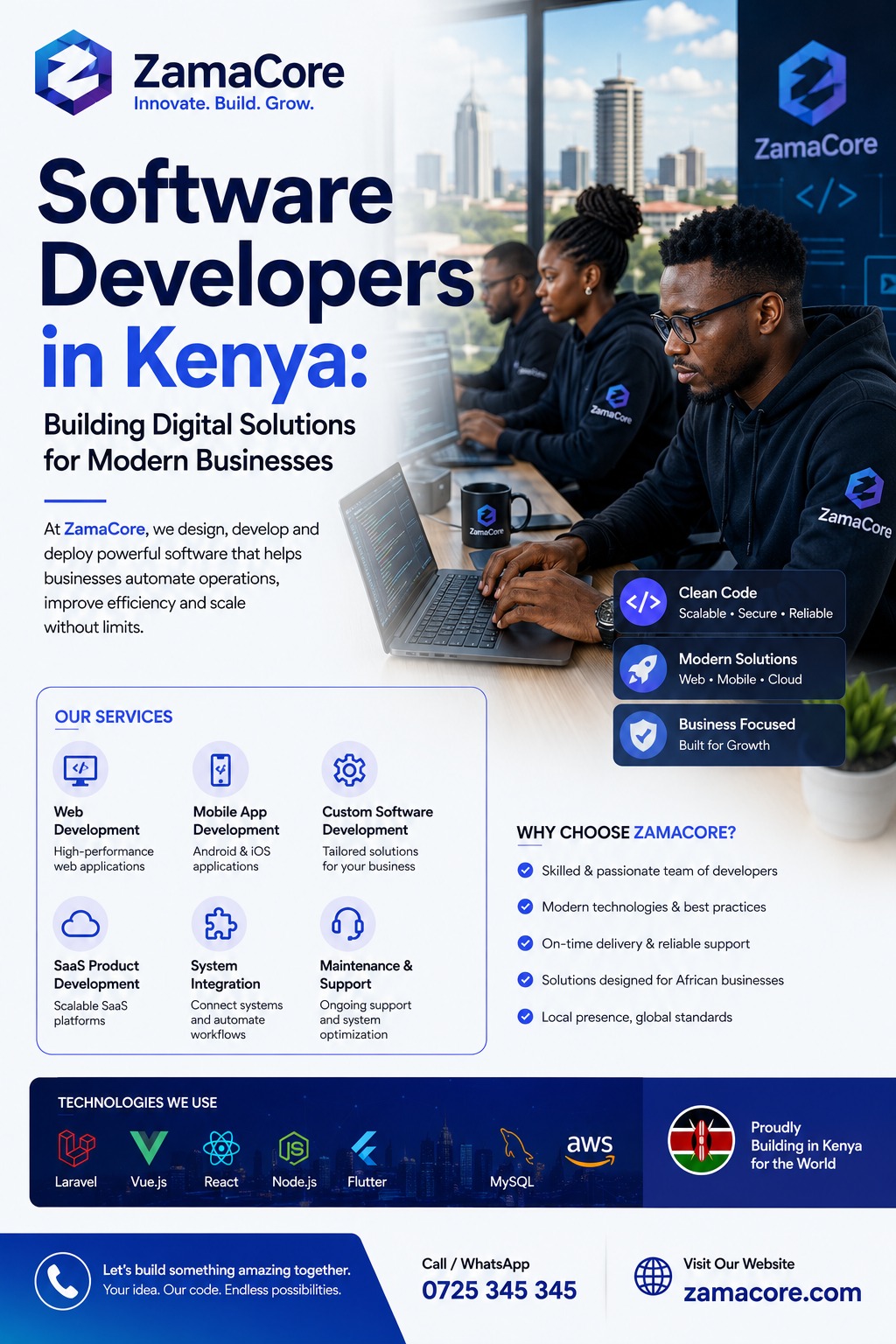
 Businesses across Kenya are increasingly turning to technology to improve efficiency, automate repetitive tasks, manage customers, process payments, and make better decisions. As companies grow, spreadsheets and disconnected systems can become difficult to manage. This is where software developers in Kenya play an important role.
Professional software developers help businesses transform ideas and operational challenges into reliable digital solutions. From custom business management systems and SaaS platforms to M-Pesa integrations, dashboards, mobile applications, and automation, software development is helping Kenyan organizations operate more efficiently.
What Do Software Developers in Kenya Do?
Software developers in Kenya design, build, test, deploy, and maintain software applications for businesses, organizations, and individuals.
Depending on the project, developers may build:
- Custom business management systems
- Web applications
- Mobile applications
- SaaS platforms
- ERP systems
- CRM systems
- Inventory and POS systems
- Property management software
- School management systems
- Courier and delivery management platforms
- Payment and M-Pesa integrations
- Business dashboards
- Automated workflows
- API integrations
The most effective development projects begin by understanding the business problem before writing code. This approach helps ensure that the final system solves a genuine operational need rather than simply adding another piece of technology.
Why Kenyan Businesses Need Professional Software Developers
Many businesses begin with spreadsheets, WhatsApp messages, paper records, or several unrelated applications. These tools can be useful when a business is small, but they can become inefficient as operations expand.
A growing company may need to manage customers, employees, inventory, payments, branches, reports, approvals, and documents from one system.
Custom software can help bring these processes together.
For example, a business management platform can provide:
- Centralized business data
- User and staff management
- Automated approvals
- Real-time dashboards
- Payment tracking
- Customer portals
- Reports and exports
- Role-based permissions
- Automated notifications
This allows management teams to spend less time searching for information and more time making decisions.
Custom Software Development in Kenya
One of the most important services offered by modern software developers in Kenya is custom software development.
Custom software is designed around a company’s specific processes. This can be particularly useful when an organization has workflows that standard software cannot handle effectively.
For example, a logistics company may require a platform for orders, dispatching, riders, proof of delivery, customer notifications, and operational reporting.
A property company may need software for tenants, leases, rent collection, arrears, statements, and property management.
A retail business may need an integrated system for sales, inventory, staff roles, payments, receipts, and reporting.
Zamacore develops custom business systems for areas including property, retail, logistics, education, agriculture, hospitality, and other operational environments.
M-Pesa Integration and Business Software
For many Kenyan businesses, payment processing is an essential part of daily operations.
Software developers can integrate M-Pesa into business applications to help automate processes such as:
- Customer payments
- STK Push
- Paybill payments
- Till payments
- Payment callbacks
- Payment matching
- Receipts
- Reconciliation
- Payment reporting
Instead of manually checking payment messages and updating records, an integrated system can connect payment activity with customer accounts, invoices, orders, or other business records.
Zamacore specifically provides M-Pesa integration services designed around payment collection, matching, receipts, reconciliation, and finance workflows.
SaaS Development in Kenya
Kenya also has growing opportunities for entrepreneurs building software products.
A SaaS development company in Kenya can help businesses turn an idea into a subscription-based software platform.
A modern SaaS application may require:
- User registration
- Customer accounts
- Multi-tenant architecture
- Subscription plans
- Billing
- Payment integration
- User permissions
- Analytics
- Notifications
- Administrative dashboards
- Customer support tools
Zamacore builds SaaS platforms with features such as user management, subscriptions, billing, roles, analytics, integrations, and product operations.
Business Automation Through Software
Automation is another major reason businesses work with software developers.
Instead of employees repeatedly performing the same manual tasks, software can automate workflows such as:
- Sending reminders
- Assigning tasks
- Generating reports
- Approving requests
- Updating records
- Sending customer notifications
- Creating invoices
- Tracking payments
- Escalating overdue tasks
For growing organizations, automation can improve consistency and reduce the amount of repetitive administrative work.
Zamacore’s software development approach includes workflow automation, dashboards, approvals, reminders, notifications, and escalation rules.
How to Choose Software Developers in Kenya
Choosing the right development partner is an important decision. Businesses should look beyond price and evaluate the developer’s ability to understand the business and support the system after launch.
1. Check Previous Projects
Look at the developer’s previous work and determine whether they have built systems similar to what you need.
2. Understand Their Development Process
A professional team should have a clear process covering discovery, requirements, design, development, testing, deployment, and support.
Zamacore follows a discovery-led approach that maps users, workflows, data, permissions, reports, and payment requirements before development begins.
3. Consider Integrations
If your business depends on M-Pesa, SMS, WhatsApp, accounting software, ERP systems, CRM platforms, or external APIs, confirm that the development team can handle the required integrations.
4. Ask About Support
Software development should not end when the application goes live.
Ask about:
- Hosting
- Backups
- Monitoring
- Bug fixes
- Security updates
- User support
- Training
- Future improvements
Zamacore offers post-launch support that can include hosting, monitoring, backups, updates, bug fixes, security reviews, user assistance, and product improvements.
5. Clarify Ownership
Before development starts, make sure the agreement clearly explains system access, source code, hosting, documentation, administrator credentials, and ownership responsibilities.
This helps prevent misunderstandings later.
Software Developers in Nairobi and Across Kenya
Nairobi is an important technology and business hub, making it a major market for software development services. However, businesses outside Nairobi can also work with software development teams to build and manage digital platforms.
Software developers can support organizations across Kenya in industries such as:
- Real estate
- Retail
- Education
- Agriculture
- Logistics
- Hospitality
- Finance
- Professional services
- E-commerce
- Healthcare
- Manufacturing
The important factor is not simply where the developer is located, but whether the team understands the organization’s requirements and can deliver and maintain the required system.
Why Choose Zamacore for Software Development in Kenya?
Zamacore is a software development company in Kenya focused on custom software, SaaS platforms, business systems, dashboards, M-Pesa integrations, automation, and digital solutions.
The company works with real operational workflows across industries including property, hospitality, agriculture, retail, logistics, and education.
Its development process covers discovery and workflow mapping, product design, engineering, integrations, testing, onboarding, deployment, and ongoing support.
Businesses looking for software developers can therefore start with the problem they want to solve rather than simply requesting a list of features.
The Future of Software Development in Kenya
As Kenyan businesses continue adopting digital tools, demand for reliable software development is likely to remain strong.
Companies increasingly need systems that can connect payments, customers, employees, operations, reporting, and external services.
The future is not simply about having software. It is about having software that works around the way a business actually operates.
For businesses that have outgrown spreadsheets or disconnected tools, investing in a well-designed software platform can provide better visibility, automation, accountability, and scalability.
Finding the right software developers in Kenya can help your business move from manual processes to structured digital operations.
Whether you need custom software, a SaaS platform, an ERP system, M-Pesa integration, business automation, dashboards, or a specialized industry solution, the right development partner should understand your business before building the technology.
Zamacore helps Kenyan organizations design, develop, launch, and support software systems built around real business operations.
Ready to build your software solution? Contact Zamacore to discuss your requirements and request a software project proposal. Zamacore lists its Nairobi contact details as +254 725 345 345 and muki@zama.co.ke.
How Software Developers Help Businesses Grow
Hiring professional software developers in Kenya is not only about creating an application. The goal is to build technology that supports business growth and improves the way employees, customers, and managers interact with the organization.
A well-designed software system can help a company reduce manual work, improve accuracy, and gain better visibility into its operations.
1. Improving Business Efficiency
Manual processes often require employees to enter the same information into multiple systems. This can waste time and increase the risk of errors.
Custom software can connect different processes so that information flows automatically.
For example, when a customer places an order, the system can automatically:
- Record the order
- Confirm payment
- Update inventory
- Notify the relevant employee
- Assign delivery
- Send a customer notification
- Generate a report
This type of automation can make daily operations faster and more organized.
2. Better Business Reporting
Business owners need accurate information to make informed decisions.
Modern business software can provide dashboards showing important information such as:
- Sales
- Revenue
- Expenses
- Customer activity
- Inventory levels
- Employee performance
- Pending tasks
- Payments
- Outstanding balances
- Delivery performance
Instead of waiting for employees to prepare reports manually, management can access important information directly from the system.
3. Managing Customers More Effectively
Customer information is one of the most valuable assets of any business.
A custom CRM or business management system can keep customer information in one centralized location.
Businesses can track:
- Customer contacts
- Orders
- Payments
- Communication history
- Support requests
- Invoices
- Account balances
- Customer activity
This makes it easier for employees to provide consistent customer service.
Custom ERP Software Development in Kenya
As businesses grow, they often need to manage multiple departments and processes from one platform.
An ERP system in Kenya can connect functions such as finance, inventory, sales, procurement, human resources, operations, and reporting.
Instead of using several disconnected applications, businesses can create a centralized platform that provides management with a complete view of operations.
Custom ERP development can be particularly useful when existing off-the-shelf ERP systems do not match the organization’s workflows.
Mobile App Development in Kenya
Mobile applications are also becoming an important part of digital business operations.
A mobile application can allow customers, employees, drivers, agents, or field teams to access information while away from the office.
Examples include:
- Delivery tracking apps
- Sales agent applications
- Customer apps
- Field service applications
- Employee portals
- Booking applications
- E-commerce apps
Software developers can build mobile applications that communicate with a central web-based business system through secure APIs.
This allows information collected in the field to become available to management in real time.
Web Application Development
A web application can provide businesses with access to their systems through a browser without requiring users to install traditional desktop software.
Modern web applications can support:
- Secure user accounts
- Role-based access
- Dashboards
- Reports
- Online payments
- Customer portals
- Inventory management
- Workflow automation
- API integrations
For businesses operating across different branches or locations, web-based software can make it easier for authorized users to access the same system from different locations.
Security Should Be a Priority
When developing business software, security should be considered from the beginning of the project.
A professional software development team should consider:
- User authentication
- Password security
- Role-based permissions
- Data encryption
- Secure APIs
- Database security
- Backups
- Activity logs
- Access controls
- Monitoring
Businesses should also ensure that sensitive information is only accessible to employees who need it.
Security is especially important for systems handling customer information, financial records, payments, employee data, and business transactions.
Cloud-Based Software for Kenyan Businesses
Cloud technology allows businesses to host applications and data on managed infrastructure instead of relying entirely on local computers or servers.
Cloud-based systems can provide benefits such as:
- Remote access
- Automated backups
- Easier updates
- Centralized data
- Scalability
- Business continuity
- Multi-location access
A business with offices in Nairobi, Mombasa, Kisumu, or other locations can use a centralized cloud platform to manage operations from one system.
Software Development for Startups
Kenyan startups can also benefit from working with experienced software developers.
A startup may have an idea for a digital product but lack an internal engineering team to turn the concept into a working platform.
Software developers can help transform an idea into a minimum viable product (MVP), test it with users, collect feedback, and continue improving the product.
A typical startup development process may include:
- Understanding the business idea
- Defining the target users
- Identifying the most important features
- Designing the user experience
- Developing the MVP
- Testing the application
- Launching the product
- Collecting user feedback
- Improving and scaling the platform
This approach helps startups avoid spending excessive resources building features that customers may not need.
How Much Does Software Development Cost in Kenya?
The cost of software development in Kenya depends on several factors.
There is no single price for a custom software project because every business has different requirements.
The cost can be influenced by:
- Number of features
- Number of users
- Complexity of workflows
- Mobile and web requirements
- Third-party integrations
- M-Pesa integration
- Reporting requirements
- Security requirements
- UI/UX design
- Hosting requirements
- Ongoing maintenance
A simple internal application will generally require a different budget from a large enterprise platform with multiple integrations and thousands of users.
The best way to determine the cost is to begin with a detailed requirements and discovery process.
Why Businesses Should Start With Requirements
One of the biggest mistakes businesses can make is asking developers to start coding before clearly defining the problem.
Before development begins, businesses should identify:
- What problem needs to be solved?
- Who will use the system?
- What processes should be automated?
- What information needs to be stored?
- What reports are required?
- Which existing systems need integration?
- What payment methods are required?
- What user roles are needed?
- What should the system do in the future?
Clear requirements help developers create a more accurate solution and reduce unnecessary development costs.
Choosing the Right Technology Partner
The right software developers in Kenya should be more than programmers.
They should be able to understand business processes, identify opportunities for automation, design user-friendly systems, integrate external services, test applications, and provide ongoing technical support.
When evaluating a development company, consider its:
- Technical experience
- Industry knowledge
- Previous projects
- Communication process
- Development methodology
- Security practices
- Integration capabilities
- Support services
- Scalability approach
- Understanding of your business
The cheapest developer is not always the best option. A poorly designed system can become expensive to maintain or replace later.
Frequently Asked Questions About Software Developers in Kenya
What do software developers in Kenya specialize in?
Software developers in Kenya can specialize in web applications, mobile apps, SaaS platforms, ERP systems, CRM systems, business automation, payment integrations, APIs, e-commerce platforms, and custom business software.
How do I find software developers in Kenya?
Start by identifying your business requirements and then compare development companies based on their experience, portfolio, technical capabilities, communication, security practices, and ongoing support.
Can software developers integrate M-Pesa?
Yes. Developers can integrate M-Pesa payment services into applications to support processes such as customer payments, STK Push, transaction processing, callbacks, payment matching, and reconciliation.
Can I build custom software for my business?
Yes. Custom software can be designed around your specific workflows, users, business rules, reporting requirements, and integrations.
Do Kenyan software developers provide maintenance?
Many professional development companies provide post-launch maintenance, monitoring, security updates, bug fixes, hosting support, and additional development.
How long does it take to build custom software?
The development timeline depends on the complexity of the project. A small application may take significantly less time than a large platform with multiple user roles, integrations, mobile applications, payment systems, and advanced reporting.
Start Your Software Development Project
Technology should solve business problems rather than create additional complexity.
If your business is relying on spreadsheets, manual processes, disconnected applications, or repetitive administrative work, custom software may provide a more efficient way to manage your operations.
Whether you need a business management system, SaaS platform, ERP, CRM, mobile application, M-Pesa integration, dashboard, or workflow automation, working with experienced software developers can help turn your requirements into a practical digital solution.
For businesses looking for software developers in Kenya, Zamacore provides custom software development and digital solutions designed around real business workflows.
The first step is simple: identify the problem, define the workflow, and build the right technology around your business.
One response