Hotel management software for Kenyan hotels should connect a guest’s journey to the financial records created during that stay. Reservations, room availability, check-in, restaurant orders, housekeeping, payments, and reporting should not become separate islands that staff must reconcile at the end of every shift.
This buyer guide explains the workflows to compare before selecting a system. For live product evidence, visit Zamacore’s property and hospitality software category and the Hoteldesk product page.
The core hotel workflow to test
Ask the vendor to demonstrate one booking from reservation to financial close. The room should move through availability, reservation, check-in, occupied status, housekeeping, and checkout. Charges from accommodation, restaurant, or other outlets should reach the correct guest folio. Payment should produce a traceable record, and management reports should reflect the transaction.
This single scenario reveals whether the system is integrated or simply a group of screens. It also shows whether front-office and finance teams can investigate a difference without relying on memory.
Modules Kenyan hotels should compare
- Reservations and front office: Room availability, multi-night rates, amendments, cancellations, check-in, room moves, and guest history.
- Housekeeping: Room-cleaning assignments, inspection, progress, and room-ready status connected to the front desk.
- POS and cashiering: Itemized orders, receipts, shift controls, refunds, voids, and cash variance review.
- Restaurant and kitchen: Menus, orders, kitchen status, recipe or ingredient controls, and posting charges to a room.
- Inventory and procurement: Stores, stock movement, purchasing, and cost visibility.
- Accounting and reports: Expenses, journals, trial balance, profit and loss, balance sheet, and bank matching where supported.
- Staff controls: Roles, permissions, shift responsibilities, and traceable sensitive actions.
Payments, M-Pesa and eTIMS
Payment integration needs operational controls around it. Ask how M-Pesa payments are matched, how failed or duplicate callbacks are handled, and who can correct an exception. If eTIMS is required, confirm the exact workflow, the credentials needed, and what happens when the external service is unavailable.
Third-party services may carry separate Safaricom, KRA, SMS, email, domain, or implementation charges. These costs should be visible during commercial evaluation rather than discovered after onboarding.
Review Hoteldesk plans and evidence
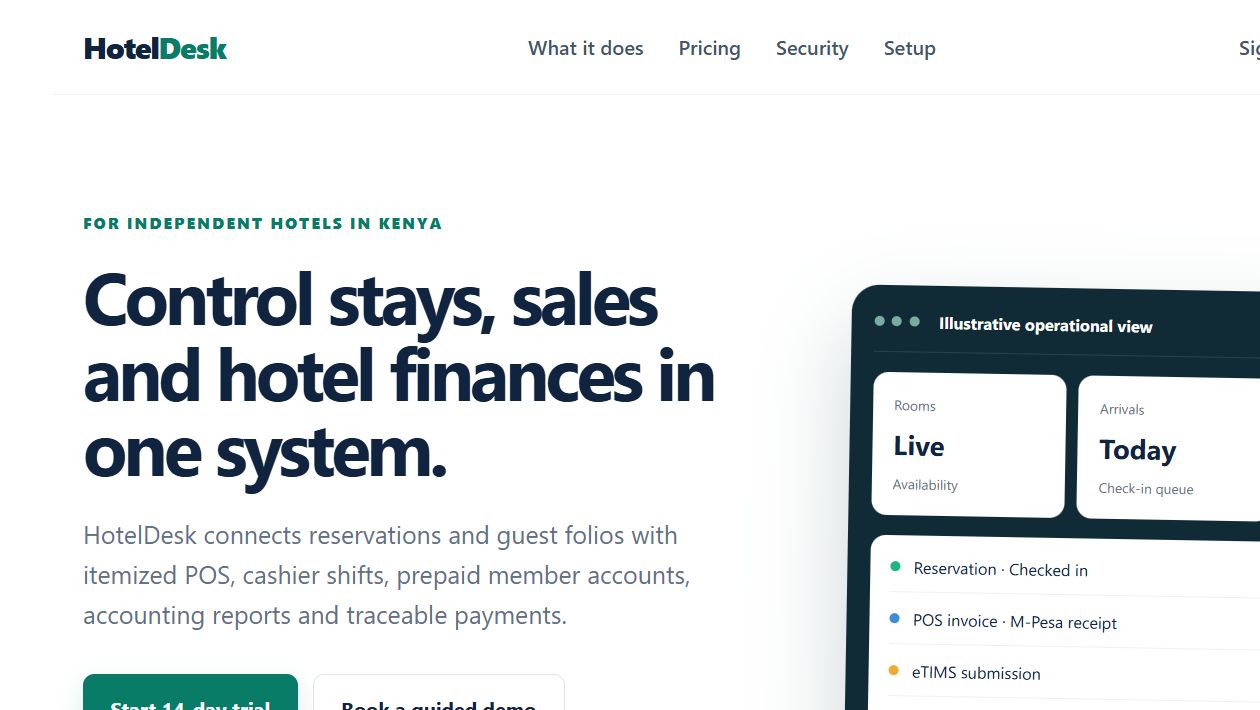
Hoteldesk is designed for hotels, lodges, serviced apartments, and accommodation teams. Its public evidence page shows the operating workflow and published plans. Current public monthly pricing is KES 7,500 for Starter, KES 15,000 for Growth, and KES 30,000 for Enterprise. Every plan begins with a 14-day trial, with no card requested at signup.
Plan selection should follow room count, user count, outlets, modules, and support needs. A small hotel may need strong front-office and POS control without enterprise limits, while a multi-outlet operation may need accounting, M-Pesa, eTIMS, and broader user access.
How to prepare for a hotel software demo
Bring a room list, rate structure, current departments, example restaurant menu, payment channels, and the reports management uses every week. Ask the vendor to map each item to a real screen and named user role. The demo should cover normal activity and exceptions such as a cancelled reservation, room move, split payment, refund, or cashier variance.
Next step: Compare the property and hospitality product category, then review the verified screens, workflows, trial, and pricing on the Hoteldesk page.