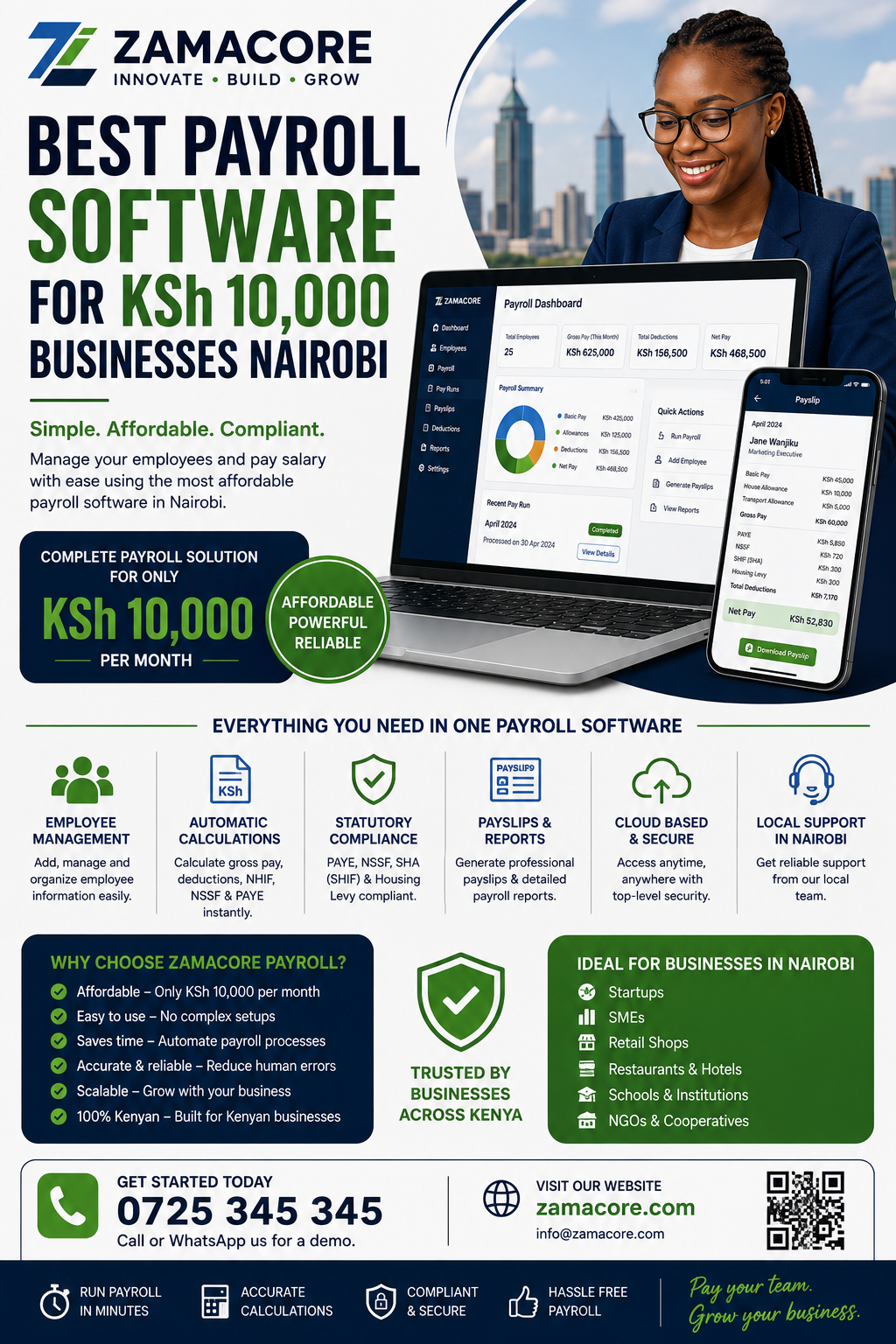
Running payroll manually may seem manageable when a business has only a few employees. However, as the team grows, calculating salaries, deductions, allowances, overtime, PAYE, NSSF, SHIF and the Affordable Housing Levy can quickly become complicated.
This is why businesses searching for the best payroll software for KSh 10,000 businesses Nairobi should focus on more than price alone. The right payroll system should help automate salary calculations, maintain employee records, generate professional payslips and make monthly payroll administration easier.
For a Nairobi SME operating on a limited software budget, a payroll solution around or below KSh 10,000 can provide an affordable way to move away from spreadsheets and manual calculations.
At Zamacore, we develop custom business and payroll software for Kenyan companies that need practical systems built around their operations.
Why Nairobi Businesses Need Payroll Software
Nairobi has thousands of SMEs operating in industries such as retail, construction, hospitality, technology, professional services, logistics, healthcare, manufacturing, security, cleaning and distribution.
Regardless of industry, businesses with employees have one important monthly responsibility: payroll.
Payroll involves considerably more than sending salaries.
Employers may need to manage:
- Basic salaries
- Allowances
- Overtime
- Bonuses
- Commissions
- PAYE
- NSSF
- SHIF
- Affordable Housing Levy
- Pension deductions
- Salary advances
- Loans
- Other deductions
- Net salaries
- Payslips
Kenya Revenue Authority states that employers paying employees are required to deduct and account for PAYE, with PAYE returns and payments generally due by the 9th day of the following month. KRA’s current PAYE guidance also recognizes deductions including Affordable Housing Levy and SHIF contributions.
Trying to handle all of these calculations manually increases the possibility of mistakes.
Payroll software helps automate much of this work.
What Is Payroll Software?
Payroll software is a business application designed to calculate, process, record and report employee salaries.
Instead of calculating every employee’s salary manually, the business enters relevant payroll information and the system performs configured calculations.
For example, an employee record might contain:
Basic salary: KSh 45,000
Allowances: KSh 5,000
Gross earnings: Calculated automatically
Applicable statutory deductions: Calculated according to configured rules
Other deductions: Applied where appropriate
Net salary: Calculated automatically
The payroll system can then generate a payslip containing the relevant salary information.
For a company with 20, 50 or 100 employees, this can save significant administrative time every month.
Best Payroll Software Under KSh 10,000 in Nairobi
Price is particularly important for SMEs.
A small company may not need an expensive enterprise HR platform costing hundreds of thousands of shillings.
Instead, it may need a focused payroll solution that provides essential functionality at an affordable cost.
Businesses comparing payroll software under KSh 10,000 in Nairobi should look for a solution that provides a good balance between affordability and functionality.
The system should ideally handle:
- Employee management
- Salary processing
- PAYE calculations
- NSSF
- SHIF
- Housing Levy
- Allowances
- Deductions
- Payslips
- Payroll reports
- Employee history
- User access controls
The exact functionality included will depend on the software provider and package.
Price should therefore never be the only consideration.
Kenyan Payroll Compliance Matters
One of the biggest differences between generic international payroll software and payroll software designed for Kenya is statutory payroll handling.
Kenyan employers need systems that can accommodate local requirements.
PAYE
PAYE stands for Pay As You Earn.
Employers deduct applicable income tax from employee earnings and remit it to the Kenya Revenue Authority.
KRA currently publishes individual PAYE bands ranging from 10% to 35%, together with applicable reliefs and deductions. Employers should always use the prevailing KRA rules for the relevant payroll period because tax requirements can change.
Good Kenyan payroll software should therefore make it possible to update payroll rules when regulations change.
NSSF Payroll Management
NSSF is another important payroll consideration.
A good payroll platform should allow the business to maintain employee NSSF information and calculate contributions according to the applicable rates.
NSSF issued updated Year 4 contribution rates for 2026, demonstrating why payroll software needs to support changing statutory configurations rather than permanently hard-coding old contribution figures.
NSSF also states that registered employers should submit returns electronically and make monthly contributions by the applicable deadline.
For growing companies, automation can make managing these employee records significantly easier.
SHIF Payroll Management
Payroll software designed for the Kenyan market should also accommodate Social Health Insurance Fund contributions where applicable.
KRA’s current PAYE documentation recognizes SHIF contributions when determining taxable employment income.
Businesses should therefore choose payroll software that can be updated when statutory rules change.
That flexibility is particularly important because payroll requirements evolve over time.
Affordable Housing Levy
The Affordable Housing Levy is another calculation Kenyan payroll systems need to consider.
KRA currently states that employees contribute 1.5% of gross pay, with employers making a corresponding 1.5% contribution.
A suitable payroll system can automatically calculate these amounts from employee earnings rather than requiring an accountant to perform the calculation manually for every worker.
For example, instead of manually calculating:
Gross salary × applicable levy percentage
for 100 employees, the system can perform the configured calculation during payroll processing.
This is one of the key advantages of payroll automation.
Features to Look for in Payroll Software Under KSh 10,000
An affordable price should not mean accepting unusable software.
Before purchasing or commissioning payroll software, check whether it provides the following functionality.
1. Employee Management
The system should provide a centralized employee database.
Each employee profile may contain information such as:
- Employee name
- Employee number
- Department
- Position
- Basic salary
- Phone number
- KRA PIN
- NSSF details
- Relevant health insurance details
- Bank information
- Employment date
- Employment status
Centralizing these records makes payroll administration easier.
2. Automatic Salary Calculations
The payroll system should automatically calculate salaries according to the configured payroll rules.
Calculations can incorporate:
- Basic salary
- Allowances
- Overtime
- Bonuses
- Commissions
- Deductions
- Advances
- Applicable statutory deductions
This reduces repetitive calculations.
3. Automated PAYE Calculations
PAYE can become complicated when employees have different salaries, benefits, deductions and applicable reliefs.
Payroll software should help calculate PAYE according to the configured Kenyan tax rules.
KRA currently lists PAYE bands ranging from 10% through 35%, with a monthly personal relief of KSh 2,400 for eligible resident individuals.
Because regulations can change, businesses should confirm current rates directly with KRA when processing payroll.
4. Professional Payslip Generation
Employees need clear salary information.
The payroll system should generate payslips showing information such as:
- Employee name
- Payroll month
- Basic salary
- Allowances
- Gross salary
- PAYE
- NSSF
- SHIF
- Housing Levy
- Other deductions
- Net salary
Payslips can potentially be printed, downloaded as PDFs or distributed digitally depending on the software.
5. Allowances
Employees may receive different allowances.
Examples can include:
- House allowance
- Transport allowance
- Communication allowance
- Meal allowance
- Responsibility allowance
A flexible payroll system should allow administrators to configure relevant earning categories.
6. Overtime Management
Businesses with hourly workers or employees working overtime need an easy way to record additional hours.
Payroll software can calculate overtime based on configured company policies and applicable employment requirements.
This can be particularly useful for businesses operating:
- Factories
- Restaurants
- Hotels
- Security companies
- Construction companies
- Cleaning companies
- Logistics businesses
7. Bonuses and Commissions
Not every employee earns a fixed salary.
Salespeople may receive commissions.
Other employees may receive performance bonuses.
The payroll platform should allow administrators to include these additional earnings during payroll processing.
8. Salary Advances
Employee salary advances can become difficult to track using notebooks or spreadsheets.
Payroll software can maintain a record showing:
- Advance amount
- Date
- Employee
- Amount recovered
- Remaining amount
The appropriate deduction can then be reflected in payroll according to the company’s policies.
9. Employee Loans
Some organizations provide employee loans.
A more advanced payroll system can track:
- Loan amount
- Repayment amount
- Repayment period
- Amount already recovered
- Outstanding balance
Monthly deductions can then be included in payroll.
10. Payroll Reports
Business owners need more than payslips.
They also need visibility.
Useful reports can include:
- Payroll summary
- Employee earnings report
- PAYE report
- NSSF report
- SHIF report
- Housing Levy report
- Deduction report
- Department payroll report
- Salary advance report
Reports help management understand the company’s salary costs.
Payroll Software for Small Businesses in Nairobi
Small businesses frequently assume payroll software is only necessary for large companies.
That is not true.
Even a business with five employees can benefit from payroll automation.
Consider a small Nairobi company with:
- 10 employees
- Different salaries
- Different allowances
- Several salary advances
- PAYE calculations
- NSSF
- SHIF
- Housing Levy
Managing this every month through spreadsheets takes time.
As the company grows to 20 or 30 employees, the work increases.
Using payroll software early gives the company a structured system that can grow with the business.
Payroll Software for SMEs in Kenya
SMEs are one of the strongest use cases for affordable payroll systems.
Many SMEs cannot justify purchasing complicated enterprise HR software.
At the same time, spreadsheets eventually become inefficient.
An affordable payroll platform provides a middle ground.
Businesses get important automation without paying for hundreds of features they may never use.
The ideal SME payroll system should therefore be:
Affordable
Pricing should make sense for smaller organizations.
Easy to use
A company should not require a dedicated IT department simply to run payroll.
Designed for Kenya
The software should accommodate Kenyan statutory requirements.
Scalable
The company should be able to add employees as it grows.
Secure
Employee and salary information is sensitive and should be appropriately protected.
Cloud Payroll Software Nairobi
Modern payroll platforms are increasingly cloud-based.
Instead of installing software on one office computer, authorized users can access a web-based system through a browser.
This can provide several advantages.
Access From Different Locations
Authorized managers can access payroll from supported devices and locations.
This is particularly useful for companies operating multiple branches.
Centralized Data
Information is stored within one central platform rather than multiple spreadsheets.
Easier Updates
Cloud software can be updated centrally when features or statutory configurations need changing.
Backup Options
A properly configured cloud environment can provide automated backup and recovery options.
Cloud hosting still needs appropriate security controls; being cloud-based alone does not guarantee security.
Payroll Software for Multi-Branch Businesses
Many Nairobi businesses operate several branches.
Consider a restaurant company with locations in:
- Nairobi CBD
- Westlands
- Kilimani
- Karen
- Ruaka
Each branch may have its own employees.
Without a centralized system, management may receive separate spreadsheets from every location.
Payroll software can centralize these records.
Management can potentially view:
- Employees by branch
- Salary costs by branch
- Department costs
- Total payroll
- Individual employee records
This makes expansion easier to manage.
Payroll Software for Restaurants in Nairobi
Restaurants have unique payroll requirements.
Employees can include:
- Managers
- Chefs
- Waiters
- Cashiers
- Cleaners
- Delivery staff
- Security staff
Some employees may receive fixed salaries while others have overtime, bonuses or additional allowances.
Payroll software helps organize these differences within one system.
Payroll Software for Construction Companies
Construction businesses may manage permanent employees alongside project-based workers.
Payroll administration can therefore become complicated.
A suitable payroll system can help organize:
- Employees
- Departments
- Projects
- Earnings
- Overtime
- Deductions
- Salary records
This provides management with clearer payroll information.
Payroll Software for Security Companies
Security companies can employ hundreds of guards across multiple client locations.
Managing salaries through spreadsheets can quickly become difficult.
Payroll software can help maintain:
- Employee profiles
- Assigned locations
- Salary rates
- Overtime
- Deductions
- Advances
- Payroll histories
The ability to handle many employees efficiently becomes increasingly important as the company expands.
Payroll Software for Schools
Schools also require payroll management.
Employees can include:
- Teachers
- Administrators
- Accountants
- Drivers
- Cleaners
- Security personnel
- Support staff
A payroll system provides a centralized way to manage employee salary records.
Payroll Software for Clinics and Healthcare Businesses
Clinics can have doctors, nurses, receptionists, laboratory staff, accountants and other employees.
Different employee categories may have different salary structures.
A configurable payroll platform can help the organization maintain these structures more efficiently.
Payroll Software for Startups in Nairobi
Startups usually operate with limited budgets.
This makes a payroll solution around KSh 10,000 particularly attractive.
Instead of investing immediately in a large enterprise HR system, the startup can begin with essential payroll features and expand later.
A good starting package might contain:
- Employee management
- Payroll processing
- Statutory calculations
- Payslips
- Reports
- User management
Additional modules can be introduced as the company grows.
Payroll Software vs Excel
Excel remains useful for many business tasks.
However, payroll becomes increasingly difficult to manage through spreadsheets as the company grows.
Excel Payroll
A spreadsheet may require:
- Manual formulas
- Manual employee updates
- Manual payslip preparation
- Manual reports
- Manual backups
An accidental formula change can also affect calculations.
Payroll Software
A dedicated payroll platform can provide:
- Structured employee records
- Standardized calculations
- Automatic reports
- Payroll history
- User permissions
- Payslip generation
Excel may work for a very small business, but dedicated software generally provides better structure as payroll becomes more complex.
Payroll Software and HR Management
Payroll becomes even more powerful when integrated with HR management.
An HR and payroll system can potentially manage:
- Employees
- Departments
- Leave
- Attendance
- Contracts
- Payroll
- Documents
- Performance information
For example:
Attendance → Overtime → Payroll → Payslip
Integrating these processes can reduce duplicate data entry.
Payroll and Biometric Attendance Integration
Businesses with many employees may also integrate payroll with attendance systems.
A biometric or digital attendance platform can record:
- Check-in
- Check-out
- Working hours
- Late arrivals
- Overtime
Approved attendance information can then feed into payroll according to the company’s policies.
This can be useful for organizations with hourly or shift-based employees.
Payroll and Accounting Integration
Payroll is a major business expense.
Connecting payroll information with accounting or ERP software can make financial reporting more efficient.
A possible workflow could be:
Process payroll → Approve payroll → Record salary expense → Generate financial reports
Integration can reduce the need to enter the same information repeatedly.
Security Features Payroll Software Should Have
Payroll contains highly sensitive information.
The system may store:
- Salaries
- Identification information
- Tax information
- Bank details
- Employee contact information
Security should therefore be a major consideration.
Important features include:
Role-Based Permissions
Only authorized employees should access payroll information.
Secure Authentication
Users should authenticate before accessing sensitive information.
Audit Logs
Important administrative actions should be recorded.
Backups
Businesses should maintain appropriate backups.
Encryption
Sensitive information should be appropriately protected during transmission and storage.
Why Cheap Payroll Software Can Become Expensive
The cheapest system is not necessarily the best system.
Imagine buying payroll software for KSh 3,000 that cannot handle updated statutory requirements.
Your accountant may still need to calculate deductions manually.
You have paid for software but continue doing much of the work yourself.
A better question is:
What value will the system provide for the money spent?
A slightly higher investment can be worthwhile when it provides:
- Better automation
- Reliable support
- Updates
- Reporting
- Security
- Scalability
Questions to Ask Before Buying Payroll Software
Before selecting a payroll system, ask the provider:
- Does it support Kenyan payroll requirements?
- How are statutory changes updated?
- Does it calculate PAYE?
- Does it support NSSF?
- Does it support SHIF?
- Does it calculate Affordable Housing Levy?
- Can it generate payslips?
- Can I export reports?
- How many employees can I add?
- Can I manage multiple branches?
- Are backups provided?
- What support is available?
- Can the system integrate with other software?
- Are there additional setup charges?
- Can functionality be customized?
These questions make comparing different payroll systems easier.
Why Choose Zamacore for Payroll Software Development?
Zamacore develops business software solutions designed around actual company operations.
Instead of forcing every business into exactly the same workflow, custom software can be configured around the organization’s requirements.
Depending on the project, a payroll solution can incorporate:
- Employee management
- Payroll processing
- Statutory deduction configurations
- Allowances
- Bonuses
- Commissions
- Overtime
- Salary advances
- Employee loans
- Payslips
- Reports
- Branch management
- HR functionality
- Attendance integration
- Accounting integration
This makes it possible to begin with the features you need and expand the platform as your business grows.
Affordable Payroll Software for Growing Nairobi Businesses
Payroll software should ultimately save the business time.
A business owner should not spend several days every month checking spreadsheet formulas.
The accountant should not repeatedly prepare individual payslips manually.
HR should not maintain different versions of employee records across multiple files.
A centralized payroll system can bring these processes together.
For Nairobi SMEs operating within a limited technology budget, looking for the best payroll software under KSh 10,000 is therefore a sensible starting point.
However, businesses should evaluate the complete value of the system rather than price alone.