Customer Complaint Management System Kenya is searched by organisations that already recognise an operational problem and are comparing practical solutions. ZamaCore helps banks, utilities, hospitals, schools, retailers and service organisations replace fragile manual work with a controlled, measurable platform.
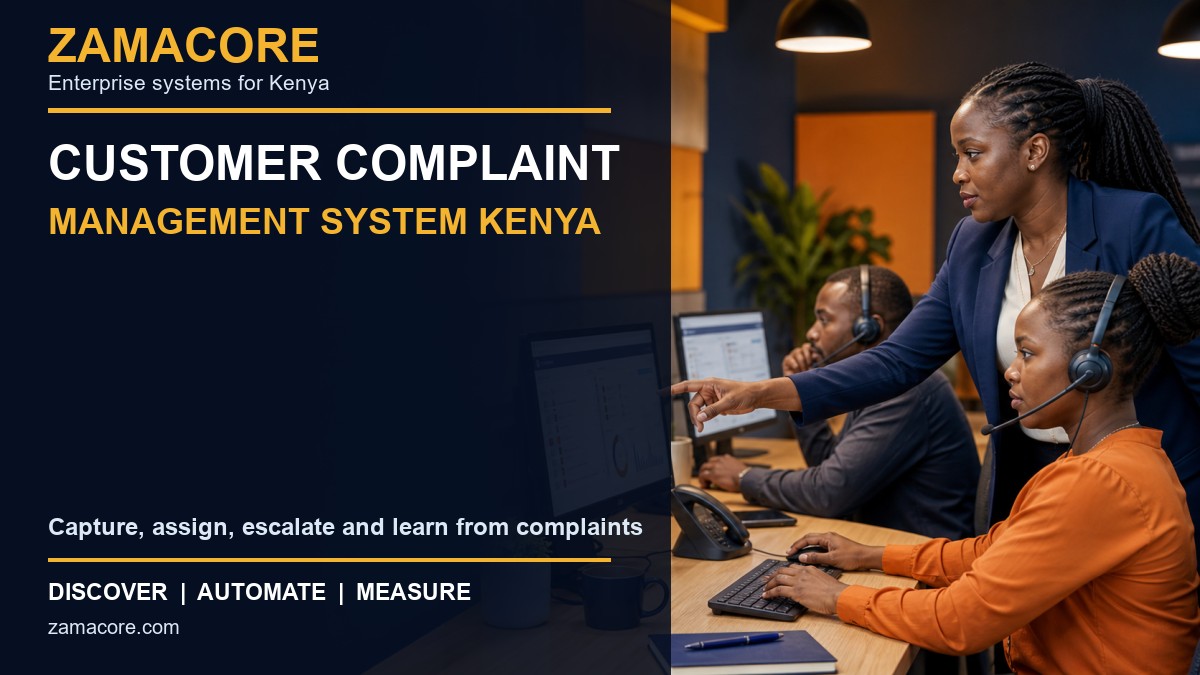
The immediate problem is that complaints disappear across calls, email, WhatsApp and branches without one case owner or reliable response record. The right system should make ownership clear, shorten turnaround time and give management dependable evidence.
Why Customer Complaint Management System Kenya matters
Manual work is not merely inconvenient. It creates hidden operating cost through repeated follow-up, inconsistent decisions, missing records and weak customer or supplier communication. As volumes grow, capable employees spend more time locating information than acting on it.
A digital system should create one traceable journey from request to decision and reporting. It must fit real roles, branches, approval limits and exceptions. Copying a broken paper process into software only makes the same problem faster.
Core capabilities to compare
- multichannel complaint capture — define the users, information, decisions, exceptions and reports required.
- classification and priority rules — define the users, information, decisions, exceptions and reports required.
- case assignment and SLA timers — define the users, information, decisions, exceptions and reports required.
- escalations and approvals — define the users, information, decisions, exceptions and reports required.
- customer updates and closure evidence — define the users, information, decisions, exceptions and reports required.
- root-cause and trend dashboards — define the users, information, decisions, exceptions and reports required.
Features should be evaluated as connected outcomes. A notification has little value if nobody owns the next action; a dashboard is unreliable if source data is incomplete; an integration is risky when failures are invisible.
Map the workflow before selecting technology
Document who starts the process, what information is required, who checks it, which conditions change the route, what deadlines apply and what evidence closes the case. Include exceptions such as rejected requests, absent approvers, duplicate records and integration outages.
Agree measurable baselines before implementation: turnaround time, error rate, unresolved cases, stockouts, quote response time, support calls or manual entries. The system can then be assessed against business results rather than the number of screens delivered.
What determines implementation cost?
- channels and case volumes
- SLA and escalation rules
- branch and department structure
- CRM or core-system integration
- privacy, reporting and support
A credible proposal separates discovery, configuration or development, integration, migration, training and launch from recurring hosting, licences, messaging, maintenance and support. Ask suppliers to show assumptions, exclusions and acceptance criteria.
Security, privacy and accountability
Use role-based access, secure authentication, encrypted connections, tested backups and auditable activity appropriate to the information being handled. Collect only necessary data and document retention, export and deletion responsibilities.
Confirm who owns the hosting account, database, domains, source-code rights, third-party accounts and administrator credentials. Recovery procedures should be tested, not merely promised.
Integration questions to answer early
List every ERP, accounting, payment, CRM, inventory, identity or messaging platform that must exchange information. Verify that a supported interface exists. Decide which system owns each record, how duplicates are prevented, how failed messages retry and who receives alerts.
A lower-risk implementation plan
- Discovery: interview decision-makers and frontline users, map the present process and agree success measures.
- Design: define roles, permissions, data, exceptions, integrations and reports.
- Prototype: validate important journeys before full development.
- Build in milestones: demonstrate working capabilities frequently and record decisions.
- Test: verify realistic data, edge cases, permissions, devices, performance and recovery.
- Pilot: launch with a controlled user group, train them and measure adoption.
- Improve: maintain security and prioritise enhancements from evidence.
How to choose a development partner
Choose a team that investigates the workflow before promising a price. Ask how it manages scope changes, integration uncertainty, security, user acceptance, documentation, migration and support. Relevant experience is useful, but the ability to explain your process clearly is more valuable than a long feature list.
Avoid proposals that treat every requirement as easy, leave ownership unclear or offer a single total without deliverables and exclusions. A phased first release usually reduces risk and produces earlier learning.
Why work with ZamaCore?
ZamaCore designs enterprise systems, portals, workflow automation, dashboards and integrations for organisations in Kenya and East Africa. We connect public-facing and internal processes so teams can serve customers, suppliers and staff with better visibility.
Start with the problem, users, current records, integrations and reports you need. Request a discovery consultation with ZamaCore.
Frequently asked questions
What should Customer Complaint Management System Kenya include?
It should cover the complete priority workflow, permissions, notifications, reporting, integrations, security and support rather than isolated screens.
How much does Customer Complaint Management System Kenya cost?
Cost depends on workflow complexity, users, integrations, data migration, security, testing and support. Discovery is needed for a responsible quotation.
How long does implementation take?
A focused first release may take several weeks, while complex integrations and migrations require more time. Prompt decisions and realistic test data reduce delays.
Can it integrate with existing software?
Often yes where supported APIs or controlled data interfaces exist. Access, data ownership, error handling and reconciliation must be verified.
Should every feature launch at once?
Usually no. Start with the workflow that creates the clearest operational result, measure adoption and expand from evidence.
Who owns the data and system?
The agreement should state ownership, administrator access, source-code terms, hosting accounts, backups, documentation and data-export rights.