A logistics management system in Kenya should give one team a single view of orders, dispatch, delivery, proof of delivery, payments, and reporting. When those steps live in phone calls, WhatsApp groups, notebooks, and separate spreadsheets, managers cannot see what is moving, what is late, and what is unprofitable.
This guide explains what a logistics management system does, the modules that matter for Kenyan operations, how to compare options, and how to roll one out. It links to Zamacore’s logistics and delivery industry solutions, the transport management system, the courier dispatch software, and the electronic proof of delivery pages.
What a logistics management system actually does
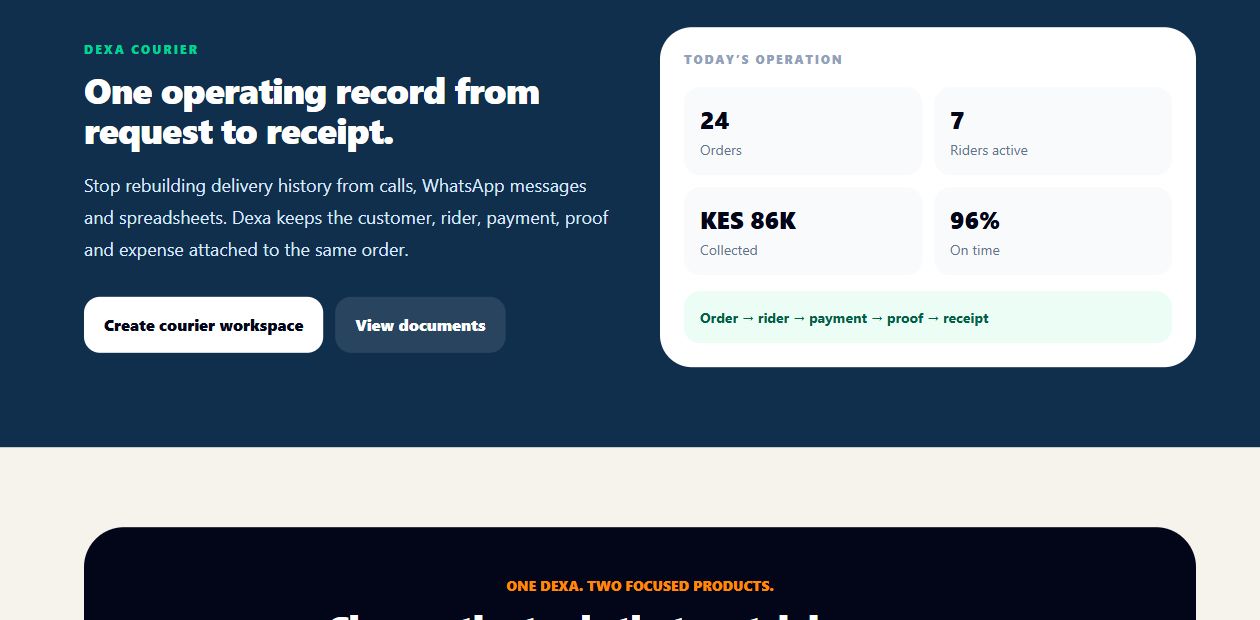
A logistics management system is the operating backbone of a movement business. It captures a request, prices it, assigns it to a vehicle or rider, tracks progress, records proof of delivery, captures the money, and reports performance. The value is not any single screen; it is that every step shares one reference so nothing is rebuilt from memory.
In Kenya this matters because logistics rarely runs in perfect conditions. Traffic, fuel costs, customer availability, cash-on-delivery, and unreliable network coverage all affect the day. A system that cannot handle those realities adds work instead of removing it.
Signs you have outgrown spreadsheets and WhatsApp
- Dispatchers cannot tell which jobs are still open without calling riders.
- Customers ask for updates and nobody can answer quickly.
- Proof of delivery is missing or disputed after the fact.
- Cash and M-Pesa collections do not reconcile at end of day.
- Fuel, maintenance, and trip costs are guessed, not measured.
- Management reports are assembled by hand from several sources.
If two or more of these sound familiar, the bottleneck is the missing shared record, not the effort of your team.
Core modules to look for
- Order and job intake: Customer, pickup, destination, items, pricing, and instructions captured once.
- Dispatch and assignment: Assign to the right vehicle or rider by zone, capacity, and availability.
- Trip and status tracking: Accepted, dispatched, picked up, in transit, arrived, delivered, failed.
- Proof of delivery: Signature, code, photo, quantities, and exceptions attached to the order.
- Payments and COD: Cash, M-Pesa, invoices, receipts, and reconciliation.
- Fleet and drivers: Vehicles, drivers, licences, fuel, maintenance, and documents.
- Customer communication: SMS, email, or WhatsApp updates triggered by status.
- Reporting: Delivery success, on-time performance, cost per delivery, and profitability.
Courier, freight, and distribution are not the same
A courier moves many small parcels with rapid status changes. A freight operator moves fewer, larger loads with documents, weight, and depot handovers. A distributor delivers stock to shops with quantities, returns, and credit terms. The system should match the operating model rather than force one rigid template.
For parcel and last-mile work, review courier dispatch software. For trucks, buses, and mixed fleets, review a transport management system. For the evidence layer that closes disputes, review electronic proof of delivery.
Payments, cash on delivery, and reconciliation
Money is where logistics systems earn their keep. A delivery that is complete but uncollected is a loss. The system should record the amount collected, the payment method, the reference, and the receipt against the order, then reconcile cash and M-Pesa per rider or vehicle. Shortages and uncollected orders should be visible the same day, not discovered at month end.
Integrations that matter in Kenya
Few logistics operations run in isolation. Look for:
- M-Pesa and banking for collections, payouts, and reconciliation.
- GPS and telematics to enrich trip visibility where devices and APIs allow.
- Accounting or ERP for invoices, payments, and cost allocation.
- e-commerce and order sources so orders are not re-keyed.
- SMS, WhatsApp, and email for customer updates.
Confirm which integrations are included, what they cost, and how failures are handled and retried.
How to compare logistics management systems
Run one real job end to end during a demo: capture the order, price it, dispatch it, track it, capture proof, collect payment, and produce a report. Then test an exception — a failed attempt, a reassignment, a short delivery, or a payment mismatch. The exception path tells you more than the happy path.
Rollout without disrupting deliveries
Start with one branch, fleet segment, or route. Keep the old process alongside the new one briefly, train using real scenarios, and expand once data quality and adoption are stable. Phase the modules: core order, dispatch, and proof first; then payments, maintenance, and analytics.
Costs and return on investment
Compare the full picture, not just the licence. Include configuration, integrations, devices, training, data migration, hosting, and support. Then measure what improves: dispatch time, on-time delivery, proof completeness, collection accuracy, fuel variance, and management time saved. A system that fixes leakage usually pays for itself faster than the subscription alone suggests.
Frequently asked questions
What is the difference between a logistics management system and a transport management system?
A logistics management system focuses on moving goods to customers — orders, dispatch, delivery, and proof. A transport management system focuses on the fleet that does the moving — vehicles, drivers, trips, fuel, and maintenance. Many businesses need elements of both.
Can a logistics system work with poor network coverage?
Yes, where it is designed offline-first. Drivers capture proof, status, and quantities on the device and the app synchronises when connectivity returns.
Will it handle cash on delivery and M-Pesa?
Yes. Look for systems that record collections against the order and reconcile them by rider or vehicle, rather than treating payments as an afterthought.
How long does implementation take?
A focused first release can go live in weeks, with advanced analytics, portals, and integrations added in later phases. Timeline depends on scope, data, and integrations.
Next step: review logistics and delivery solutions, compare courier dispatch and transport management, inspect the Dexa platform, and contact Zamacore to scope your logistics system.