Businesses, startups, organizations, entrepreneurs and innovators increasingly have digital ideas that can become practical products. However, having a great solution idea is only the beginning. Turning that idea into a reliable website, mobile application, SaaS platform, marketplace, business system or automated workflow requires technical expertise, planning and continuous development.
A founder may understand the problem perfectly but may not have an in-house development team capable of designing, coding, testing, deploying and maintaining the required platform.
This is where collaboration with a capable technology partner becomes valuable.
If you are searching for a Software company to collaborate my Solution, the objective should not simply be to find someone who can write code. You need a partner who can understand your business model, examine your proposed solution, identify technical requirements, develop the product and help transform the concept into something customers can actually use.
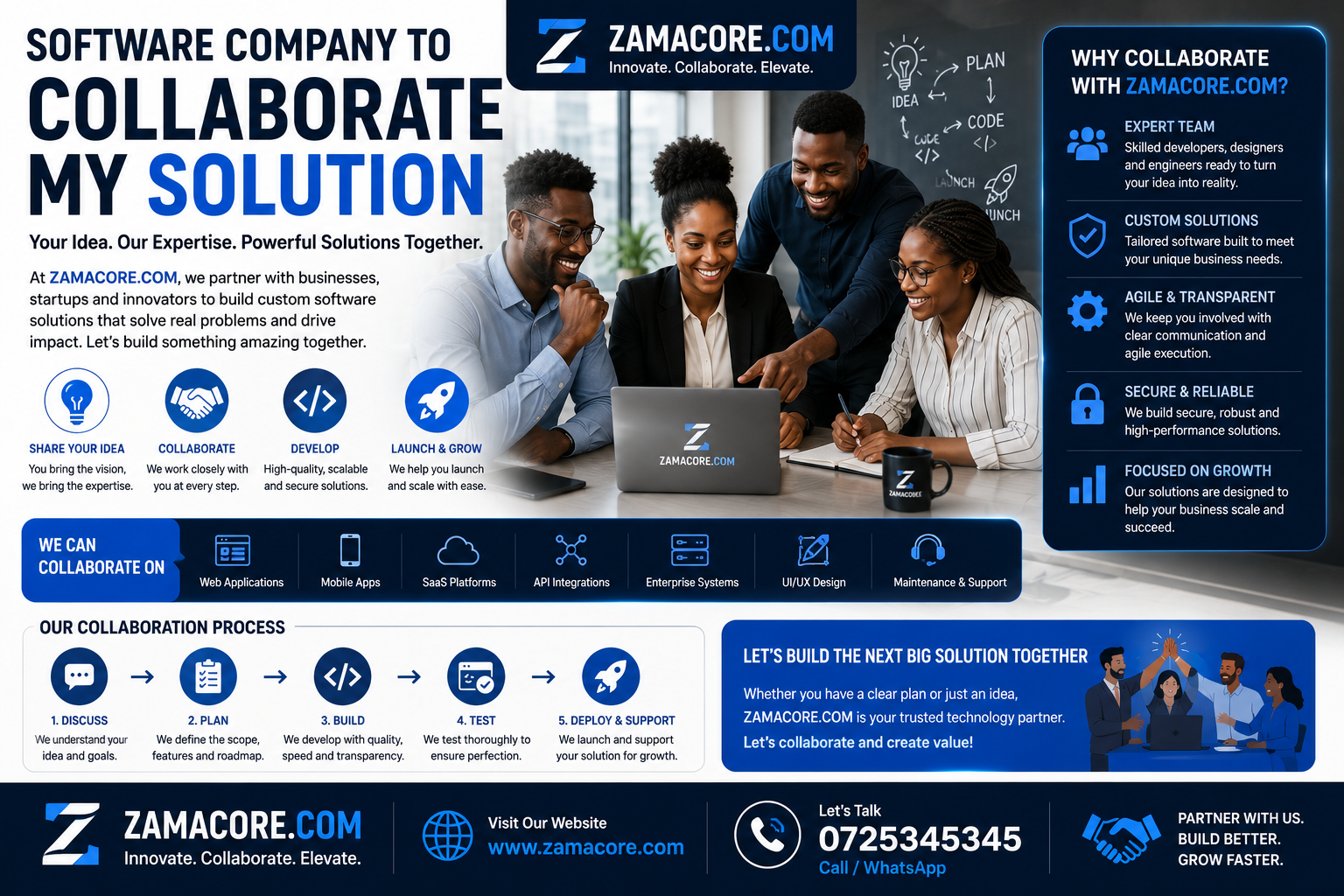
Zamacore currently positions itself as a Kenyan software development company working on custom business systems, SaaS platforms, websites, dashboards, M-Pesa integrations, automation and other digital products.
Software company to collaborate my Solution: Why Collaboration Matters
A technology project rarely succeeds through coding alone.
The development team needs to understand what the solution is supposed to achieve, who will use it, what problem it solves, how users will interact with it and what business processes must happen behind the scenes.
For example, a business idea may sound simple:
“Customers should be able to order online.”
But building the complete system could require:
- Customer registration
- Product management
- Shopping cart
- Order processing
- Payment integration
- Inventory management
- Delivery management
- Notifications
- Customer accounts
- Administrative dashboards
- Reports
- User permissions
The original idea may be one sentence, while the actual software could involve dozens of interconnected workflows.
A collaborative development approach allows the business owner and technical team to break the idea into manageable components.
Software company to collaborate my Solution: Turning an Idea Into a Digital Product
Many entrepreneurs have strong business ideas but are uncertain about the technical path.
You may know:
- The problem you want to solve
- Your target customers
- How customers currently handle the problem
- What you want the new solution to accomplish
However, you may not know:
- Which programming technologies to use
- Whether you need a web application or mobile app
- How databases should be structured
- How payment systems should connect
- How users should be authenticated
- How the application should scale
- How hosting should be configured
A professional development partner can help bridge this gap.
Zamacore’s current development offering includes custom business systems, SaaS platforms, dashboards, payment integrations and automation, making this type of technical-business collaboration one of its stated areas of work.
Software company to collaborate my Solution: Start With the Business Problem
The first step should not be choosing a programming language.
Start with the problem.
Ask:
What problem does the solution solve?
Who experiences this problem?
How is the problem currently solved?
Why are existing methods inadequate?
Who will pay for the solution?
What would make customers continue using it?
These questions help transform a vague software idea into a defined business opportunity.
For example, an entrepreneur might say:
“I want to build software for property managers.”
That statement is too broad.
The actual requirement could be:
“I want property managers to track tenants, leases, rent payments, arrears, maintenance requests and property expenses from one online dashboard.”
That second description gives a development team much more information.
Software company to collaborate my Solution: Define Your Target Users
A successful application needs clearly defined users.
Different users may interact with the same system in completely different ways.
A property platform could have:
Administrator
Controls the entire platform.
Property Manager
Manages properties, tenants and reports.
Accountant
Reviews payments, balances and financial records.
Tenant
Views statements and submits requests.
A logistics system could instead have:
Administrator
Manages the platform.
Dispatcher
Creates and assigns deliveries.
Rider
Receives delivery assignments.
Customer
Tracks an order.
Defining these roles before development makes it easier to design permissions and workflows.
Software company to collaborate my Solution: Decide Whether You Need Custom Software
Not every business needs software built from scratch.
Sometimes an existing specialized platform may already solve the problem.
For example, Kenya’s software ecosystem includes platforms addressing particular business needs such as retail, logistics, property management, agriculture, events, WiFi billing and other operational requirements.
The right question is therefore:
“Do I need custom development, or can an existing solution handle my requirements?”
Zamacore’s own published material similarly notes that not every business needs completely custom software and that specialized platforms can sometimes be a more efficient choice.
Custom development becomes more attractive when the business has unique workflows, specialized requirements, proprietary processes or a product that it intends to commercialize.
Software company to collaborate my Solution: Evaluate the Development Partner
Choosing a development company should involve more than comparing prices.
Consider the company’s:
- Technical capabilities
- Previous projects
- Industry experience
- Communication process
- Development methodology
- Security practices
- Support structure
- Integration experience
- Documentation standards
- Post-launch support
A development partner should also be willing to discuss your business objectives rather than immediately quoting a price without understanding the project.
Zamacore’s published company information describes its focus around reliability, accountability, security, clarity and customer outcomes, alongside software development, custom business systems, SaaS, M-Pesa integrations, automation and ERP development.
Software company to collaborate my Solution: Custom Business Systems for Unique Workflows
Some organizations operate processes that cannot easily fit into generic software.
A business may have unique:
- Approval procedures
- Pricing structures
- Customer categories
- Branch structures
- Payment workflows
- Reporting requirements
- Staff responsibilities
- Inventory processes
Custom business software can be designed around these workflows.
Zamacore describes custom business systems as applications tailored to an organization’s specific operations instead of forcing the organization to adapt its processes to generic software.
This can be especially useful when software becomes part of the organization’s competitive advantage.
Software company to collaborate my Solution: Build an MVP Before a Large Platform
An MVP, or Minimum Viable Product, is a smaller version of the proposed solution containing the essential features required to test the business idea.
Instead of immediately developing fifty features, an entrepreneur may start with five core capabilities.
For example, a delivery marketplace MVP could include:
- Customer registration
- Delivery request
- Rider assignment
- Delivery tracking
- Payment confirmation
Once customers begin using the platform, the business can learn which additional features are genuinely valuable.
This approach can reduce unnecessary development and provide real-world feedback before a major investment is made.
Software company to collaborate my Solution: Plan for Scalability
A solution that works for ten users may not automatically work for ten thousand users.
Scalability should therefore be considered during development.
Important considerations include:
- Database architecture
- Hosting infrastructure
- API design
- User authentication
- File storage
- Performance
- Caching
- Backup systems
- Monitoring
- Security
The development team should understand your expected growth.
If the solution is intended to become a national platform, the architecture should account for that possibility.
If it is an internal tool for a small company, the architecture can be designed according to the actual operational requirement.
Software company to collaborate my Solution: Include Payment Integration
Many digital solutions require payments.
A Kenyan platform might need M-Pesa integration, card payments, bank payments or other supported payment methods.
Payment integration can allow software to:
- Initiate payment requests
- Receive payment confirmations
- Match payments to customers
- Update balances
- Generate receipts
- Record transactions
- Produce financial reports
Zamacore specifically identifies M-Pesa STK Push, Paybill and Till callbacks, reconciliation and related payment integrations among its development capabilities.
Payment workflows should be designed carefully because financial transactions require security, reliable records and appropriate reconciliation.
Software company to collaborate my Solution: Connect Your Solution to Business Operations
A software application becomes more valuable when it connects the different parts of a business.
Consider a wholesale company.
A customer places an order.
The system records the order.
Inventory is updated.
An invoice is created.
The customer makes payment.
The payment is reconciled.
The warehouse prepares the goods.
The delivery team receives the assignment.
The customer receives the order.
Management can then view the complete transaction.
This is much more powerful than having separate applications for each activity.
Software company to collaborate my Solution: Integrate Existing Business Systems
You may already use accounting software, CRM software, payment systems, websites or other platforms.
A new application does not necessarily need to replace everything.
APIs can allow different systems to communicate.
For example:
Website → CRM → Payment Gateway → Accounting
Or:
Online Store → Inventory → Delivery → Customer Notifications
Integration reduces duplicate data entry.
It can also make the customer experience smoother.
A development company should therefore ask what systems you currently use before proposing the architecture for your new solution.
Software company to collaborate my Solution: Build Around Real User Experience
Good software should be easy to understand.
A technically powerful application can still fail if users find it confusing.
User experience planning should consider:
- Navigation
- Buttons
- Forms
- Search
- Notifications
- Dashboards
- Mobile responsiveness
- Error messages
- Accessibility
Users should understand what to do next without extensive training.
For example, instead of presenting a manager with hundreds of database fields, a dashboard could display the most important information first:
Today’s Sales
Pending Orders
Outstanding Payments
Active Customers
Tasks Requiring Attention
The application should support decisions rather than simply display data.
Software company to collaborate my Solution: Software Development for Kenyan Businesses
Kenyan businesses operate across many different industries.
These include:
- Agriculture
- Retail
- Property
- Logistics
- Hospitality
- Education
- Events
- Healthcare
- Finance
- Construction
- Professional services
- Connectivity
Each sector has different operational requirements.
A technology partner with experience across different business workflows can help identify common patterns while still designing around the specific organization’s requirements.
Zamacore’s current portfolio and published material describe software work across business systems, SaaS, property, agriculture, logistics, retail and other operational environments.
Software company to collaborate my Solution: Protect Your Business Data
Data security should be considered from the beginning.
Your software may contain:
- Customer information
- Employee information
- Financial records
- Business documents
- Payment information
- Operational information
- Login credentials
Security measures can include:
- Strong authentication
- Role-based permissions
- Secure passwords
- Encryption
- Backups
- Activity logs
- Secure hosting
- Regular updates
- Access controls
Different users should only have access to the information required for their responsibilities.
For example, a salesperson may need customer and order information but not access to payroll records.
Software company to collaborate my Solution: Establish Ownership Before Development
Ownership should be discussed before the project begins.
Clarify:
Who owns the source code?
Who owns the database?
Who controls the domain?
Who controls the hosting account?
Who owns the design assets?
Who has administrator credentials?
Who can access the repository?
What happens if the relationship ends?
These details should be included in the agreement.
Zamacore’s published development guidance recommends clearly defining ownership, repository access, hosting, administrator credentials, documentation and handover responsibilities in the proposal or contract.
Clear ownership arrangements protect both parties.
Software company to collaborate my Solution: Consider the Total Cost
The cheapest quotation is not necessarily the cheapest solution.
A low initial price may exclude:
- Hosting
- Maintenance
- Security
- Integrations
- Data migration
- User training
- Support
- Future development
The total project cost should therefore be evaluated across the expected life of the software.
A slightly more comprehensive solution can sometimes provide better value if it reduces future redevelopment.
The development proposal should explain what is included and what is excluded.
Software company to collaborate my Solution: Plan for Ongoing Support
Software needs maintenance after launch.
Businesses may need:
- Bug fixes
- Security updates
- Server maintenance
- Database monitoring
- New features
- Performance improvements
- User support
- Integration updates
- Backups
A development relationship can therefore continue beyond the initial project.
Zamacore’s current materials describe post-launch support around hosting, monitoring, backups, bug fixes, security reviews, user assistance, training and planned improvements.
Before signing a contract, ask what support is included after launch.
Software company to collaborate my Solution: Think About Web and Mobile Access
Depending on the product, you may need:
- Website
- Web application
- Android application
- iOS application
- Progressive web application
- Mobile-responsive dashboard
Do not automatically assume that every solution requires separate native mobile applications.
Sometimes a responsive web application can provide everything the business needs.
Other solutions may genuinely benefit from mobile applications.
The decision should be based on user behavior and business requirements.
Software company to collaborate my Solution: Use Technology to Automate Repetitive Tasks
Automation can reduce repetitive work.
Examples include:
Automatic invoice creation
When an order is confirmed, the system generates the appropriate invoice.
Automatic payment notification
When a payment is received, the customer’s account is updated.
Automatic reminders
Customers can receive reminders about outstanding obligations.
Automatic reporting
Managers can receive scheduled performance reports.
Automatic task assignment
New requests can be routed to the appropriate employee.
The development team should identify automation opportunities during requirements analysis.
Software company to collaborate my Solution: Create a Clear Development Roadmap
A development roadmap helps everyone understand what happens next.
A typical roadmap may include:
Software company to collaborate my Solution: Discovery
Understand the business problem and users.
Software company to collaborate my Solution: Requirements
Document features, workflows and integrations.
Software company to collaborate my Solution: Design
Create user interfaces and system architecture.
Software company to collaborate my Solution: Development
Build the agreed functionality.
Software company to collaborate my Solution: Testing
Check functionality, security and usability.
Software company to collaborate my Solution: Deployment
Launch the application.
Software company to collaborate my Solution: Training
Help users understand the system.
Software company to collaborate my Solution: Support
Maintain and improve the application.
A roadmap makes a large technology project easier to manage.
Software company to collaborate my Solution: Test Before Launch
Testing should happen throughout development rather than only at the end.
Test:
- User registration
- Login
- Password recovery
- Payments
- Reports
- Notifications
- Search
- Data entry
- Permissions
- Mobile responsiveness
- Integrations
- Error handling
Different user roles should also be tested.
A system may work correctly for an administrator while failing for a normal employee.
Testing should therefore represent real-world usage.
Software company to collaborate my Solution: Train Your Team
Even the best application can fail if employees do not know how to use it.
Training can cover:
- Logging in
- Creating records
- Updating information
- Processing transactions
- Generating reports
- Managing users
- Handling errors
- Contacting support
Documentation can also help employees learn independently.
Training should be tailored to each user role.
An accountant does not need the same training as a dispatcher.
Software company to collaborate my Solution: Measure the Results
After launch, measure whether the software is actually improving the business.
Useful metrics can include:
- Time saved
- Number of transactions processed
- Customer response time
- Payment processing speed
- Error reduction
- Employee productivity
- Customer retention
- Revenue
- Operating cost
- System usage
For example, if a company previously spent four hours preparing a daily report and the new application reduces this to thirty minutes, the business has measurable value.
Software company to collaborate my Solution: When a Partnership Makes Sense
A development partnership can make sense when:
- Your idea requires custom functionality.
- Existing software does not fit your workflow.
- You want to build a SaaS product.
- You need multiple integrations.
- You want to automate a manual process.
- You need a customer portal.
- You require a specialized dashboard.
- You need an industry-specific platform.
- You want to develop a marketplace.
- You want to digitize internal operations.
The development company becomes an extension of the business’s technical capability.
Software company to collaborate my Solution: Questions to Ask Before Signing
Before selecting a technology partner, ask:
Can you show previous projects?
Examples demonstrate practical capability.
How do you handle project requirements?
A clear requirements process reduces misunderstandings.
Who will work on my project?
Know whether development is handled by an internal team or external contractors.
How will progress be reported?
Regular updates keep the project transparent.
How are changes handled?
New requirements can affect cost and timeline.
Who owns the source code?
This should be clearly documented.
What happens after launch?
Understand support and maintenance.
How is security handled?
Security should be part of architecture rather than an afterthought.
How will the application scale?
Discuss expected growth.
Software company to collaborate my Solution: Specialized Software Versus Generic Applications
Generic software can be useful when your requirements are standard.
However, custom development can make sense when your processes are unique.
For example, a business might have a specialized workflow connecting customers, field workers, payments, inventory and delivery.
Trying to force this process into unrelated software could result in multiple spreadsheets and manual workarounds.
Custom development allows the system to reflect the actual process.
Zamacore’s business software development material emphasizes the distinction between specialized platforms and custom software, noting that existing industry-specific systems may be preferable when they already meet the required workflow.
Software company to collaborate my Solution: Build for Business Growth
Software should not only solve today’s problem.
Where appropriate, it should provide room for tomorrow’s requirements.
A small company may start with one branch.
Later, it could have five branches.
A platform may initially have ten employees.
Later, it could have one hundred.
A business might initially process a few transactions each day.
Later, it may process thousands.
Scalable architecture makes future growth easier to manage.
However, scalability should be balanced against actual requirements. Building unnecessary complexity into a small application can increase cost without providing meaningful benefits.
Software company to collaborate my Solution: Collaborate With a Partner That Understands Your Goals
A successful software project requires collaboration between business and technology teams.
The business owner understands the customers and operational challenges.
The development team understands software architecture and implementation.
Neither side should operate in isolation.
The business should explain the problem clearly.
The technical team should explain practical implementation options.
Together, they can determine:
- What should be built
- What should not be built
- What should be automated
- What should remain manual
- Which integrations matter
- Which features should come first
- How the system should scale
- How users should be trained
- How the platform should be maintained
This collaborative approach can produce a solution that is both technically practical and commercially useful.
Software company to collaborate my Solution: Why Zamacore Can Be Considered
Zamacore’s current company profile describes it as a software development company in Kenya operating under Zama Systems LTD. Its stated development areas include software development, custom business systems, SaaS development, M-Pesa integrations, business automation and ERP development.
Its website also presents software solutions covering operational areas such as property, hospitality, farms, logistics, schools and other business workflows.
For an entrepreneur who already has a business idea or partially developed solution, the important question is whether the development team can understand the existing system and determine what should happen next.
That could mean:
- Building a new product
- Improving existing software
- Developing missing modules
- Connecting APIs
- Creating a dashboard
- Building a customer portal
- Integrating payments
- Automating workflows
- Migrating data
- Improving security
- Supporting an existing application
Software company to collaborate my Solution: From Concept to Working Software
A strong digital solution normally develops through several stages.
Idea
Identify the business problem.
Validation
Determine whether customers actually need the solution.
Requirements
Define what the platform must do.
Prototype
Visualize how users will interact with it.
Development
Build the software.
Testing
Verify that the system works.
Launch
Release it to users.
Feedback
Study actual usage.
Improvement
Add or refine features based on evidence.
Growth
Expand the system as the business grows.
This process prevents the development project from becoming a simple exercise in writing code.
The final product should solve a real problem.
Software company to collaborate my Solution: Industries That Can Benefit From Collaboration
Software development collaboration can support many industries.
Software company to collaborate my Solution: Agriculture
Farmers and agribusinesses can digitize records, sales, inventory, production and operations.
Software company to collaborate my Solution: Property
Property businesses can digitize tenants, leases, rent, maintenance and reporting.
Software company to collaborate my Solution: Logistics
Delivery businesses can manage customers, parcels, riders, tracking and proof of delivery.
Software company to collaborate my Solution: Connectivity
WiFi businesses can manage customers, packages, billing and connectivity workflows.
Software company to collaborate my Solution: Beauty Businesses
Salons, spas and related businesses can use specialized booking, payment and operational software.
Software company to collaborate my Solution: Events
Event organizers can digitize registrations, tickets, attendance and reporting.
Software company to collaborate my Solution: Property Enterprises
Large property organizations may require more extensive multi-property and multi-user workflows.
The right development approach depends on the actual problem rather than the industry label alone.
Software company to collaborate my Solution: What to Prepare Before Contacting a Developer
Before approaching a development company, prepare as much information as possible.
You can document:
Problem
What problem are you solving?
Customers
Who will use the product?
Current Process
How is the problem currently handled?
Desired Process
How should it work after automation?
Features
What must the software do?
Payments
How will customers pay?
Users
What types of users will exist?
Reports
What information should management see?
Integrations
Which external systems must connect?
Budget
What investment range are you considering?
Timeline
When would you like the initial version?
You do not need to know the technical answers.
Your development partner can help translate business requirements into technical specifications.
Software company to collaborate my Solution: Make Your Software Idea Practical
The best software projects begin with a clear understanding of the problem.
Technology is the tool.
The business objective is the destination.
If your solution is intended to automate operations, connect customers with providers, manage payments, organize records, provide dashboards, operate as a SaaS platform or create a specialized digital marketplace, collaboration with an experienced development team can help move the idea from concept to implementation.
Zamacore’s current development offering covers custom business systems, SaaS platforms, websites, dashboards, M-Pesa integrations and automation, while its broader software portfolio demonstrates experience with specialized business workflows.
When evaluating a partner, look beyond the initial quotation.
Consider technical capability, business understanding, communication, security, ownership, scalability, integrations, testing and long-term support.
A good development relationship should make the solution clearer as the project progresses.
It should help answer important questions rather than create additional uncertainty.
For entrepreneurs and organizations with a digital idea that needs technical execution, Zamacore’s software development team can be considered as a potential development and technology partner for custom software, SaaS, business systems, dashboards, automation and payment-integrated solutions.
The goal is not simply to launch another application.
The goal is to build a useful digital product that solves a genuine problem, provides value to its users and gives the business a reliable platform for future growth.