Businesses in Kenya are increasingly moving away from manual processes, disconnected spreadsheets, paper records, and generic applications that do not match the way their teams actually work. A well-designed digital platform can bring customers, payments, employees, records, reports, communication, and daily operations into one controlled environment.
A business looking for a reliable technology partner needs more than someone who can write code. It needs a development team that understands business workflows, user requirements, integrations, security, scalability, testing, deployment, and long-term support.
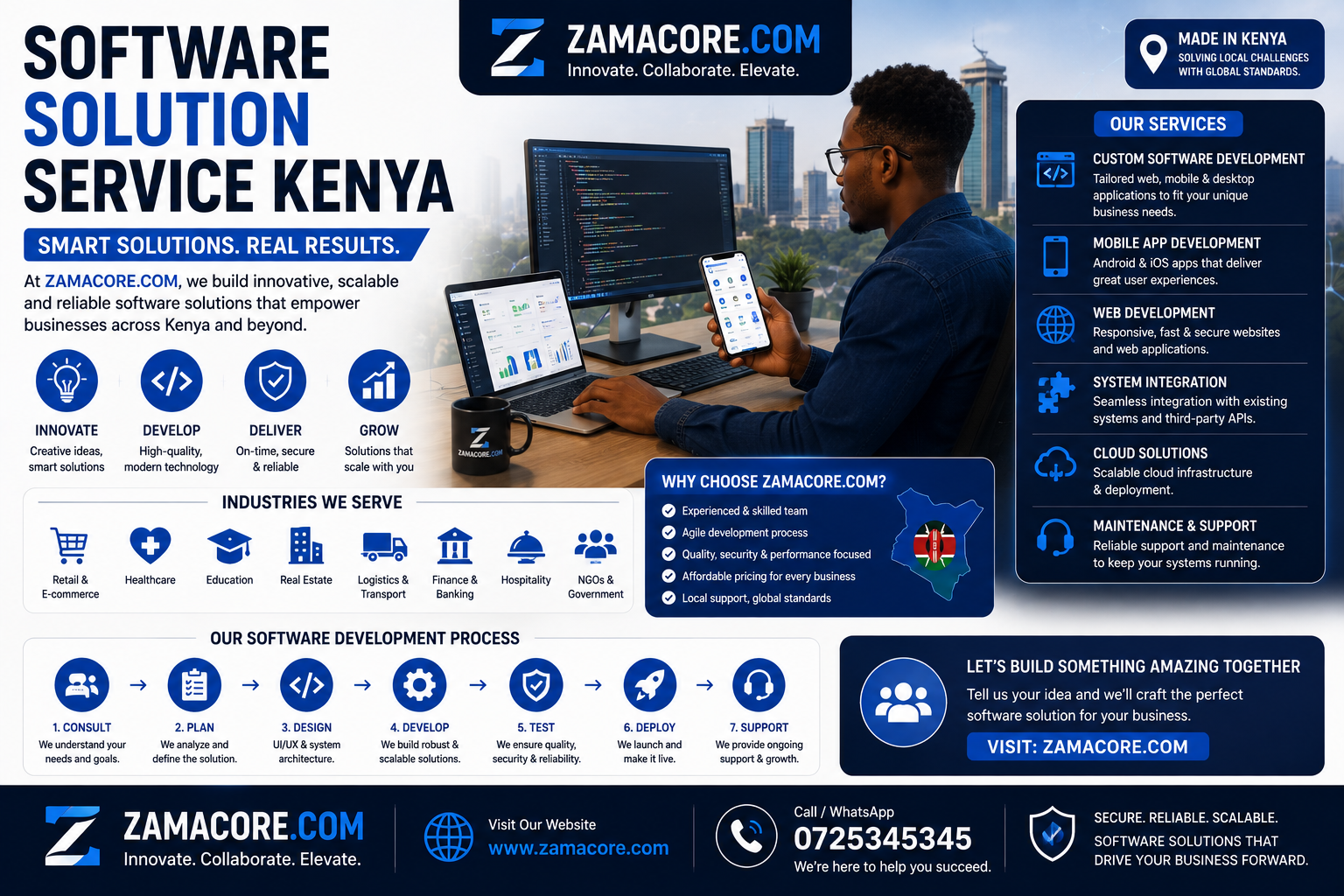
Zamacore positions itself around websites, custom software, SaaS platforms, M-Pesa workflows, dashboards, business systems, automation, and industry-specific solutions for Kenyan operations. Its current platform also covers sectors including property, hospitality, agriculture, education, logistics, business, and finance.
Software Solution Service Kenya: Why Kenyan Businesses Need Purpose-Built Technology
Many organizations start with spreadsheets, WhatsApp messages, notebooks, paper files, shared folders, or several unrelated applications. These tools can be useful during the early stages of a business, but problems often appear as operations become more complex.
A growing company may need to manage:
- Customer records
- Sales and invoices
- Employee activities
- Inventory
- Payments
- Deliveries
- Property records
- Farm operations
- Bookings
- Reports
- Approvals
- Documents
- Communication
- User permissions
- Financial reconciliation
When these activities exist in separate systems, employees spend time moving information from one place to another. This increases the possibility of duplicated records, missing information and delayed reporting.
A properly planned platform can connect these activities into a single workflow.
For example, a business can capture a customer order, assign an employee, receive payment, generate documentation, update the relevant record and produce a report without requiring several manual handovers.
Software Solution Service Kenya: What a Complete Digital Solution Can Deliver
A digital platform should solve a clearly identified business problem rather than simply provide a large collection of features.
The first step is understanding what the organization currently does.
A developer should examine how information enters the business, who processes it, where decisions are made, what approvals are required, how payments are handled, how customers interact with the organization and how management receives reports.
This approach makes the resulting platform more practical.
For example, a logistics company may require order management, rider assignment, delivery tracking, customer notifications, proof of delivery and payment records. A property organization may need tenants, leases, rent collection, maintenance, statements and arrears tracking.
Different businesses require different workflows.
This is why customization can be more valuable than simply purchasing a generic application.
Software Solution Service Kenya: Custom Development for Unique Business Workflows
Custom development becomes useful when a business has processes that cannot easily be represented by an off-the-shelf application.
A custom system can be designed around the organization’s actual workflow.
Instead of forcing employees to change everything they do to fit a generic application, the development process begins by documenting the existing process and identifying opportunities for improvement.
A custom platform may include:
- Different user roles
- Department-specific dashboards
- Approval workflows
- Custom reports
- Automated notifications
- Payment integrations
- Customer portals
- Employee portals
- Document management
- Data imports
- API integrations
- Audit trails
- Business-specific calculations
Zamacore describes its custom development offering around web applications, portals, dashboards, administration panels, customer accounts and scalable SaaS functionality built around real workflows.
Software Solution Service Kenya: Start With Business Requirements
Before development begins, the organization should document what it wants the system to accomplish.
A useful requirements document can describe the current problem, intended users, business processes, required reports, payment methods, integrations, security requirements and expected future growth.
The document does not have to be highly technical.
Business owners can describe processes in ordinary language.
For instance:
“When a customer places an order, the sales team should receive it, payment should be recorded, the operations team should receive the task, the customer should receive an update, and management should be able to see the transaction.”
A development team can then translate that requirement into workflows and technical specifications.
This reduces misunderstandings and makes project pricing more realistic.
Software Solution Service Kenya: Build Software Around the Users
The people using a system every day should influence its design.
A manager may need high-level dashboards, while an employee may only need access to a few forms. A customer may require a simple portal for checking orders, invoices or account information.
Different users therefore require different interfaces.
Good user experience can reduce training requirements and improve adoption.
A system should make common activities easy to discover. Frequently used functions should not be buried behind complicated navigation.
For mobile workers, responsive design can be especially important because employees may access the platform from phones or tablets while away from the office.
User roles should also be clearly defined.
A cashier does not necessarily need access to employee payroll. A delivery rider does not need access to company financial reports. A property tenant should not see information belonging to another tenant.
Software Solution Service Kenya: Integrate Payments Into Business Operations
Payment processing is an important part of many Kenyan digital platforms.
Instead of treating payments as a separate activity, businesses can integrate payment information into the relevant workflow.
For example, a platform may connect an invoice to a payment transaction and automatically update the customer’s account after confirmation.
Depending on requirements, integrations may include M-Pesa, bank systems, SMS platforms, accounting applications, CRM systems or other APIs.
Zamacore currently describes support for M-Pesa STK Push, Paybill and Till callbacks, invoice payments, subscriptions, receipts and reconciliation workflows.
Payment integration can reduce manual reconciliation and make transaction information easier to track.
It can also improve the customer experience because customers can receive confirmations and access updated account information without repeatedly contacting staff.
Software Solution Service Kenya: Automate Repetitive Business Activities
Automation is one of the strongest reasons to digitize business operations.
Employees frequently spend substantial time performing repetitive activities such as sending reminders, preparing reports, updating spreadsheets, checking records, notifying customers or moving information between departments.
Software can automate many of these activities.
Examples include:
- Payment confirmations
- Appointment reminders
- Renewal alerts
- Low-stock notifications
- Delivery updates
- Customer messages
- Staff notifications
- Report generation
- Approval alerts
- Follow-up reminders
Automation does not necessarily mean removing employees from a process.
Instead, it can allow employees to focus on activities that require judgment, communication and decision-making.
Zamacore currently highlights business automation involving WhatsApp inboxes, AI knowledge bases, onboarding messages, reminders, reporting and customer alerts.
Software Solution Service Kenya: Create Industry-Specific Platforms
Different industries have different information structures.
A farm may need crop records, machinery, workers, suppliers and production information. A property organization may require leases, tenants, rent and maintenance. A logistics company may require drivers, dispatches, routes and proof of delivery.
Using the same generic workflow for all these organizations can create unnecessary complexity.
Industry-specific platforms can instead focus on the terminology and processes employees already understand.
Zamacore’s current solution library includes platforms for property and hospitality, agriculture and trade, education and commerce, mobility and logistics, business and finance, among other operating areas.
This industry approach can shorten the distance between software functionality and everyday business operations.
Software Solution Service Kenya: Improve Property and Rental Operations
Property businesses provide a strong example of how specialized systems can simplify complex operations.
A property manager may need to monitor tenants, leases, payments, arrears, statements, maintenance requests and property-level performance.
Managing these activities manually can become difficult when the portfolio grows.
A digital platform can centralize the information and make important records easier to retrieve.
RentalDesk, for example, focuses on rental operations including tenant visibility, billing automation, payment tracking, arrears follow-up and reporting.
For organizations managing larger portfolios, enterprise platforms can provide additional capabilities such as multi-branch operations, role-based access, reporting and different deployment options. KayaPro360 currently describes these capabilities for larger property organizations.
Software Solution Service Kenya: Connect Connectivity and Digital Services
Businesses providing internet connectivity also benefit from software automation.
A connectivity provider may need to manage customers, packages, payments, routers, subscriptions, account status and support requests.
A connected billing and management platform can help staff see customer information without relying on separate records.
For organizations offering public Wi-Fi or managed connectivity, software can also help automate package activation, payment confirmation and customer access.
The important principle is that the technology should match the commercial model.
A business selling recurring subscriptions requires different workflows from one selling one-time services.
Software Solution Service Kenya: Connect Business Data Across Departments
A company can have excellent individual departments and still experience operational problems if information does not move correctly between them.
Sales may know what customers purchased while finance knows what customers paid. Operations may know what has been delivered while management waits for a report.
Integration brings these pieces together.
A well-designed system can create a shared source of operational information.
For example:
Sales creates an order.
Finance receives the payment status.
Operations receives the task.
The customer receives updates.
Management sees the transaction in a dashboard.
This reduces repeated data entry and makes the organization more coordinated.
Software Solution Service Kenya: Use Dashboards for Better Decision-Making
Business leaders need information they can understand quickly.
A dashboard can display key indicators without requiring managers to manually combine multiple spreadsheets.
Depending on the organization, useful metrics might include:
- Sales
- Revenue
- Outstanding payments
- Customer growth
- Inventory
- Deliveries
- Employee activity
- Occupancy
- Production
- Expenses
- Service requests
- Operational performance
The dashboard should reflect actual management decisions.
There is little value in displaying dozens of statistics if none of them helps management determine what action to take.
A better approach is to identify the questions managers repeatedly ask and build dashboards around those questions.
Software Solution Service Kenya: Combine Websites With Business Systems
A website and a business application do not necessarily need to operate as isolated systems.
A website can generate leads, accept bookings, receive inquiries, collect customer information or present products.
That information can then flow into an internal system.
For example, a customer could submit a request through a website. The request could automatically enter an internal dashboard where staff assign it, process it and update its status.
This creates a more complete digital journey.
Zamacore currently presents websites, SaaS products, dashboards, business systems, payments and automation as connected parts of a broader development service.
The advantage is that the website becomes more than an online brochure. It can become an active part of business operations.
Software Solution Service Kenya: Develop SaaS Products for Recurring Revenue
Software as a Service can allow businesses to offer digital functionality to multiple customers through recurring subscriptions.
A SaaS platform may provide:
- Customer registration
- Subscription management
- Account dashboards
- Billing
- User permissions
- Automated notifications
- Usage tracking
- Reports
- Administration tools
The architecture needs to consider multiple customers from the beginning.
Data isolation is particularly important when different organizations use the same platform.
Subscription systems also need clear rules for trials, renewals, failed payments, upgrades, downgrades and account suspension.
A strong SaaS foundation can allow a digital product to grow without rebuilding the entire application whenever customer numbers increase.
Software Solution Service Kenya: Plan Security From the Beginning
Security should not be added as an afterthought.
A system may hold customer information, financial records, employee information, business documents or operational data.
Security planning should therefore consider authentication, authorization, password management, backups, permissions, audit trails, secure integrations and appropriate hosting practices.
Different employees should receive only the access they need.
Administrators should have stronger controls than ordinary users.
Sensitive operations should be logged where appropriate.
Backups should also be planned so that the organization has a recovery strategy if information is accidentally deleted or a system experiences an outage.
Zamacore states that its project approach includes permissions, backups, monitoring, testing, training and support according to the operational requirements of the system.
Software Solution Service Kenya: Make Ownership Clear Before Development
Ownership should be discussed before development starts.
A business commissioning a digital platform should understand what happens to source code, repositories, hosting accounts, administrator credentials, documentation and other project assets.
These responsibilities should appear in the written agreement.
This is important because software is a long-term business asset.
The organization should know who can access the system, who maintains it and what happens if the business later changes development partners.
Zamacore’s current buyer guidance specifically highlights written scope, delivery stages, source-code ownership, repository access, hosting, administrator credentials, documentation and handover responsibilities.
Clear ownership terms protect both the client and the development partner.
Software Solution Service Kenya: Choose a Development Partner Carefully
Choosing a development company should not be based only on the cheapest quotation.
A low initial price can become expensive if the system is difficult to maintain, poorly documented or unable to accommodate future requirements.
Evaluate the development partner based on:
- Previous projects
- Technical capability
- Industry understanding
- Communication
- Project methodology
- Testing processes
- Security approach
- Integration experience
- Documentation
- Support
- Ownership terms
- Scalability
- Post-launch maintenance
Zamacore identifies reliability, accountability, security, clarity and customer outcomes among its stated values, while describing its mission around reliable software platforms for everyday Kenyan business operations.
The right partner should be able to explain technical decisions in language that business stakeholders understand.
Software Solution Service Kenya: Begin With Discovery and Workflow Mapping
A serious project should start with discovery.
During discovery, the development team should understand users, departments, records, approvals, payments, reports, integrations and support requirements.
This is where hidden complexity often becomes visible.
For example, a business may initially request a simple customer management platform but later reveal that customers have different account types, payments arrive through several channels, managers require approval before certain actions and monthly reports must be exported to another system.
Discovering these requirements early is better than discovering them after development has already started.
Zamacore describes its development process as beginning with discovery and workflow mapping before moving into prototypes, engineering, integrations, testing and onboarding.
Software Solution Service Kenya: Build an MVP Before Expanding
Not every digital project needs every feature on day one.
A Minimum Viable Product can provide the essential workflow first.
Suppose a company wants to develop a marketplace.
Instead of immediately building advanced analytics, loyalty programs, complex recommendation engines and dozens of integrations, the first version might focus on:
- User registration
- Product listings
- Orders
- Payments
- Notifications
- Administration
Once customers start using the platform, the business can learn what additional features actually matter.
This reduces unnecessary development and creates an opportunity to validate the business model.
An MVP should not mean a careless or insecure product. It should mean a focused first release containing the essential functionality required to prove the concept.
Software Solution Service Kenya: Design for Scalability
A system that works for 20 users may struggle when the organization reaches 2,000 users.
Scalability should therefore be considered early.
Questions to consider include:
- How many users may access the system?
- How much data will be generated?
- Will several branches use the system?
- Will customers access the platform simultaneously?
- Will the business add new locations?
- Will additional integrations be required?
- Will the platform eventually become a SaaS product?
The answers influence architecture, hosting, database design, permissions and application structure.
Scalability does not mean building the most complicated system possible.
It means avoiding design choices that make reasonable future growth unnecessarily expensive.
Software Solution Service Kenya: Test Before Launch
Testing is essential before a digital platform becomes part of daily operations.
Testing should cover both individual functions and complete workflows.
For example, a payment system should not only be tested for whether a payment button works. The team should also verify what happens after payment, whether the transaction is recorded correctly, whether the customer receives confirmation, whether the invoice changes status and whether management reports display the transaction correctly.
Testing may include:
- Functional testing
- User acceptance testing
- Security testing
- Mobile testing
- Browser testing
- Integration testing
- Performance testing
- Permission testing
- Backup testing
- Error handling
Real users should participate in acceptance testing because they understand the practical workflow better than anyone else.
Software Solution Service Kenya: Train Employees Before Going Live
Even an excellent platform can fail if employees do not understand how to use it.
Training should focus on actual tasks.
Instead of showing every available feature, employees can be trained according to their roles.
For example:
A finance employee learns payment reconciliation.
A manager learns dashboards and approvals.
A sales employee learns customer and order management.
An administrator learns user permissions.
A field employee learns mobile task management.
Documentation should also be available for common tasks.
Training can reduce resistance and help the organization realize the value of its technology investment faster.
Software Solution Service Kenya: Support the System After Launch
Launching the platform is not the end of the project.
Software exists within a changing business environment.
Customers change their expectations. Payment providers change APIs. Employees change roles. Businesses open new branches. New reporting requirements appear.
Ongoing support can therefore include:
- Bug fixes
- Security updates
- Monitoring
- Backups
- Hosting
- User assistance
- Performance improvements
- New features
- Integration updates
- Training
- System reviews
The support arrangement should be clearly documented.
Zamacore states that post-launch support can cover hosting, monitoring, backups, bug fixes, security reviews, user assistance, training and planned improvements depending on project requirements.
Software Solution Service Kenya: Measure the Business Results
Technology should ultimately produce measurable business value.
After deployment, management should monitor whether the platform is actually improving operations.
Useful indicators may include:
- Reduced administrative time
- Faster customer response
- Fewer data-entry errors
- Faster payment reconciliation
- Reduced outstanding balances
- Better employee productivity
- Improved reporting speed
- Increased customer retention
- Higher transaction volumes
- Lower operational costs
The exact metrics depend on the project.
For a delivery company, delivery completion time may be important.
For a property business, collections and arrears may matter more.
For a farm, production records and resource utilization may be the key indicators.
For a school, student administration and communication may be more important.
The measurement framework should therefore be connected to the original business problem.
Software Solution Service Kenya: Why Zamacore Can Be Considered for Digital Projects
Zamacore’s current offering covers multiple parts of the digital product lifecycle, including custom software and SaaS development, websites, payment systems, business management systems, industry SaaS platforms and automation.
Its solution portfolio also demonstrates an industry-oriented approach rather than focusing exclusively on one type of application.
The platform currently identifies operating solutions across property and hospitality, agriculture and trade, education and commerce, mobility and logistics, and business and finance.
For organizations with an existing process that needs to become digital, the useful starting point is not necessarily “What application should we buy?”
A better question is:
“What business process are we trying to improve?”
Once that question has been answered, the development team can determine whether the best option is a ready-made platform, customization, integration, SaaS development or a completely new system.
Software Solution Service Kenya: What Businesses Should Prepare Before Requesting a Proposal
A company can make the development process easier by preparing basic information before contacting a developer.
Useful information includes:
- Business description
- Current workflow
- Main operational problems
- Number of users
- Expected customer volume
- Required features
- Payment methods
- Existing systems
- Required integrations
- Reporting requirements
- Security concerns
- Preferred launch timeline
- Future expansion plans
It is also useful to identify which features are essential and which ones are optional.
This allows the development team to separate the core project from future enhancements.
Zamacore’s current proposal process emphasizes translating workflows, roles, records, integrations, reports and launch priorities into defined deliverables, milestones and commercial terms.
Software Solution Service Kenya helps businesses automate important operations. A reliable Software Solution Service Kenya can organize customer information and workflows. Software Solution Service Kenya supports efficient delivery operations. Software Solution Service Kenya can improve transport management.
Software Solution Service Kenya helps businesses digitize daily processes. Software Solution Service Kenya can connect technology with operations. Software Solution Service Kenya supports customized business systems.
Software Solution Service Kenya can simplify property operations. Software Solution Service Kenya can strengthen digital workflows. Software Solution Service Kenya can organize agricultural records. Software Solution Service Kenya can improve rental administration.
Software Solution Service Kenya can streamline connectivity businesses. Software Solution Service Kenya can support operational management. Software Solution Service Kenya can improve business coordination. Software Solution Service Kenya can strengthen online business systems. Software Solution Service Kenya can support scalable platforms. Software Solution Service Kenya can integrate payments.
Software Solution Service Kenya can automate workflows. Software Solution Service Kenya can provide dashboards. Software Solution Service Kenya can transform ideas into practical digital products.
Software Solution Service Kenya: Choose Technology That Matches the Business
The strongest digital investment is not necessarily the platform with the most features.
It is the one that makes important business activities easier, faster, safer and more measurable.
A small company may need a simple customer and payment system.
A growing organization may require an integrated business management platform.
A property company may need specialized rental operations.
A logistics business may require dispatch and delivery management.
A farm may require structured production and resource records.
A technology startup may require a scalable SaaS product.
The correct approach depends on the organization’s workflow, customers, budget, users and growth plans.
Businesses should therefore evaluate technology as an operational investment rather than simply an IT expense.
For companies looking to turn manual processes into connected digital workflows, Zamacore provides a route from discovery and workflow mapping through design, engineering, integrations, testing, onboarding and ongoing support.
Software Solution Service Kenya: Request a Software Development Proposal
If your organization has a business problem that could be solved through automation, a customer portal, a management platform, a SaaS product, payment integration, a dashboard or a custom workflow, the next step is to document the problem and discuss the requirements with a development team.
A strong project begins with clarity.
Explain what currently happens, what is slowing the organization down, who needs to use the platform and what success should look like.
From there, the development process can establish the appropriate scope, technology, integrations, delivery stages and support requirements.
Zamacore currently invites businesses to bring a business problem, workflow or product idea so that requirements, timelines and launch plans can be developed around the intended customers and operations.
For Kenyan organizations looking to replace fragmented processes with practical digital systems, a carefully planned development partnership can turn an operational challenge into a scalable business asset.