Every growing business eventually reaches a point where manual processes become difficult to manage. Spreadsheets become complicated, customer information becomes scattered, employees spend too much time entering the same data, and management struggles to obtain accurate reports quickly.
This is where a suitable digital platform can make a major difference.
When a business owner searches for a Software Solution for My Business, the goal should not simply be to purchase an application with many features. The goal should be to find technology that solves specific operational problems and supports the way the business actually works.
A modern business system can help organize customers, employees, payments, inventory, documents, projects, approvals, reports and daily tasks. It can also connect different departments so that information moves between teams without unnecessary duplication.
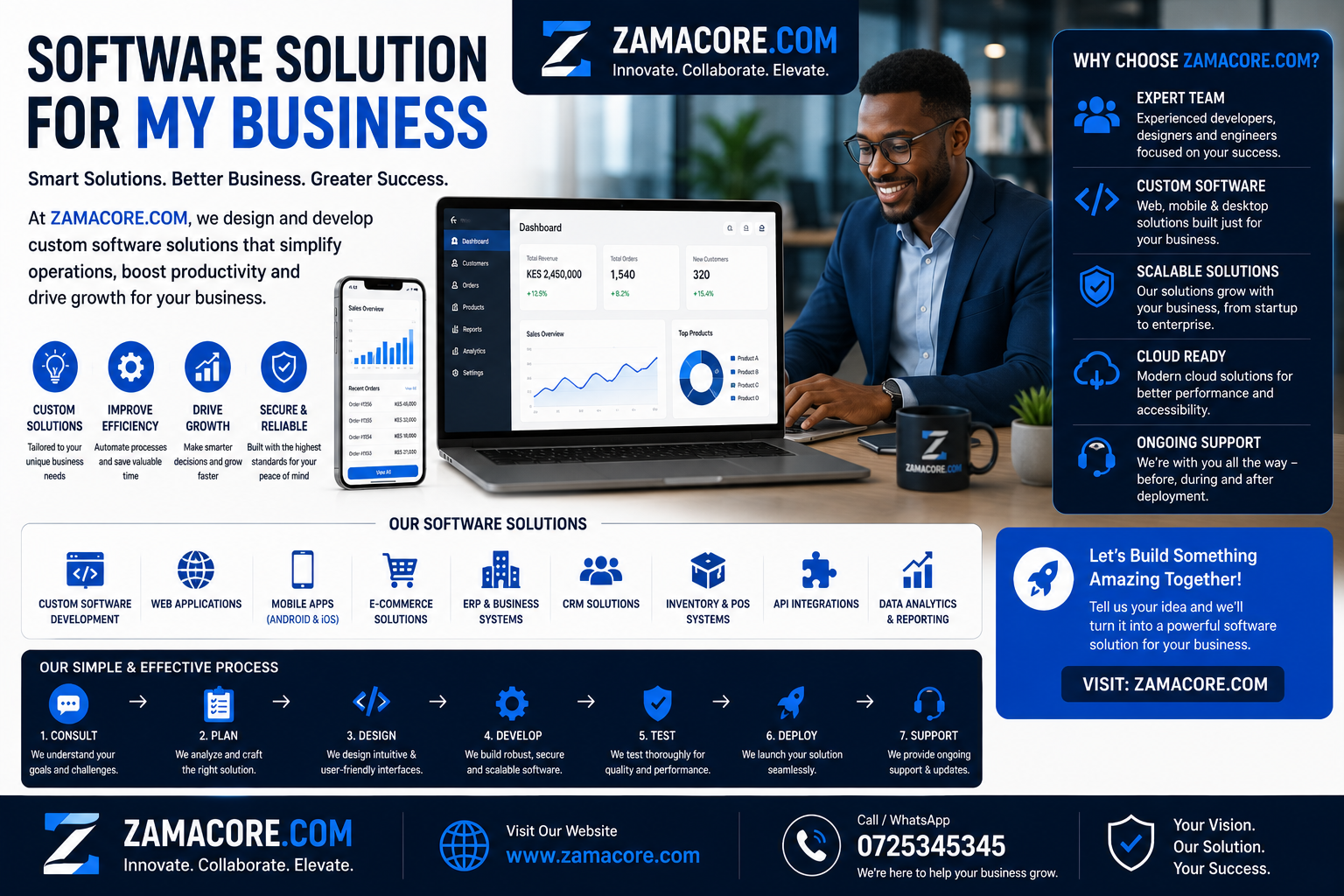
Zamacore develops custom software, SaaS platforms, business systems, dashboards, M-Pesa integrations and automation solutions designed around real business workflows.
The right approach begins by understanding what your organization needs before deciding what technology to build or implement.
Software Solution for My Business: Identify the Problem Before Choosing Technology
The first step is to identify the business problem.
Software Solution for My Business many organizations start by listing features they want. They may ask for a dashboard, mobile application, customer portal, payment system or management system without first explaining why those features are necessary.
A better approach is to identify the operational difficulty.
Ask questions such as:
- What takes employees too much time?
- Which processes are currently manual?
- Where are errors occurring?
- Which information is difficult to retrieve?
- What do customers repeatedly ask about?
- Which reports take too long to prepare?
- Where does money get lost through poor tracking?
- Which departments struggle to share information?
- Which activities are being repeated unnecessarily?
For example, if a company manually receives orders through WhatsApp and then transfers them into spreadsheets, the real problem may not be the absence of a “mobile app.” The real problem could be fragmented order management.
Once the problem is understood, the software can be designed around the required workflow.
Software Solution for My Business: Map Your Existing Business Workflow
Before development begins, document how work currently moves through the organization.
Consider a simple sales process.
A customer makes an inquiry.
The sales employee records the customer.
A quotation is prepared.
The customer accepts.
An invoice is generated.
Payment is received.
The operations team processes the order.
The customer receives an update.
Management later needs the transaction included in a report.
If every stage is handled using a different tool, the organization may have unnecessary delays.
A connected platform can bring these stages together.
Workflow mapping also reveals which activities should remain manual and which can be automated.
This is important because good software should not simply digitize inefficient processes. It should provide an opportunity to improve them.
Software Solution for My Business: Decide Between Ready-Made and Custom Software
One of the most important decisions is whether to use an existing application or commission a custom system as Software Solution for My Business.
Ready-made software can work well when the business follows standard processes and the available configuration options are sufficient.
Custom development becomes more useful when the business has unique workflows, specialized reporting requirements, unusual payment processes, complex integrations or customer experiences that generic applications cannot adequately support.
Zamacore explains that custom development can be valuable when workflow, data, reporting or customer experience is central to how an organization operates.
The decision should therefore be based on fit rather than the assumption that custom software is always better.
A ready-made application may be ideal for a standardized requirement.
A customized platform may be more appropriate when the software itself becomes an important part of the company’s competitive advantage.
Software Solution for My Business: Consider the People Who Will Use the System
Employees, managers, customers and administrators may interact with the same platform differently.
An employee may need a simple task screen.
A manager may need performance reports.
A customer may need an account where they can view orders and payments.
An administrator may need extensive controls for users and permissions.
The interface should therefore reflect each user’s responsibilities.
A system that gives every person access to every feature can become confusing and risky.
Role-based access can make the platform easier to use while protecting sensitive information.
For example, employees responsible for sales do not necessarily need access to payroll records. Customers should not be able to view another customer’s information. A field worker may only need access to assigned jobs.
Understanding these user groups early makes development more efficient.
Software Solution for My Business: Build Around Real Business Requirements
A strong development process converts business requirements into specific workflows and technical requirements.
Zamacore’s custom software service focuses on tailored systems for organizations that have outgrown spreadsheets, generic tools and disconnected manual processes.
Software Solution for My Business: Improve Customer Management
Customer information is one of the most valuable assets in any organization.
When customer records are stored in notebooks, spreadsheets, personal phones and unrelated applications, employees may struggle to obtain a complete picture.
A centralized platform can organize customer profiles, interactions, transactions, service requests, invoices and communication history.
Depending on the business, customers may also receive their own accounts.
A customer portal can allow users to:
- Register
- View services
- Place orders
- Request support
- Check invoices
- Make payments
- Download documents
- Track requests
- Update their details
This can reduce repetitive customer inquiries and provide customers with greater visibility.
Customer management can also help businesses understand buying patterns and identify opportunities for retention and follow-up.
Software Solution for My Business: Automate Repetitive Tasks
Automation can make a digital system considerably more useful.
Employees frequently perform repetitive activities that do not require significant human judgment.
Examples include sending payment reminders, updating statuses, creating notifications, preparing recurring reports and confirming transactions.
These processes can often be automated.
Software Solution for My Business: Organize Business Data
Data becomes increasingly valuable as a company grows.
However, data only creates value when it is organized and accessible.
A digital platform can establish structured records for customers, employees, suppliers, transactions, inventory, projects and other operational activities.
Instead of maintaining several versions of the same information, the organization can work from a shared database.
This can make reporting easier.
It can also improve accountability because management can see who performed an action, when it happened and what the current status is.
The structure of the database should be carefully planned because poor data architecture can create problems later.
A good system should make it possible to retrieve useful information without requiring employees to manually combine several files.
Software Solution for My Business: Use Specialized Systems Where Necessary
Some businesses operate in industries with highly specialized requirements.
Property management is one example.
A property organization may need to manage tenants, leases, rent, arrears, maintenance, statements and payment records.
A retail business may instead require stock management, sales, receipts, cashier controls and branch reporting.
A logistics business may require dispatches, riders, tracking, delivery statuses and proof of delivery.
Agricultural operations may require crop, farm, staff, machinery, production and stock records.
This demonstrates why industry-specific platforms can be useful.
Zamacore currently operates or develops platforms covering property, retail, logistics, agriculture, education and other business workflows.
The technology should reflect the operational reality of the industry rather than forcing every organization into the same structure.
Software Solution for My Business: Connect Payment Processing
Payment management is a critical requirement for many Kenyan businesses.
A modern system can connect payment transactions with invoices, customer accounts, orders, subscriptions or other records.
M-Pesa integration can be particularly valuable where mobile payments form an important part of daily operations.
Zamacore provides M-Pesa integration services covering workflows such as STK Push, Paybill and Till callbacks, payment matching, receipts and reconciliation.
The key consideration is not simply accepting payments.
The entire transaction workflow should be considered.
For example:
Customer receives invoice → customer pays → system receives confirmation → payment is matched → account is updated → receipt is generated → management report is updated.
This type of integration can reduce manual reconciliation.
Software Solution for My Business: Integrate Existing Business Tools
Businesses rarely operate with only one application.
They may already use accounting software, messaging tools, payment platforms, spreadsheets, CRMs, ERP systems or external services.
Replacing every existing tool may not be necessary.
Integration can allow information to move between systems.
For example, an application may send customer notifications through an external messaging service while payment information comes through an external payment gateway.
APIs can connect these services to the main application.
Zamacore states that its integration work can include M-Pesa, SMS, WhatsApp, accounting tools, CRM systems, ERP platforms and custom APIs.
Before integrating anything, however, the business should determine whether the integration provides measurable value.
Every integration introduces maintenance requirements, so unnecessary integrations should be avoided.
Software Solution for My Business: Create Useful Management Dashboards
Business owners need visibility.
A dashboard can bring important information into one place so managers can monitor operations without manually compiling spreadsheets.
Depending on the business, a dashboard could show:
- Revenue
- Sales
- Outstanding payments
- Orders
- Inventory
- Employees
- Tasks
- Deliveries
- Customers
- Expenses
- Projects
- Branch performance
The dashboard should be designed around management questions.
If the manager needs to know which customers have unpaid invoices, that information should be easy to access.
If an operations manager needs to know which jobs are delayed, the system should present that information clearly.
A dashboard should support decisions rather than simply display impressive graphics.
Software Solution for My Business: Improve Business Reporting
Reporting becomes more important as the organization grows.
Management may require daily, weekly, monthly or annual reports.
Manual reporting can consume considerable employee time.
A connected application can generate reports from the same underlying records used for daily operations.
Reports might cover:
- Sales
- Revenue
- Payments
- Customers
- Inventory
- Employee activity
- Expenses
- Projects
- Deliveries
- Property
- Production
Businesses should define their reporting requirements early.
A report that management considers essential should be part of the system design rather than an afterthought.
Export options can also be useful when reports need to be shared with accountants, managers, auditors, partners or other stakeholders.
Software Solution for My Business: Connect Your Website With Internal Operations
A website can become more valuable when it connects to the organization’s internal system.
Instead of operating only as a marketing page, a website can support customer registration, inquiries, bookings, orders, payments and service requests.
For example, a visitor could complete an online form and have that information automatically appear in an internal dashboard.
A customer could make a payment online and receive an automated confirmation.
A client could log into a portal and view the status of a request.
This creates a connected digital experience.
Zamacore’s current development offering combines websites, business systems, SaaS platforms, dashboards, payment workflows and automation.
The objective is to make the website and the operational platform work together.
Software Solution for My Business: Consider Inventory and Stock Management
Inventory problems can affect profitability.
Businesses may lose money through overstocking, stock shortages, damaged products, inaccurate records or unauthorized stock movements.
A digital inventory system can help track stock levels and transactions.
Depending on the business, functionality may include:
- Product records
- Stock quantities
- Purchases
- Sales
- Transfers
- Adjustments
- Suppliers
- Branches
- Stock alerts
- Reports
Retail businesses may require direct integration between sales and stock.
When a product is sold, the inventory record should update automatically.
This creates a more accurate picture of available stock.
The system can also provide management with historical information for purchasing and planning.
Software Solution for My Business: Manage Employees and Internal Workflows
Employees are central to business operations, and internal management can become difficult when staff information is scattered.
A business platform may include employee records, attendance, tasks, leave requests, payroll-related workflows, documents and approvals.
Not every company needs a full human-resource system.
The important consideration is identifying which employee processes are currently creating administrative work.
For example, a company may need a simple approval workflow for leave requests.
Another organization may need employee task assignment and performance monitoring.
The platform should therefore reflect the actual organizational structure.
Role-based permissions can ensure that employees only access the information relevant to their responsibilities.
Software Solution for My Business can help organizations manage operations more efficiently. A reliable Software Solution for My Business can centralize important business records. Software Solution for My Business can improve customer and delivery workflows.
Software Solution for My Business can support transport operations. Software Solution for My Business can simplify administrative processes. Software Solution for My Business can connect digital tools with business activities. Software Solution for My Business can provide customized workflows.
Software Solution for My Business can support organized property operations. Software Solution for My Business can improve task coordination. Software Solution for My Business can organize business records. Software Solution for My Business can simplify rental processes. Software Solution for My Business can support connectivity management.
Software Solution for My Business can streamline business activities. Software Solution for My Business can improve operational visibility. Software Solution for My Business can strengthen online business processes. Software Solution for My Business can connect different departments.
Software Solution for My Business can integrate payment workflows. Software Solution for My Business can automate repetitive tasks. Software Solution for My Business can create useful dashboards. Software Solution for My Business can help businesses build scalable digital operations.
Software Solution for My Business: Manage Logistics and Field Operations
Businesses with employees working outside the office often need stronger operational visibility.
Delivery companies, service providers, technicians, sales teams and field workers may need mobile access to assignments.
A digital platform can provide information about assigned tasks, customer details, locations, statuses and completion records.
For logistics operations, software can connect orders with drivers or riders and provide management with visibility into progress.
The same principle applies to other field services.
An employee can receive an assignment, update its status and provide evidence of completion.
Management can then monitor outstanding work.
This reduces the need for constant phone calls and manual status updates.
Software Solution for My Business: Make Mobile Access Part of the Plan
Many employees now perform business activities using smartphones.
Mobile accessibility should therefore be considered early rather than after the main system has already been built.
A responsive web application can often provide access across phones, tablets and computers.
Some businesses may require dedicated mobile applications where device capabilities or offline functionality make them necessary.
The choice should depend on the workflow.
For a field worker who needs to update a job while travelling, mobile usability is critical.
For a finance manager working from an office, a desktop dashboard may be more appropriate.
Technology decisions should always follow business requirements.
Software Solution for My Business: Protect Business Information
Security should be considered throughout development.
A business system may contain sensitive customer information, payment information, employee records, documents and operational data.
Security measures can include:
- Authentication
- Role-based permissions
- Secure passwords
- Access controls
- Backups
- Audit trails
- Monitoring
- Secure integrations
- Data protection practices
The organization should also establish who can administer the system.
Administrative credentials should not be casually shared.
Backups should be planned and tested.
The business should understand how the system can be restored if data is accidentally deleted or a technical incident occurs.
Zamacore identifies security, backups, monitoring, permissions and support as elements considered in its development and post-launch approach.
Software Solution for My Business: Plan for Future Growth
A platform should support reasonable business growth.
If a company currently has one branch but expects to open several locations, that possibility should be discussed during architecture planning.
Similarly, if the business may eventually serve thousands of customers, the platform should not be designed around assumptions that only a few dozen users will ever exist.
Growth considerations can include:
- More users
- More branches
- More customers
- More transactions
- More data
- Additional integrations
- New products
- New departments
- Additional reports
Scalability does not mean building the most expensive architecture from day one.
It means avoiding decisions that make future growth unnecessarily difficult.
Software Solution for My Business: Consider SaaS If You Are Building a Product
Some businesses are not looking for internal software only.
They may want to create a software product that customers subscribe to.
This requires a different approach.
A SaaS platform may need:
- Customer registration
- Multiple organizations
- Subscription plans
- Billing
- Payment processing
- User roles
- Usage controls
- Analytics
- Customer support
- Administration
- Notifications
Zamacore’s SaaS development offering includes user management, subscriptions, billing, roles, analytics, integrations and support workflows.
A SaaS product should therefore be designed for product operations as well as technical functionality.
The platform needs to make it possible for the business to onboard, support and manage customers efficiently.
Software Solution for My Business: Start With the Most Valuable Modules
A business does not necessarily need to digitize every process simultaneously.
A phased implementation can be more practical.
For example, the first phase could include:
- Customers
- Orders
- Payments
- Invoices
- Basic reporting
The second phase might add:
- Employee management
- Inventory
- Notifications
- Advanced reports
Software Solution for My Business: Support Larger Organizations
Large organizations often have multiple departments, branches, approval structures and reporting requirements.
An enterprise platform needs to coordinate these components.
Different branches may need their own operational views while headquarters requires consolidated reporting.
Different employees may have different permissions.
Management may need centralized dashboards.
The platform may also need integrations with existing enterprise applications.
Enterprise software should therefore be planned around organizational structure.
The development team should understand not only what the application does but also how information and responsibility move through the organization.
Zamacore describes enterprise systems around departments, branches, partners, data controls and management reporting.
Software Solution for My Business: Choose a Development Partner With Product Experience
When selecting a technology partner, look beyond a list of programming languages.
Consider whether the team understands business processes.
Ask to see relevant work.
Find out how requirements are gathered.
Ask how testing is handled.
Ask how payment integrations are managed.
Ask how security and backups are approached.
Ask who owns the source code.
Ask what happens after launch.
Zamacore presents itself as a Kenyan software development company building custom business systems, SaaS platforms, websites, dashboards, M-Pesa integrations and automation.
Its portfolio includes operational platforms in areas such as property, retail, logistics and agriculture, providing examples of software designed around specific business workflows.
This type of product experience can be useful when a business requires more than a simple website.
Software Solution for My Business: Prepare Before Requesting a Software Proposal
Before contacting a developer, prepare a simple description of the business.
Explain:
- What the company does
- Who the customers are
- How the current process works
- What problems exist
- Who will use the system
- Which features are essential
- What payments are required
- Which existing systems need integration
- What reports are required
- How many users are expected
- Whether there are multiple branches
- What support is expected
This information helps the development team understand the project.
Zamacore’s current project inquiry guidance recommends describing the business problem, current tools, users, core workflows, payment and integration needs, reports, timeline, data migration and support expectations.
A clear project brief can therefore make early discussions much more productive.
Software Solution for My Business: Understand the True Cost
The price of software depends on more than the number of screens.
Development complexity can be influenced by:
- Number of users
- User roles
- Number of modules
- Payment integrations
- External APIs
- Reporting
- Mobile functionality
- Data migration
- Security requirements
- Hosting
- Testing
- Training
- Support
- Future scalability
A platform with ten simple pages may be less complicated than one application with five screens but several payment, accounting and messaging integrations.
This is why businesses should be cautious about comparing quotations based solely on price.
The better comparison is based on scope, deliverables, technology, ownership, support and expected business value.
Software Solution for My Business: Test Before Employees Depend on the System
Testing should occur before full deployment.
A system should be tested from the user’s perspective.
If a customer submits an order, does it appear correctly?
If a payment is received, does the account update?
If an employee completes a task, can management see it?
If a user does not have permission, is access blocked?
If an integration fails, does the system handle the error appropriately?
Testing should cover complete workflows rather than isolated buttons.
User acceptance testing is especially valuable because actual employees can identify practical issues that developers may not notice.
A controlled rollout can then reduce disruption when the platform becomes part of everyday operations.
Software Solution for My Business: Establish Ownership and Access
Before signing a development agreement, clarify ownership.
The contract should explain responsibilities around:
- Source code
- Repository access
- Hosting
- Domain ownership
- Administrator accounts
- Documentation
- Third-party services
- Data
- Maintenance
- Future development
Zamacore’s current project information highlights source-code ownership, repository access, hosting, administrator credentials, documentation and handover responsibilities as matters to establish in the written proposal or contract.
This protects the business and makes future maintenance easier.
A software system is a long-term business asset, so ownership should never be left unclear.
Software Solution for My Business: Plan Post-Launch Support
Software requires maintenance after launch.
Users may identify bugs.
Third-party services may change.
Payment APIs may be updated.
The organization may request new reports.
The business may open another branch.
Customers may require new features.
Support arrangements can cover hosting, monitoring, backups, bug fixes, security reviews, user assistance, training and planned improvements. Zamacore currently lists these types of post-launch responsibilities as part of its support approach.
Businesses should agree on support responsibilities before the system goes live.
This creates clarity about who handles technical issues and how future improvements are managed.
Software Solution for My Business: Measure Whether the System Is Delivering Value
The success of a digital platform should be measured against the original business problem.
If the goal was to reduce manual reporting, measure the time spent preparing reports before and after implementation.
If the objective was to improve payment reconciliation, monitor reconciliation time and unresolved transactions.
If customer service was the main problem, measure response times.
If inventory accuracy was poor, compare stock discrepancies.
Possible performance indicators include:
- Time saved
- Faster processing
- Reduced errors
- Improved collections
- Better customer response
- Lower administrative workload
- Increased visibility
- Improved reporting
- Better employee accountability
This ensures the platform remains connected to business outcomes.
Software Solution for My Business: Know When Custom Development Makes Sense
Custom development is particularly useful when the organization’s workflow is unusual or strategically important.
Examples include businesses that require:
- Unique approval processes
- Specialized calculations
- Custom customer portals
- Industry-specific dashboards
- Multiple payment channels
- Complex integrations
- Specialized reports
- Multi-branch controls
- Subscription management
- Automated workflows
If a standard application already solves the problem effectively, purchasing or configuring that application may be the better decision.
The important issue is fit.
The business should select the approach that delivers the required functionality at a sustainable cost.
Software Solution for My Business: Turn a Business Problem Into a Digital Product
The best software projects begin with a business problem rather than technology for its own sake.
A business may want to reduce paperwork.
It may want to centralize customer information.
It may need to automate payments.
It may want better control over deliveries.
It may need an online booking platform.
It may want to develop a SaaS product.
It may need a management dashboard.
Whatever the requirement, the development process should begin by understanding the workflow.
Zamacore’s stated development process moves from discovery and workflow mapping to prototype and interface direction, engineering and integrations, followed by quality assurance, onboarding and managed support.
That approach allows technology to follow the business requirement instead of forcing the business to adapt blindly to technology.
Software Solution for My Business: Get Started With Zamacore
If your business is struggling with spreadsheets, paper records, disconnected applications, manual payment reconciliation, repetitive administrative work or limited operational visibility, it may be time to evaluate a more connected digital platform.
The starting point does not need to be complicated.
Describe the problem.
Explain the current workflow.
Identify the people who will use the system.
List the most important processes.
Identify payment and integration requirements.
Define the reports management needs.
Then discuss the requirements with a development team that can translate those needs into a practical technical plan.
Zamacore currently invites businesses to submit their business problem, workflow or product idea and develop it into defined requirements, a practical timeline and a launch plan.
For a Kenyan organization looking to digitize operations, improve customer experiences, automate repetitive work or create a scalable software product, the right technology should be selected according to the business—not the other way around.