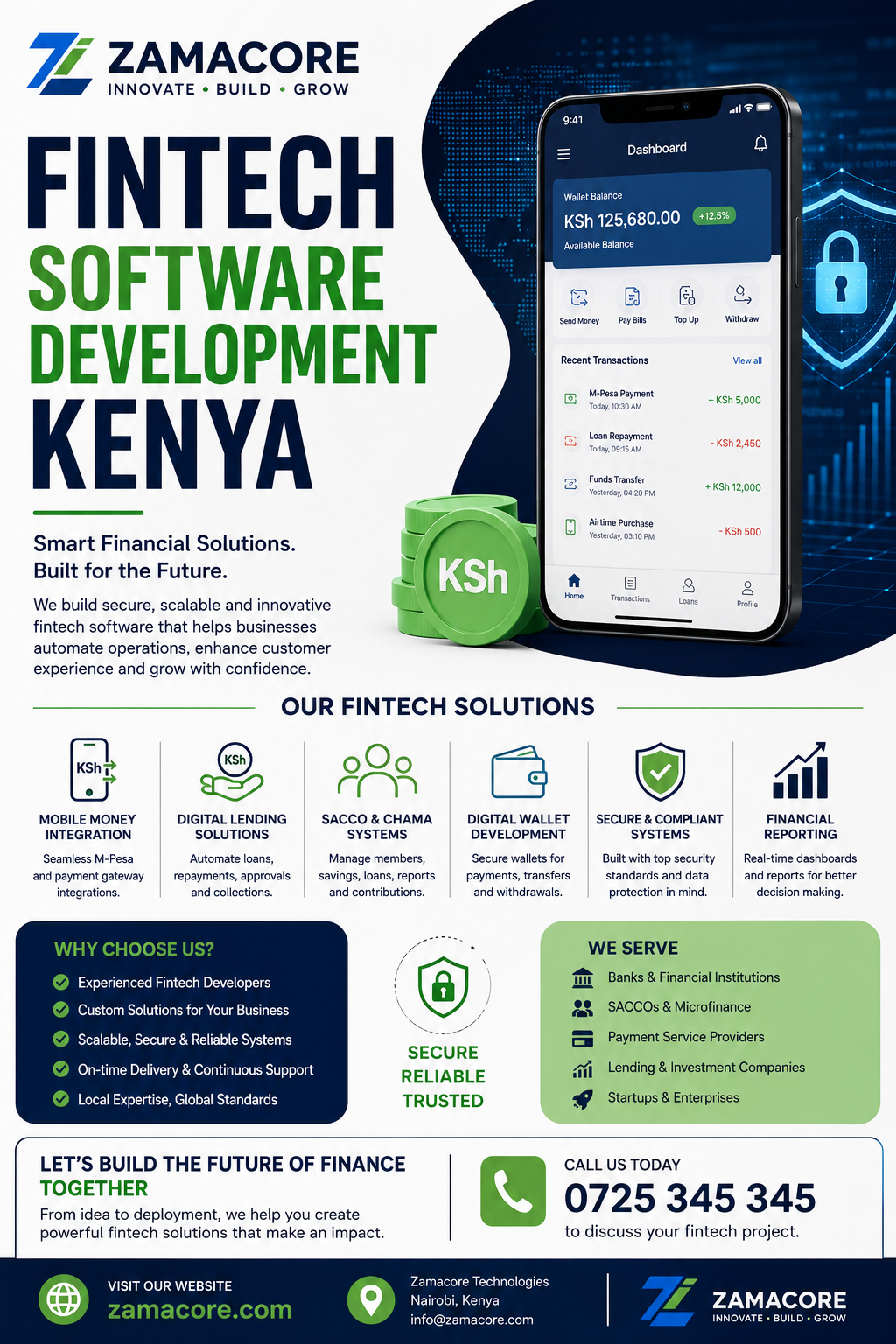
Kenya has become one of Africa’s most important markets for financial technology. From mobile payments and digital lending to SACCO platforms, banking applications, payment gateways, insurance technology, investment platforms, and business payment systems, financial services are increasingly being delivered through software.
For businesses looking to participate in this growing digital economy, choosing the right fintech software development Kenya partner is an important step. A fintech application must do more than provide an attractive interface. It needs to process financial information accurately, protect sensitive data, integrate with payment infrastructure, maintain reliable transaction records, scale as usage increases, and provide administrators with visibility over operations.
At Zamacore, we develop custom software solutions designed around the operational requirements of businesses in Kenya. Whether an organization needs a digital lending platform, payment solution, SACCO management system, mobile financial application, financial dashboard, API integration, or a completely custom fintech product, the goal is to build technology that supports real business processes.
This guide explores fintech software development in Kenya, the technologies involved, essential features, security considerations, integrations, development processes, and what businesses should consider before investing in a fintech platform.
What Is Fintech Software Development?
Fintech is short for financial technology. It describes technology used to provide, automate, manage, or improve financial services.
Fintech software development involves designing and building digital systems that perform financial functions such as:
- Processing payments
- Managing loans
- Collecting repayments
- Managing savings and contributions
- Generating invoices
- Managing customer accounts
- Recording financial transactions
- Processing mobile money payments
- Managing investment portfolios
- Automating accounting processes
- Providing financial reports
- Managing insurance processes
- Performing identity verification
- Connecting financial platforms through APIs
A fintech system can be a mobile application, web application, cloud platform, API, administrative dashboard, payment platform, or combination of several technologies.
The exact architecture depends on the problem being solved.
For example, a digital lending company may require borrower onboarding, loan applications, approval workflows, repayment schedules, M-Pesa collections, penalties, reports, and automated notifications.
A SACCO may instead require member registration, contributions, savings, loans, guarantors, dividends, statements, and accounting reports.
This is why custom fintech development can be valuable. Instead of forcing every financial organization into the same workflow, software can be developed around its specific operations.
Growth of Fintech Software Development Kenya
Kenya has developed a strong digital financial ecosystem, particularly around mobile money.
Consumers have become comfortable paying bills, transferring money, purchasing products, receiving payments, and interacting with businesses through digital channels.
Businesses are also moving away from spreadsheets and manual records toward integrated platforms that provide better automation and visibility.
Several factors are increasing demand for fintech software development companies in Kenya.
Mobile Money Adoption
Mobile money has transformed how businesses collect and distribute payments.
Companies increasingly want their internal systems connected directly to payment infrastructure so that transactions can automatically update customer accounts.
Instead of an employee checking payment messages and manually updating a spreadsheet, an integrated platform can receive transaction information and update the appropriate account automatically.
Smartphone Adoption
Mobile applications provide financial companies with a convenient way to interact with customers.
Customers can potentially use an application to:
- Register
- View balances
- Request services
- Apply for loans
- Check repayment schedules
- Download statements
- Receive notifications
- Make payments
This creates opportunities for organizations to provide services beyond traditional physical offices.
Demand for Automation
Manual financial operations become difficult to manage as businesses grow.
A company managing hundreds or thousands of transactions needs systems capable of organizing information automatically.
Fintech software can reduce repetitive administrative work while providing management with real-time information.
Growth of Digital Businesses
E-commerce platforms, subscription businesses, property companies, logistics companies, schools, healthcare providers, marketplaces, and other organizations increasingly require digital payment functionality.
Fintech therefore extends beyond traditional banks.
Almost any modern business can require financial technology.
Why Businesses Need Custom Fintech Software Development in Kenya
Off-the-shelf software works for some organizations. However, financial businesses frequently have unique workflows that cannot easily be handled by generic systems.
Custom fintech development provides greater control over how the platform operates.
1. Software Designed Around Your Business
Every financial organization operates differently.
Consider two lending companies.
One may provide short-term business loans with weekly repayments, while another provides asset financing with monthly repayments.
Their requirements could differ significantly regarding:
- Interest calculations
- Approval workflows
- Penalties
- Repayment schedules
- Guarantors
- Collateral
- Notifications
- Reporting
- User permissions
Custom development allows these rules to be incorporated into the platform.
2. Integration With Existing Systems
A fintech application rarely operates completely independently.
It may need to communicate with:
- Payment providers
- Accounting platforms
- CRM systems
- ERP systems
- SMS platforms
- Email services
- Identity verification services
- Banking services
- Mobile applications
- External APIs
Good software architecture makes these integrations possible while keeping the system maintainable.
3. Better Operational Automation
Financial operations contain many repetitive processes.
For example, when a customer makes a payment, several things may need to happen.
The system may need to identify the customer, record the transaction, update the outstanding balance, generate a receipt, update reports, and send a confirmation.
Without automation, staff may need to complete several of these tasks manually.
A well-designed fintech platform can automate much of this workflow.
4. Real-Time Financial Visibility
Management needs reliable information.
A fintech dashboard can provide information such as:
- Total transactions
- Revenue
- Outstanding balances
- Loan portfolio
- Repayment performance
- Customer growth
- Collections
- Failed transactions
- Daily payment totals
This makes it easier for decision-makers to understand what is happening within the business.
Fintech Software Solutions We Can Build
Fintech is a broad technology sector. Different organizations require different platforms.
Some common solutions include the following.
Digital Lending Software
Digital lending platforms help lenders manage the complete loan lifecycle.
A lending system may include:
- Borrower registration
- KYC information
- Loan applications
- Loan products
- Approval workflows
- Interest calculations
- Disbursement records
- Repayment schedules
- Payment tracking
- Penalties
- Loan restructuring
- Guarantors
- Collateral records
- Customer statements
- Portfolio reports
- SMS notifications
A strong lending platform gives management visibility from application through final repayment.
Loan Management Systems Kenya
Managing loans manually becomes increasingly difficult as the number of borrowers increases.
Spreadsheets can create challenges including duplicate records, calculation errors, missing repayments, inconsistent balances, and limited reporting.
A loan management system centralizes these operations.
Administrators can monitor:
- Active loans
- Fully repaid loans
- Overdue accounts
- Outstanding principal
- Interest collected
- Penalties
- Repayment performance
Automation can also reduce the time employees spend preparing reports.
Mobile Money and M-Pesa Integration
Mobile money integration is an important requirement for many Kenyan fintech products.
A properly integrated system can help businesses automate payment collection and reconciliation.
Depending on the service and approved integration available, businesses may implement capabilities involving:
- Customer payment collection
- Payment confirmation
- Transaction reconciliation
- Account updates
- Payment notifications
- Transaction histories
- Payout workflows
The exact implementation depends on the organization’s payment setup, provider requirements, and approved APIs.
Why Payment Integration Matters
Imagine a lender serving 2,000 borrowers.
If every repayment must be checked manually, the administrative workload becomes significant.
With integration, incoming payment information can be processed automatically and matched against customer records according to the application’s business logic.
This improves operational efficiency and reduces repetitive work.
SACCO Management Software Development
SACCOs and cooperative organizations handle complex financial relationships involving members, savings, loans, contributions, and other transactions.
Custom SACCO software may include:
- Member registration
- Member profiles
- Savings accounts
- Contributions
- Loan applications
- Loan approvals
- Guarantor management
- Repayment tracking
- Member statements
- Dividend calculations
- Financial reports
- SMS notifications
- Role-based permissions
- Audit logs
Members can also be provided with a portal where appropriate.
A member portal can allow users to view their contributions, balances, loan information, and statements without visiting an office.
Chama Management Software
Investment groups and chamas are also becoming increasingly digital.
A chama management platform can help groups manage:
- Members
- Contributions
- Fines
- Loans
- Meetings
- Expenses
- Investments
- Member balances
- Statements
- Reports
Instead of relying entirely on spreadsheets and WhatsApp messages, groups can maintain structured financial records within one platform.
Payment Processing Platforms
Businesses increasingly need centralized payment systems capable of processing transactions from different sources.
Custom payment software may provide:
- Transaction processing
- Customer accounts
- Payment status tracking
- Transaction references
- Reconciliation
- Refund workflows
- Reports
- API connectivity
- Notifications
The platform can also provide an administrative dashboard where authorized employees monitor transactions.
Digital Wallet Development
Digital wallet platforms allow customers to maintain digital balances within an application, subject to the applicable business model and regulatory requirements.
Potential functionality may include:
- User registration
- Wallet balances
- Transaction histories
- Deposits
- Transfers
- Withdrawals
- Notifications
- Account statements
- Administrative controls
Security is especially important because wallet systems deal directly with financial balances and transaction records.
Mobile Banking Application Development
Financial organizations increasingly want mobile applications that give customers convenient access to services.
A financial mobile app can potentially provide:
- Account registration
- Login and authentication
- Account balances
- Statements
- Transfers
- Payment functionality
- Loan applications
- Notifications
- Customer support
Applications can be developed for Android, iOS, or through cross-platform technologies depending on project requirements.
Insurance Technology Software
Fintech development also overlaps with insurance technology, commonly known as InsurTech.
Insurance platforms can help organizations manage:
- Customer onboarding
- Policies
- Premiums
- Renewals
- Claims
- Agents
- Documents
- Payments
- Reports
Automation can make it easier to track policies and communicate with customers.
Investment Management Platforms
Investment companies may require software that allows administrators and customers to monitor portfolios and financial activities.
Features can include:
- Investor onboarding
- Investment accounts
- Deposits
- Portfolio tracking
- Statements
- Performance dashboards
- Transaction histories
- Administrative reporting
The exact functionality should reflect the organization’s investment model and applicable requirements.
Financial Management Software for Businesses
Fintech technology is not limited to financial institutions.
Regular businesses also need software capable of managing money efficiently.
A business financial platform may include:
- Invoicing
- Expenses
- Customer balances
- Supplier payments
- Payment collection
- Financial reports
- Cash flow monitoring
- Receivables
- Payables
Connecting these features with other business systems can provide management with a more complete picture of operations.
Essential Features of Fintech Software
The exact functionality depends on the project, but several features are common across financial applications.
Secure Authentication
Users should have secure mechanisms for accessing their accounts.
Depending on risk requirements, this can involve:
- Password authentication
- One-time passwords
- Multi-factor authentication
- Session management
- Device controls
- Login monitoring
Administrative accounts may require stronger controls because they can access sensitive functions.
Role-Based Access Control
Not every employee should have access to every function.
For example, a customer service employee may need access to customer profiles but should not necessarily have permission to modify financial configurations.
Possible roles might include:
- Administrator
- Accountant
- Manager
- Loan officer
- Customer service
- Auditor
Permissions should reflect actual responsibilities.
Transaction Management
Every transaction should have sufficient information for the business to understand what occurred.
Records can include:
- Transaction reference
- Amount
- Customer
- Date and time
- Payment method
- Transaction status
- Related account
- Processing information
Accurate transaction records are fundamental to fintech software.
Audit Trails
Financial systems should provide traceability for important administrative actions.
An audit log may record:
- User responsible for an action
- Action performed
- Time
- Relevant record
- Changes made
This helps businesses investigate discrepancies and maintain accountability.
Financial Reporting
Reports transform transaction data into information managers can use.
A fintech platform may provide reports covering:
- Collections
- Revenue
- Loans
- Outstanding balances
- Customer accounts
- Transactions
- Expenses
- Portfolio performance
- Daily summaries
- Monthly summaries
Reports may also be exportable where required.
Notifications
Communication is important in financial services.
Applications can integrate SMS, email, push notifications, or other approved communication channels.
Notifications can be triggered by events such as:
- Successful payment
- Loan approval
- Upcoming repayment
- Overdue payment
- Account activity
- Password reset
- Statement availability
Automation helps businesses communicate consistently with customers.
API Integration
Modern financial technology depends heavily on APIs.
An API allows separate software platforms to exchange information.
A fintech platform may connect to:
- Mobile money
- Banks
- SMS providers
- Accounting software
- ERP systems
- CRM systems
- Identity services
- E-commerce platforms
API-first architecture can also make future integrations easier.
Security in Fintech Software Development
Security must be considered throughout development rather than added after the system is complete.
Financial platforms may contain sensitive customer and transaction information, making them attractive targets for cyberattacks.
Important security measures can include:
Encryption
Sensitive information should be appropriately protected during transmission and storage.
Secure APIs
APIs should require authentication and authorization and should validate requests appropriately.
Access Control
Users should only access information and actions required for their role.
Secure Password Storage
Passwords should never be stored as readable plain text.
Monitoring
Important system activity should be logged to help identify suspicious behavior and operational problems.
Backups
Businesses should maintain suitable backup and recovery processes to reduce the impact of data loss.
Security Updates
Applications and dependencies should be maintained and updated as security vulnerabilities are discovered.
Data Protection in Kenya
Organizations handling personal data in Kenya need to consider applicable data protection obligations.
Financial applications can collect information such as:
- Names
- Phone numbers
- Identification details
- Financial records
- Transaction histories
- Addresses
- Employment information
Businesses should therefore consider privacy and data protection from the beginning of the project.
This includes thinking carefully about what information is collected, why it is required, who can access it, how long it is retained, and how it is protected.
Regulatory and compliance requirements vary depending on the nature of the financial service. Businesses entering regulated activities should obtain appropriate professional and regulatory guidance before launching.
Our Fintech Software Development Process
Successful software development begins with understanding the business rather than immediately writing code.
Step 1: Requirements Analysis
We first establish what the system needs to accomplish.
This can involve understanding:
- Business model
- Customer journey
- Financial products
- Payment methods
- Employee roles
- Approval workflows
- Reporting requirements
- Integrations
- Existing software
- Expected number of users
These requirements form the foundation of the project.
Step 2: System Architecture
Once requirements are understood, the technical architecture can be planned.
This may involve decisions regarding:
- Database structure
- Backend architecture
- APIs
- Authentication
- Frontend technologies
- Hosting
- Integrations
- Security controls
Good architecture makes future development easier.
Step 3: UI and UX Design
Fintech software should be easy to understand.
Customers should be able to complete important actions without unnecessary confusion.
Administrators should also have dashboards that make daily operations easier.
User experience design may include:
- Navigation
- Dashboards
- Forms
- Transaction screens
- Customer profiles
- Reports
- Mobile interfaces
Step 4: Software Development
Developers then implement the required functionality.
Depending on the project, development may involve technologies for:
- Backend services
- Web applications
- Mobile applications
- Databases
- APIs
- Cloud infrastructure
Technology should be selected based on project requirements rather than trends alone.
Step 5: Integration
The platform can then be connected with approved external services.
Examples include:
- Payment APIs
- SMS services
- Email services
- Accounting systems
- Identity services
Integrations should be thoroughly tested because external dependencies can affect critical workflows.
Step 6: Testing
Testing is particularly important for fintech.
Developers should verify scenarios such as:
- Successful transactions
- Failed transactions
- Duplicate requests
- Incorrect user input
- Authentication failures
- Permission restrictions
- Network interruptions
- Calculation accuracy
Testing financial calculations is especially important because small errors can create major problems when multiplied across thousands of transactions.
Step 7: Deployment
After testing and approval, the application can be deployed to its production environment.
Deployment should include suitable:
- Server configuration
- Database configuration
- Security controls
- Monitoring
- Backups
- Domain configuration
Step 8: Support and Maintenance
Software requires ongoing maintenance.
Over time businesses may require:
- Security updates
- Bug fixes
- New integrations
- Additional reports
- Performance improvements
- New features
- Infrastructure upgrades
Fintech software should therefore be treated as a long-term business platform rather than a one-time installation.
Cloud-Based Fintech Software Development
Cloud infrastructure provides several benefits for modern fintech applications.
These can include:
- Remote accessibility
- Flexible infrastructure
- Easier scaling
- Centralized deployment
- Backup options
- Monitoring capabilities
Cloud platforms can allow organizations to increase computing resources as customer usage grows.
However, infrastructure must still be properly secured and configured.
Simply hosting an application in the cloud does not automatically make it secure.
Fintech Mobile App Development Kenya
Mobile applications are becoming a major customer channel for financial services.
A fintech mobile app can help companies serve customers regardless of physical location.
Common mobile app functionality includes:
- Registration
- Secure login
- Customer dashboard
- Account information
- Payments
- Transaction histories
- Loan requests
- Statements
- Notifications
- Support
Mobile development should prioritize usability, security, and performance.
Many customers may also use varying network conditions and device capabilities, so applications should be designed with practical real-world usage in mind.
Fintech Web Application Development
Web applications remain important for administrators and customers.
An administrative fintech web portal can allow staff to manage operations from laptops or desktop computers.
A dashboard may display:
- Today’s transactions
- New customers
- Payments received
- Outstanding accounts
- Loan applications
- Alerts
- Financial statistics
Web platforms can also provide customer portals accessible through a browser without requiring an application installation.
Fintech API Development
Some businesses do not need a complete customer-facing application.
Instead, they may need APIs that add financial capabilities to existing software.
For example, a property management system could integrate an API that processes rent payment notifications.
An e-commerce platform could integrate payment services.
A lending application might expose APIs to a mobile app.
API development should consider:
- Authentication
- Authorization
- Validation
- Error handling
- Rate limiting
- Logging
- Documentation
- Version management
Well-designed APIs make fintech infrastructure easier to expand.
Integrating Fintech With ERP Systems
Financial information is often connected to broader business operations.
Integrating fintech systems with ERP software can allow information to flow between departments.
For example:
Customer payment → Financial platform → Invoice update → Accounting record → Management report.
Without integration, employees may have to enter the same information into multiple systems.
This increases administrative work and the possibility of errors.
Integrating Fintech With Accounting Software
Accounting integration can help businesses keep financial records synchronized.
Depending on available APIs and accounting workflows, fintech transactions may be mapped into appropriate accounting records.
This can improve:
- Reconciliation
- Reporting
- Record keeping
- Financial visibility
The integration should be designed carefully to prevent duplicate or incorrect entries.
Benefits of Fintech Software for Kenyan Businesses
Investing in appropriate financial technology can provide several advantages.
Reduced Manual Work
Automation reduces repetitive tasks such as entering transactions, preparing basic reports, and updating customer balances.
Better Accuracy
Properly tested automated calculations reduce the risks associated with manual calculations.
Improved Customer Experience
Customers can access financial information without waiting for staff to manually respond.
Faster Reporting
Management can view reports generated from current system data.
Scalability
Software allows organizations to manage larger transaction volumes without increasing administrative work at the same rate.
Centralized Information
Instead of storing information across spreadsheets, notebooks, emails, and different systems, fintech platforms can centralize important financial records.
Challenges in Fintech Software Development
Fintech projects are complex.
Businesses should understand the major challenges before development begins.
Security
Financial applications are attractive targets for attackers.
Security must therefore be considered across architecture, development, deployment, and ongoing maintenance.
Integration Complexity
External APIs may have different technical requirements and limitations.
Developers must build systems capable of handling integration failures safely.
Regulatory Requirements
Certain financial activities may require licensing, approval, reporting, or other regulatory obligations.
Software development does not replace these requirements.
Scalability
A platform serving 100 users may behave differently when serving 100,000.
Architecture should consider realistic growth expectations.
Transaction Accuracy
Financial calculations and balances must be accurate.
Testing and reconciliation processes are essential.
Choosing a Fintech Software Development Company in Kenya
Selecting a developer based purely on the lowest quotation can create expensive problems later.
Businesses should consider several factors.
Understanding of Financial Workflows
The development team should understand how transactions, balances, approvals, reconciliation, and auditability affect system architecture.
API Integration Experience
Fintech projects frequently depend on third-party APIs.
Security Awareness
Developers should demonstrate that security is part of the architecture rather than an afterthought.
Scalability
Ask how the platform will handle future growth.
Support
Understand what happens after deployment.
Software requires ongoing maintenance.
Communication
The development company should be capable of translating business requirements into clear technical functionality.
Why Choose Zamacore for Fintech Software Development in Kenya?
At Zamacore, we focus on developing technology around actual business requirements.
Our fintech development approach can cover the complete application lifecycle, from requirements analysis and architecture through development, integrations, testing, deployment, and ongoing improvement.
We can work with businesses requiring solutions such as:
- Digital lending platforms
- Loan management systems
- SACCO management software
- Chama financial systems
- Payment platforms
- Financial dashboards
- Mobile fintech applications
- Web applications
- Business financial management systems
- API development
- Payment integrations
- Custom financial automation
Instead of simply creating software screens, the objective is to understand how information and money move through the organization.
This allows the platform to support the actual operational workflow.
Custom Fintech Software vs Ready-Made Software
Businesses frequently ask whether they should purchase an existing platform or develop custom software.
Both approaches can make sense.
Ready-made software may be suitable when your requirements closely match the existing product.
Custom fintech development becomes more attractive when:
- Your workflows are unique
- You require special integrations
- You want greater control over functionality
- Existing platforms cannot support your business model
- You expect substantial future customization
- You want to build a proprietary technology product
The correct decision depends on the business case.
A good software development partner should help determine whether custom development is justified before committing to a large project.
Cost of Fintech Software Development in Kenya
There is no single price for fintech development because project complexity varies significantly.
A basic internal financial dashboard is very different from a nationwide customer-facing financial platform.
Development cost can depend on:
- Number of features
- Web versus mobile requirements
- Number of integrations
- Payment functionality
- User roles
- Reporting requirements
- Security requirements
- Infrastructure
- UI/UX complexity
- Expected traffic
- Support requirements
The best way to establish cost is to create a clear requirements document first.
Once functionality has been defined, developers can provide a more realistic quotation and timeline.
Building a Fintech MVP in Kenya
Startups do not always need to build every planned feature immediately.
An MVP, or Minimum Viable Product, can help test the core business idea.
For example, a lending startup’s first release might concentrate on:
- Customer onboarding
- Loan application
- Administrative approval
- Loan records
- Repayment tracking
- Payment integration
- Basic reporting
Additional functionality can then be introduced based on real customer feedback.
This approach can reduce initial complexity while helping founders validate their business assumptions.
However, an MVP involving financial transactions still requires appropriate security and accuracy. MVP should mean a smaller feature set—not careless engineering.
Scaling a Fintech Platform
A successful fintech product may grow rapidly.
Architecture should therefore consider future requirements.
Growth could involve:
- More customers
- More transactions
- Additional branches
- New financial products
- More integrations
- New countries
- Additional mobile applications
- More employees
Software should be designed so that expansion does not require rebuilding everything from scratch.
This does not mean overengineering the first release.
Instead, developers should make architectural decisions that leave sensible paths for growth.
The Future of Fintech Software Development in Kenya
Kenya’s financial technology market is likely to continue evolving as more organizations digitize their operations.
Several areas are particularly important.
Financial Automation
Companies will increasingly automate repetitive financial processes.
Embedded Finance
Financial functionality will increasingly appear inside non-financial platforms.
For example, marketplaces, property applications, logistics platforms, and business management systems can integrate payment or financing functionality.
API-Driven Financial Services
APIs make it easier for separate applications to communicate.
This will continue encouraging businesses to build financial functionality into their existing platforms.
Data-Driven Decision Making
Financial organizations can use properly governed operational data to understand customer behavior, repayment trends, transaction patterns, and business performance.
Mobile-First Financial Services
Smartphones will continue to play an important role in how customers interact with digital financial services.
Fintech Software Development for Startups
Kenya’s startup ecosystem creates opportunities for entrepreneurs developing new financial products.
A founder may have a strong business idea without having an internal software engineering team.
Working with a fintech development company can help transform the concept into a functional platform.
The process should begin by defining:
- Target customers
- Customer problem
- Core financial workflow
- Revenue model
- Required integrations
- Regulatory considerations
- MVP functionality
Only after these are reasonably clear should development begin.
Starting with code before understanding the business model often creates unnecessary development costs.
Fintech Software Development for Established Businesses
Established businesses also benefit from custom financial software.
A company may already have employees, customers, accounting systems, and payment processes but still rely heavily on spreadsheets.
Custom software can digitize these existing processes.
For example, a company might automate:
- Customer billing
- Payment collection
- Reconciliation
- Expense approvals
- Financial reporting
- Customer balances
The objective is not always to create a completely new fintech startup.
Sometimes the greatest value comes from improving an existing company’s financial operations.
Frequently Asked Questions About Fintech Software Development Kenya
What is fintech software?
Fintech software is technology used to deliver, manage, automate, or support financial services. Examples include payment platforms, loan management systems, digital wallets, financial mobile apps, SACCO systems, and investment platforms.
Can you develop custom fintech software in Kenya?
Yes. Fintech platforms can be developed according to a company’s specific workflows, integrations, users, products, and reporting requirements.
Can fintech software integrate with M-Pesa?
Where the required APIs, accounts, permissions, and technical requirements are available, fintech applications can integrate with supported mobile money services for functions such as payment collection and transaction processing.
Can you develop a digital lending platform?
A custom lending platform can include borrower onboarding, loan applications, approval workflows, repayment schedules, payment tracking, penalties, statements, notifications, and reports.
Can fintech software be accessed from mobile phones?
Yes. Businesses can develop mobile applications, responsive web applications, or both.
Can you develop SACCO software?
Custom SACCO platforms can support member management, contributions, savings, loans, guarantors, repayments, statements, reports, and other organization-specific functionality.
How long does fintech software development take?
Development time depends on scope and complexity. A focused MVP can take significantly less time than a large platform containing mobile apps, multiple integrations, advanced workflows, and extensive reporting.
How much does fintech software cost in Kenya?
The cost depends on features, integrations, security requirements, mobile applications, infrastructure, design, and overall project complexity. A requirements analysis should be completed before providing an accurate quotation.
Can an existing fintech platform be upgraded?
Yes, depending on the existing architecture and availability of the source code and technical documentation. Developers should first audit the current system before recommending upgrades.
Do fintech applications require ongoing maintenance?
Yes. Financial software should receive security updates, bug fixes, infrastructure monitoring, dependency updates, and improvements as requirements change.
Start Your Fintech Software Development Project in Kenya
Financial technology can help businesses automate operations, improve customer experiences, process transactions efficiently, and gain greater visibility over financial activities.
However, successful fintech development requires more than coding.
The development process needs to consider business workflows, financial accuracy, security, integrations, scalability, usability, data protection, and long-term maintenance.
Whether you are building a fintech startup, digitizing a lending company, automating SACCO operations, integrating payments into an existing platform, or creating a completely new financial product, a well-designed software foundation is essential.
Zamacore develops custom software solutions for businesses in Kenya, including fintech applications, payment integrations, mobile applications, web platforms, APIs, ERP integrations, and business automation systems.
If you are searching for a fintech software development company in Kenya, talk to Zamacore about your project requirements.
Website: zamacore.com
Call: 0725 345 345