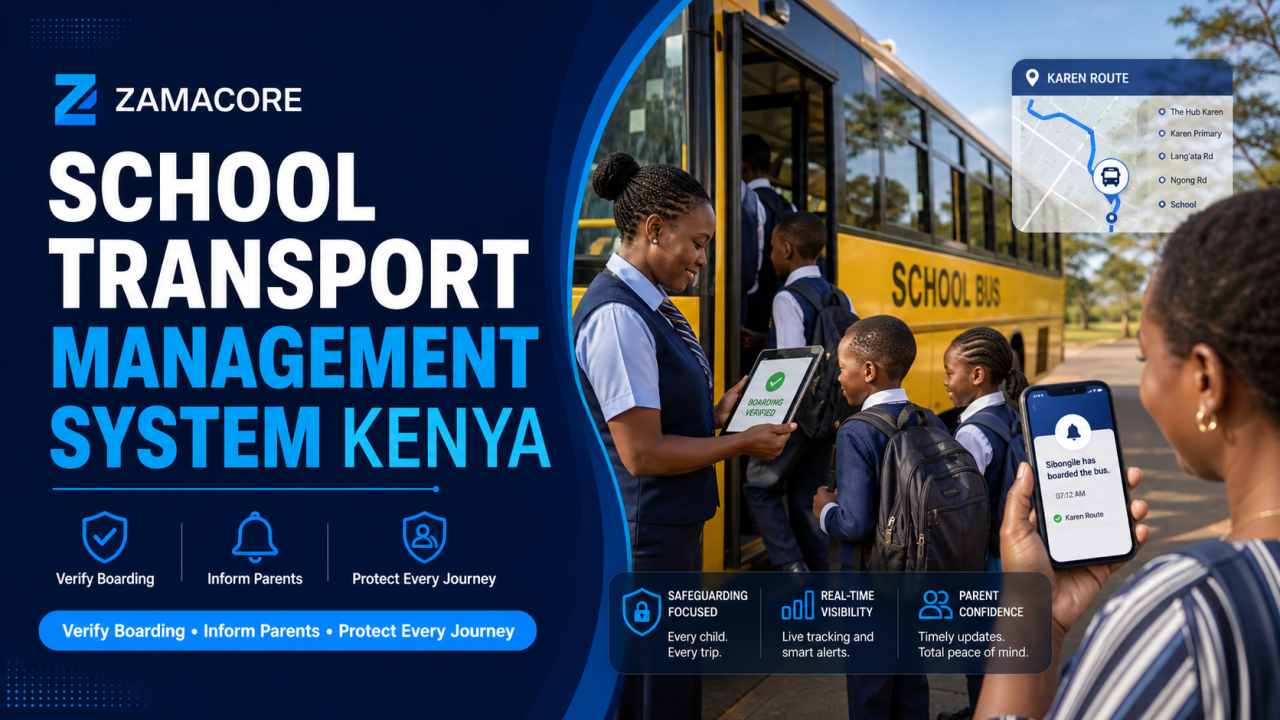
School Transport Management System Kenya gives private schools, academies, colleges and contracted school-transport operators one controlled way to replace paper route lists, phone calls and parent messaging groups. The purchase is justified when the platform shortens response time, prevents leakage, protects customer trust, and gives managers evidence they can act on.
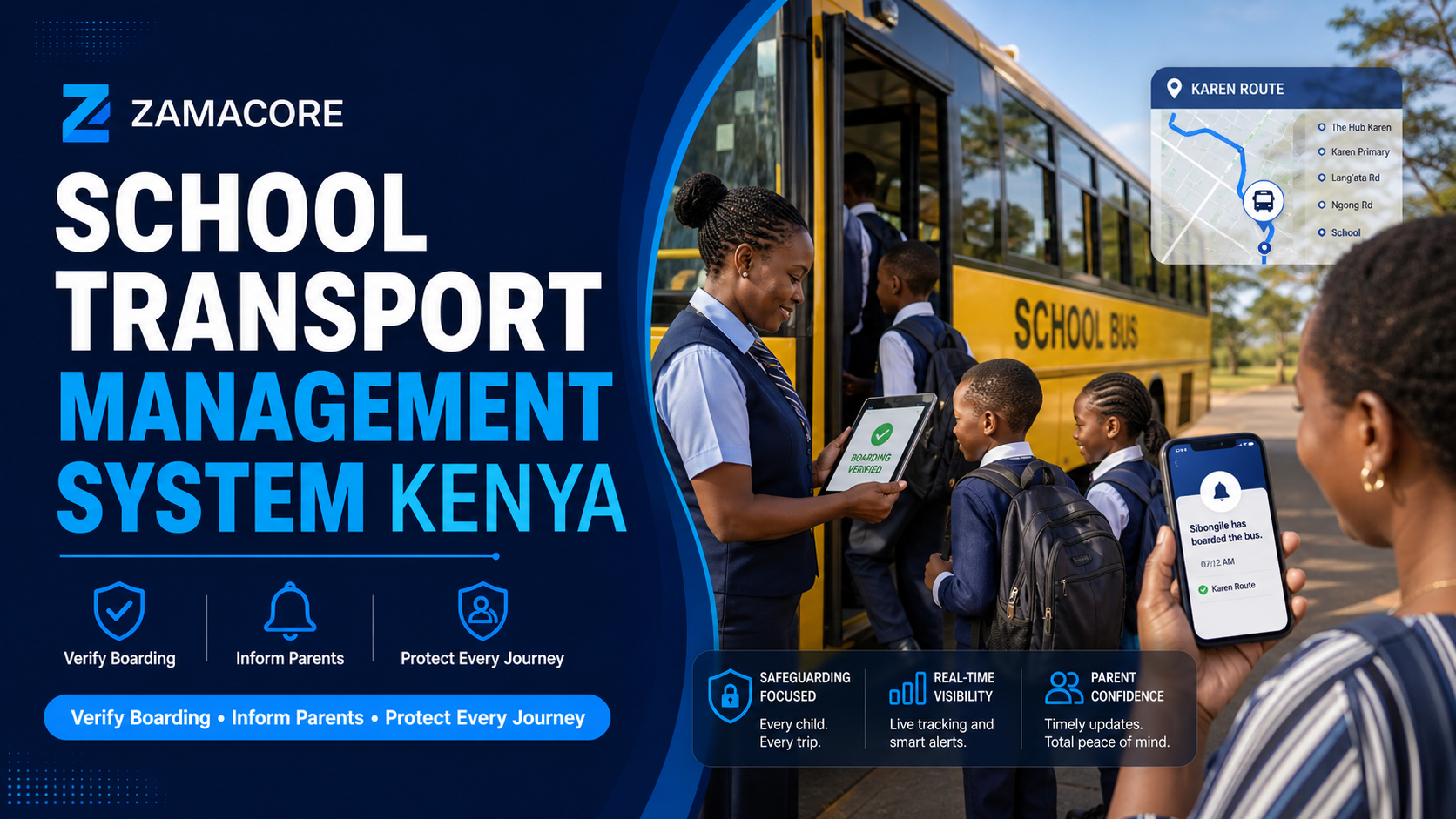
Parents want timely confirmation that a child boarded, arrived and was dropped at the authorised stop. Schools need this visibility without exposing children’s information or distracting drivers.
The daily operating problem
Routes change, learners are absent, vehicles break down and guardians request exceptions. Paper lists become outdated quickly, while parents call the school when a bus is late and administrators struggle to identify which children were affected.
Poor communication creates anxiety and safeguarding risk. Inefficient routes, weak fee records and unplanned vehicle maintenance also increase operating cost.
Warning signs the current process has outgrown spreadsheets and messaging apps
- Route lists are updated manually in several copies.
- The school cannot confirm whether a learner boarded.
- Parents receive delay information only after calling.
- Unauthorised route or drop-off changes are accepted informally.
- Transport fees do not reconcile with assigned routes.
- Vehicle and driver documents expire without alerts.
These symptoms should be measured before software is selected. The baseline makes it possible to distinguish a genuine operational improvement from a system that merely digitises the same delays.
How the complete workflow should operate
Register authorised transport arrangements
Record learner, guardian, route, stop, schedule, authorised collectors, medical notes and communication preferences.
Plan routes and resources
Assign vehicles, drivers, attendants, capacity and replacement arrangements.
Verify boarding and drop-off
Use a supervised list, QR or other safe method to record each transport event.
Communicate exceptions
Notify authorised guardians of boarding, delays, changes and arrival while escalating missing or unexpected events.
Control the fleet
Track inspections, maintenance, incidents, documents, fees and route performance.
Essential capabilities buyers should compare
- Learner, guardian, route and stop registry
- Vehicle capacity and route planning
- Driver and attendant assignment
- Supervised boarding and drop-off confirmation
- Parent notifications and authorised change requests
- Delay, breakdown and replacement-vehicle workflow
- Incident and safeguarding escalation
- Transport fee assignment and payment tracking
- Vehicle maintenance and document expiry
- Privacy, permissions and audit history
Every capability must have a named user, a rule, an exception path, an accountable owner and a measurable result. A feature that cannot be demonstrated using a realistic transaction should not determine the purchasing decision.
Who should use the system?
Transport administrators control routes; attendants verify learners; drivers focus on driving; parents receive authorised information; finance tracks fees; fleet teams maintain vehicles; safeguarding leaders handle incidents.
Management dashboards that support decisions
Monitor vehicles active, routes late, learners not accounted for, capacity, parent notifications, incidents, fee balances, inspection status, maintenance due and route cost.
Summary figures should drill down to the responsible branch, customer, supplier, asset, job, document or user. Reports without traceable source records create arguments instead of accountability.
Integrations to plan early
Connect student information, fee or accounting systems, messaging, maps, GPS providers and maintenance records. Limit personal data shared with external transport contractors.
Integration discovery must identify the master system for each record, supported interfaces, validation rules, duplicate prevention, failure alerts and reconciliation. A live API demonstration is more reliable than a general promise that two platforms can connect.
Mobile and offline requirements
Attendant-facing tools must be quick, usable offline and designed to prevent accidental confirmation. Driver interaction while moving should be prohibited.
Security, permissions and audit trail
Access should follow responsibility and location. The platform should record creation, assignment, approval, changes, cancellation, completion and export of sensitive records. High-risk actions may require a second approval. Backups, recovery tests, secure connections, device and session controls, and staff-exit procedures belong in the implementation plan.
Software can support organisational policy, but it does not automatically guarantee legal, tax, privacy, health, employment or sector compliance. The client should confirm applicable requirements with qualified advisers and translate them into testable controls.
A practical implementation roadmap
- Baseline: measure the present delay, error, cost, leakage, complaints and reporting effort.
- Discovery: observe real users, documents, approvals, exceptions and hand-offs.
- Scope: select one complete, high-value workflow for the first release.
- Data: clean the customer, supplier, asset, item, employee, project or location records needed by that workflow.
- Prototype: validate screens, terminology and permissions with daily users.
- Pilot: launch with one branch, team, customer group, route or project.
- Review: compare results with the baseline and correct adoption or process gaps.
- Roll out: expand only after the first operating unit can complete the workflow reliably.
How to measure return on investment
- Learners accounted for on every trip
- Parent notification delivery
- Route punctuality and duration
- Transport incidents and response time
- Vehicle capacity utilisation
- Transport fee collection
- Preventive maintenance and document compliance
Time saved is useful, but the commercial case should also calculate revenue accelerated, repeat work avoided, stock or asset losses prevented, downtime reduced, customer retention protected and management decisions made earlier.
Questions to ask shortlisted software companies
- How is learner identity verified without slowing boarding?
- What happens when connectivity is unavailable?
- Can guardians control authorised stops and collectors securely?
- How does the platform handle replacement vehicles and route changes?
- What personal information can drivers and contractors see?
- Can fees and maintenance connect without compromising safeguarding?
Target keyword coverage for this solution
The following searches describe related parts of the same buyer journey. They belong on one authoritative page instead of being divided into thin, competing articles.
- School Transport Management System Kenya — a buyer-intent phrase covered by this complete solution
- School Bus Tracking System Kenya — a buyer-intent phrase covered by this complete solution
- School Bus Tracking App Kenya — a buyer-intent phrase covered by this complete solution
- Student Transport Management Software Kenya — a buyer-intent phrase covered by this complete solution
- School Pickup and Drop-Off App Kenya — a buyer-intent phrase covered by this complete solution
- Parent School Bus Tracking App Kenya — a buyer-intent phrase covered by this complete solution
- Student Boarding Verification System Kenya — a buyer-intent phrase covered by this complete solution
- School Transport Fee Management System Kenya — a buyer-intent phrase covered by this complete solution
- School Vehicle Management Software Kenya — a buyer-intent phrase covered by this complete solution
- School Driver Management System Kenya — a buyer-intent phrase covered by this complete solution
Build this system with ZamaCore
ZamaCore develops ERP modules, operational portals, mobile workflows, dashboards, automation and integrations for Kenyan organisations. We begin with the business loss or service problem, then define the smallest complete workflow capable of producing a measurable result.
Explore our custom software development and ERP solutions, or request a workflow assessment. Bring representative forms, reports, spreadsheets and approval steps so the first discussion focuses on the real operation.
Frequently asked questions
Can ZamaCore provide a price before discovery?
A preliminary range may be possible, but a responsible proposal requires users, locations, workflows, data, integrations, security, acceptance tests and support expectations.
Should the organisation implement every module immediately?
No. A controlled pilot limits disruption and produces evidence before wider investment.
Can the system integrate with accounting, ERP, M-Pesa or existing portals?
Often yes, subject to supported interfaces, account access, data ownership, security and reconciliation requirements.
What causes operational software projects to fail?
Common causes include unclear ownership, copying a broken process, poor data, weak user involvement, uncontrolled scope, inadequate testing and no post-launch support plan.