a
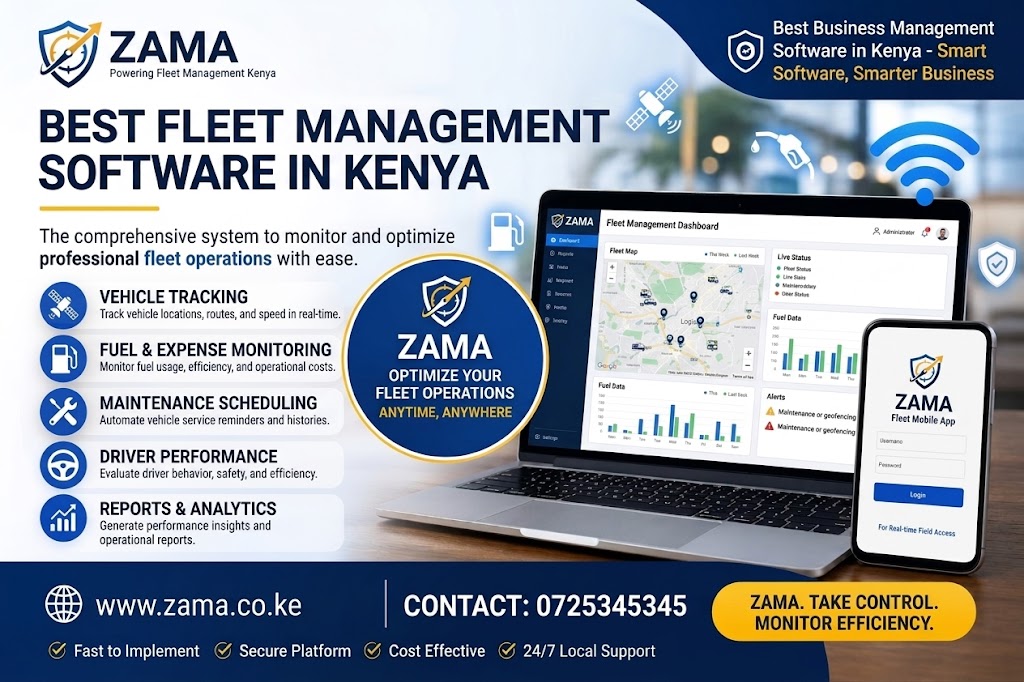 Fleet Management Software Kenya is becoming an important technology for businesses that depend on vehicles, drivers, transportation, deliveries and field operations. Companies operating cars, vans, trucks, motorcycles, buses and other commercial vehicles need accurate information to control fuel, maintenance, routes, drivers, trips, expenses and vehicle performance.
Managing a fleet using notebooks, spreadsheets, phone calls and disconnected records can become difficult as the number of vehicles increases.
A modern Fleet Management Software Kenya platform brings important fleet activities into one organized digital environment. Businesses can create vehicle records, manage drivers, plan trips, monitor fuel consumption, schedule maintenance, record expenses, track deliveries and generate management reports.
Zama develops secure business systems, SaaS platforms and industry-specific software for Kenyan organizations, including solutions covering logistics and fleet operations. (Zama Web Experts)
Table of Contents
- What Is Fleet Management Software Kenya?
- Why Fleet Management Software Kenya Matters
- Vehicle Management
- Driver Management
- GPS and Vehicle Tracking
- Route Planning and Dispatch
- Fuel Management
- Vehicle Maintenance
- Fleet Expense Management
- Delivery and Transport Operations
- Fleet Reporting and Analytics
- Fleet Management Software Kenya for Different Industries
- Benefits for Kenyan Businesses
- How to Choose Fleet Management Software Kenya
- Fleet Management Software Kenya and M-Pesa
- Data Security and Fleet Software
- Implementation
- Frequently Asked Questions
- Conclusion
What Is Fleet Management Software Kenya?
Fleet management software is a digital system that helps organizations manage vehicles, drivers, trips, fuel, maintenance, expenses, deliveries and operational information.
Instead of keeping vehicle information in separate files, businesses can centralize their fleet records.
A properly configured Fleet Management Software Kenya solution can help managers understand what vehicles are available, which drivers are assigned, which vehicles are on the road, which vehicles require service and how much the fleet is costing.
For a company operating ten vehicles, this visibility can already be valuable.
For a company operating fifty, one hundred or several hundred vehicles, centralized fleet management becomes even more important.
A fleet platform can connect:
- Vehicles.
- Drivers.
- Trips.
- Routes.
- Fuel.
- Maintenance.
- Expenses.
- Deliveries.
- Customers.
- Branches.
- Reports.
This gives management one place to review fleet activity.
Why Fleet Management Software Kenya Matters
Kenyan businesses use vehicles for many purposes.
A distributor may have trucks delivering products.
A courier company may have motorcycles and vans.
A construction company may operate pickups, trucks and heavy equipment.
A school may operate buses.
A field-service company may use vehicles to visit customers.
A transport company may operate a large commercial fleet.
Each type of organization has different requirements.
However, the underlying challenge is similar: how can the organization control vehicles, drivers, costs and daily operations efficiently?
Fleet Management Software Kenya can provide a structured approach by connecting fleet information with business workflows.
Zamacore develops software platforms and business systems for organizations that need centralized operational visibility. (Zamacore)
How Fleet Management Software Kenya Manages Vehicles
The vehicle register is one of the most important parts of a fleet system.
A business should know exactly what vehicles it owns, leases or operates.
A vehicle profile can contain information such as:
- Registration number.
- Vehicle type.
- Make and model.
- Year of manufacture.
- Chassis information.
- Current mileage.
- Assigned driver.
- Branch.
- Insurance details.
- Inspection information.
- Service history.
- Fuel records.
- Operating status.
A digital vehicle register makes it easier to retrieve information when managers need it.
For example, a transport manager can quickly identify vehicles that are active, under maintenance, unavailable or assigned to another branch.
Fleet Management Software Kenya can also be customized around the specific vehicle fields and approval processes used by an organization.
Driver Management With Fleet Management Software Kenya
Vehicles are only one part of fleet operations.
Drivers are equally important.
Businesses need to know which driver is assigned to which vehicle, which trips have been completed and whether required driver documentation is available.
A fleet system can maintain driver profiles containing:
- Driver name.
- Contact details.
- License information.
- Assigned vehicle.
- Department.
- Branch.
- Trip history.
- Performance information.
- Availability.
- Incident records.
Dereva provides a professional driver discovery platform where clients can search for driver categories including truck drivers, delivery drivers, motorcycle riders and corporate drivers. (Dereva)
A fleet business can therefore combine a structured driver-management workflow with a reliable way of identifying professional driving resources.
GPS Tracking and Fleet Management Software Kenya
Vehicle tracking can provide fleet managers with greater visibility over vehicle movements.
Instead of asking a driver where a vehicle is, a GPS-enabled system can provide location information through a centralized dashboard.
Depending on the implementation, fleet tracking can help managers monitor:
- Current vehicle location.
- Route history.
- Trip progress.
- Vehicle activity.
- Arrival and departure times.
- Unexpected stops.
- Route deviations.
- Delivery progress.
GPS tracking can be especially useful for logistics companies, courier businesses, distributors and field-service organizations.
Fleet Management Software Kenya can be combined with GPS tracking and delivery workflows to create greater operational visibility.
Dexa’s published fleet-management material describes vehicle tracking, driver management, route optimization, fuel monitoring, maintenance, delivery tracking, proof of delivery and reporting as important fleet capabilities. (Dexa)
Route Planning With Fleet Management Software Kenya
Route planning is another important fleet function.
A poorly planned route can increase:
- Fuel consumption.
- Travel time.
- Driver hours.
- Vehicle wear.
- Delivery delays.
- Customer complaints.
A fleet management platform can help businesses organize trips according to destinations, vehicle capacity, delivery requirements and operational priorities.
For example, a distributor serving Nairobi may organize routes around:
- Nairobi CBD.
- Westlands.
- Industrial Area.
- Eastlands.
- Karen.
- Kiambu.
- Thika.
- Ruiru.
A logistics manager can assign vehicles based on route requirements.
Zama also develops rider and dispatch systems that can support job assignment, location tracking, delivery status and operational reporting. (Zama Web Experts)
Fuel Management With Fleet Management Software Kenya
Fuel is one of the major operating expenses for many fleets.
Without accurate records, businesses may struggle to determine how much fuel each vehicle consumes.
A fleet system can record:
- Fuel purchases.
- Fuel quantities.
- Fuel costs.
- Vehicle mileage.
- Fuel consumption.
- Driver information.
- Fuel stations.
- Trip information.
Managers can then compare fuel usage between vehicles.
If one vehicle consumes significantly more fuel than similar vehicles, the company can investigate.
Possible causes could include:
- Poor maintenance.
- Heavy loads.
- Aggressive driving.
- Poor routes.
- Excessive idling.
- Mechanical problems.
- Inaccurate records.
Fleet Management Software Kenya can therefore support better fuel accountability.
Zama’s fuel-monitoring material also describes integration between fuel monitoring, vehicle tracking, driver activity and maintenance information. (Zama Web Experts)
Maintenance Management With Fleet Management Software Kenya
Vehicle maintenance should not only happen when a vehicle breaks down.
Preventive maintenance can help organizations plan servicing before problems become serious.
A fleet system can track:
- Service dates.
- Mileage.
- Oil changes.
- Brake inspections.
- Tyre changes.
- Battery replacement.
- Repairs.
- Spare parts.
- Maintenance costs.
- Workshop information.
Managers can create reminders for upcoming service activities.
For example:
Vehicle KDA 123A
Next service: 10,000 km
Current mileage: 9,450 km
Status: Service approaching
This is more reliable than waiting for a driver to remember that a vehicle needs servicing.
Zamacore provides software-development services for organizations that require connected operational systems and business automation. (Zamacore)
Tyre and Spare Parts Management
Tyres and spare parts can represent significant fleet expenses.
Businesses may need to know:
- Which vehicle received a tyre?
- When was the tyre installed?
- What was the cost?
- What is the expected replacement period?
- Which spare parts are currently in stock?
- Which workshop performed the repair?
A digital fleet system can connect spare parts to specific vehicles.
This creates better accountability.
It also helps management understand recurring maintenance costs.
For larger fleets, businesses can establish approval workflows before expensive repairs are authorized.
Fleet Expense Management
Managing a fleet involves more than fuel and maintenance.
Other expenses may include:
- Parking.
- Tolls.
- Repairs.
- Insurance.
- Licensing.
- Cleaning.
- Driver allowances.
- Accommodation.
- Loading charges.
- Road expenses.
- Spare parts.
Fleet Management Software Kenya can be complemented by financial-management tools where businesses need stronger visibility over expenses and invoices.
Zivo provides invoicing and expense-management functionality for businesses, including tools for recording expenses and monitoring business finances. (Zivo)
The important objective is to connect fleet expenses to vehicles, trips, branches or departments.
Fleet Management Software Kenya for Delivery Businesses
Delivery companies depend heavily on vehicles and riders.
A delivery operation may need to manage:
- Customer order.
- Delivery request.
- Vehicle or rider assignment.
- Pickup.
- Route.
- Transit.
- Customer communication.
- Proof of delivery.
- Payment.
- Completion.
A centralized Fleet Management Software Kenya platform can connect these steps.
This becomes particularly useful when a company has multiple riders or vehicles operating simultaneously.
Instead of calling every driver individually, dispatchers can manage jobs through a central system.
Fleet Management Software Kenya for Transport Companies
Transport companies need accurate information about trips.
A transport manager may need to know:
- Which vehicle is assigned?
- Which driver is operating it?
- What is the destination?
- When did the trip begin?
- When did it end?
- How much fuel was consumed?
- What were the trip expenses?
- Was the trip profitable?
This information can help businesses compare routes and vehicle performance.
A well-designed Fleet Management Software Kenya platform can also support multiple branches, user roles and management dashboards.
Zama’s software-development services specifically list logistics and fleet operations among industry-specific solution areas. (Zama Web Experts)
Fleet Management Software Kenya for Distributors
Distributors often operate vehicles that move products from warehouses to retailers and customers.
A distributor may need to manage:
- Orders.
- Warehouse dispatch.
- Vehicle loading.
- Driver assignment.
- Delivery routes.
- Customer locations.
- Proof of delivery.
- Returns.
- Delivery costs.
Fleet management can therefore work together with inventory and sales systems.
For example, Vega POS provides retail sales, stock, payment and reporting functionality, while a fleet platform can handle transportation and delivery operations. (Vega)
This separation allows each system to focus on its operational role while integrations can connect the information where required.
Fleet Management Software Kenya for Retail Businesses
Retail businesses increasingly depend on delivery vehicles.
A supermarket may deliver customer orders.
A hardware store may deliver building materials.
An electronics company may deliver appliances.
A furniture company may operate delivery trucks.
A retail operation can therefore benefit from linking sales information with transportation workflows.
Vega POS provides retail checkout, stock control, payment records and reporting for Kenyan businesses. (Vega)
A fleet platform can then manage the vehicle side of the process.
Fleet Management Software Kenya for Field-Service Companies
Field-service businesses send technicians to customer locations.
Examples include:
- Internet installation.
- Electrical services.
- Plumbing.
- Security systems.
- Equipment maintenance.
- Construction services.
- Technical support.
Each technician may need transportation to multiple customer sites.
A fleet system can help managers coordinate vehicles and service visits.
For example:
Customer A → Customer B → Customer C → Workshop
The manager can review the day’s route and compare planned versus actual movement.
This helps reduce unnecessary travel.
Fleet Management Software Kenya for Property Operations
Property-management organizations may operate vehicles for:
- Maintenance teams.
- Inspections.
- Security.
- Cleaning.
- Property visits.
- Supplier transportation.
RentalDesk provides rental and property-management workflows, including tenant, rent and property records. (RentalDesk)
KayaPro360 provides enterprise property-management functionality covering property operations and related workflows. (Kayapro360)
A fleet system can complement these platforms by managing vehicles used to support property operations.
Fleet Management Software Kenya for Agricultural Businesses
Agricultural organizations may operate:
- Pickups.
- Tractors.
- Trucks.
- Motorcycles.
- Farm equipment.
- Delivery vehicles.
These assets can move between farms, warehouses, markets and customers.
FAMA provides farm-management software designed to help agricultural businesses organize farm operations and records. (Fama)
A fleet system can complement farm-management software by tracking transport activities, vehicle costs and deliveries.
Fleet Management Software Kenya for Technical Installations
Technology businesses may also operate field vehicles.
For example, connectivity installers may travel to homes, offices, schools and commercial sites.
Spacekits provides Starlink installation and support services across Kenya, including homes, offices, schools, farms and remote locations. (Spacekits)
A field-service fleet system can help organizations coordinate technicians, vehicles, appointments and site visits.
Fleet Management Software Kenya and Business Communication
Fleet operations often involve communication between:
Manager → Dispatcher → Driver → Customer
A business may need to send:
- Trip instructions.
- Delivery notifications.
- Appointment information.
- Customer updates.
- Vehicle alerts.
- Maintenance reminders.
Wito operates as an events, tickets and contributions platform, showing another example of a specialized Kenyan SaaS workflow. (Wito)
For fleet businesses, communication systems can be integrated with operational software where appropriate.
Fleet Management Software Kenya and Business Connectivity
Fleet operations depend on connectivity.
Dispatchers need access to dashboards.
Drivers may need mobile applications.
Managers need reports.
Customers may need delivery updates.
A reliable internet infrastructure therefore supports fleet digitization.
Pawa WiFi provides WiFi and MikroTik billing functionality for connectivity businesses. (Pawa WiFi)
The exact infrastructure required will depend on the fleet’s operating environment, mobile coverage and application design.
Fleet Management Software Kenya and Infrastructure
Larger transport operations may also require physical infrastructure and security systems.
These can include:
- Fleet offices.
- Server or networking infrastructure.
- Security systems.
- Access controls.
- Communication equipment.
- Monitoring infrastructure.
ZES provides engineering solutions covering areas such as ICT and security infrastructure. (ZES — Zama Engineering Systems)
A fleet-management project should therefore consider both software and the physical environment in which the software will be used.
Fleet Management Software Kenya for Online Businesses
E-commerce businesses depend on reliable transportation.
A customer may place an order online, but the business still needs to move the product from its warehouse to the customer’s location.
The process may look like:
Order → Warehouse → Vehicle → Route → Customer → Proof of Delivery
If delivery information is disconnected from the order system, staff may spend significant time checking different platforms.
A properly integrated Fleet Management Software Kenya solution can help connect transportation information with delivery operations.
Zama’s parcel-management material describes workflows involving tracking numbers, dispatch, driver pickup, customer notifications and digital proof of delivery. (Zama Web Experts)
Fleet Management Software Kenya and M-Pesa
Payment integration can be useful for transport and delivery businesses.
Depending on the business model, customers may pay:
- Before delivery.
- During delivery.
- After delivery.
- Through a business account.
- Through M-Pesa.
- Through another payment channel.
Fleet software can be integrated with payment systems where the workflow requires it.
For tax invoicing, businesses should also consider the current requirements of the Kenya Revenue Authority.
KRA eTIMS guidance provides official information about electronic tax invoicing and eTIMS. KRA states that persons engaged in business are required to onboard eTIMS and issue electronic tax invoices, subject to the applicable rules and solutions. (Zanzibar Development)
Data Security in Fleet Management Software Kenya
Fleet systems can contain sensitive business information.
This may include:
- Driver details.
- Customer information.
- Vehicle records.
- Location information.
- Financial data.
- Trip information.
- Employee information.
Security should therefore be considered from the beginning of the project.
Important controls may include:
- Strong passwords.
- Role-based access.
- Secure authentication.
- Activity logs.
- Backups.
- Data encryption.
- Controlled administrator access.
- Secure APIs.
Kenyan businesses handling personal information should also pay attention to data-protection requirements.
Office of the Data Protection Commissioner explains its mandate around regulation of personal-data processing and protection of data-subject rights under Kenya’s data-protection framework. (odpc.go.ke)
How to Choose Fleet Management Software Kenya
Choosing the right platform requires more than comparing feature lists.
Businesses should first identify their actual operational problems.
Ask:
How Many Vehicles Do You Operate?
A five-vehicle company may have different requirements from a 500-vehicle organization.
Do You Need GPS?
If real-time location visibility is important, confirm the available tracking capabilities.
Do You Need Driver Management?
Check whether the system can maintain driver profiles and assignments.
Do You Need Maintenance?
Look for service schedules, reminders and repair histories.
Do You Need Fuel Monitoring?
Confirm that fuel purchases and consumption can be recorded and analyzed.
Do You Need Delivery Management?
If the fleet also handles deliveries, consider dispatch and proof-of-delivery functionality.
Do You Need Multiple Branches?
Large businesses should check branch-level permissions and consolidated reporting.
Do You Need Integrations?
Ask whether the platform can connect to accounting, payments, ERP, CRM, GPS or other systems.
Benefits of Fleet Management Software Kenya
A properly implemented fleet platform can provide several benefits.
Better Visibility
Managers can see fleet information without searching through multiple spreadsheets.
Improved Accountability
Drivers, vehicles and expenses can be associated with specific activities.
Better Maintenance Planning
Scheduled servicing can reduce the risk of unexpected vehicle downtime.
Improved Fuel Control
Fuel records can be compared against mileage and trip activity.
Faster Reporting
Management can generate reports from centralized information.
Better Customer Service
Delivery and transport businesses can provide more accurate updates.
Improved Scalability
A digital workflow can be expanded as the number of vehicles increases.
How to Implement Fleet Management Software Kenya
Implementation should be planned carefully.
Step One: Document Existing Processes
Understand how the business currently manages vehicles.
Step Two: Identify Problems
List issues such as:
- Fuel leakage.
- Delayed maintenance.
- Poor route planning.
- Missing records.
- Vehicle downtime.
- Driver accountability.
- Reporting delays.
Step Three: Define Requirements
Create a list of essential modules.
Step Four: Clean Existing Data
Vehicle and driver records should be reviewed before migration.
Step Five: Configure User Roles
Different users should receive appropriate access.
Step Six: Test the System
Test normal transactions and unusual situations.
Step Seven: Train Users
Drivers, dispatchers, administrators and managers may require different training.
Step Eight: Launch in Phases
A pilot deployment can reduce implementation risk.
Step Nine: Measure Results
Track improvements in fuel usage, maintenance, vehicle utilization, delivery performance and reporting.
Fleet Management Software Kenya and Website Integration
A fleet business can also benefit from a professional website.
The website can provide:
- Services.
- Fleet information.
- Delivery coverage.
- Booking forms.
- Contact information.
- Customer portals.
- Tracking links.
- Frequently asked questions.
Kenya Website Experts can be considered for website design, development and digital experiences for Kenyan businesses.
The website and fleet platform can operate as separate systems or be connected through APIs depending on the business requirements.
Fleet Management Software Kenya Reporting
Reports turn fleet data into business information.
Useful reports may include:
- Vehicle utilization.
- Fuel consumption.
- Fuel cost.
- Maintenance costs.
- Driver performance.
- Trip costs.
- Delivery performance.
- Vehicle downtime.
- Revenue per vehicle.
- Cost per kilometre.
- Monthly fleet expenses.
Management can use these reports to identify trends.
For example, if maintenance costs for one vehicle continue increasing, management can investigate whether replacement is more economical than continued repairs.
Fleet Management Software Kenya and Cost Control
The purpose of fleet technology is not simply to create more records.
It should help businesses control costs.
A company can compare:
Fuel + Maintenance + Driver Costs + Trip Expenses + Vehicle Downtime
against:
Revenue + Deliveries + Trips + Vehicle Utilization
This provides a clearer view of fleet economics.
Businesses can then make better decisions about:
- Vehicle replacement.
- Route planning.
- Driver allocation.
- Maintenance schedules.
- Fuel controls.
- Fleet expansion.
Fleet Management Software Kenya for Small Businesses
Fleet management is not only for large corporations.
A small business with five or ten vehicles can also benefit from organized records.
A small fleet can experience many of the same challenges as a large fleet:
- Fuel expenses.
- Vehicle repairs.
- Driver management.
- Insurance renewals.
- Trip records.
- Customer deliveries.
Starting with a focused system can help the business establish good processes before the fleet becomes larger.
Zama Software Development can be used to discuss a fleet solution designed around the organization’s actual workflows. Zama lists enterprise systems, automation, logistics and fleet operations among its software-development capabilities. (Zama Web Experts)
Fleet Management Software Kenya for Large Enterprises
Large enterprises require more sophisticated controls.
A large fleet may operate across:
- Nairobi.
- Mombasa.
- Kisumu.
- Nakuru.
- Eldoret.
- Thika.
- Machakos.
- Other counties.
The organization may need multiple branches, departments, administrators, drivers and management teams.
The software should therefore support:
- Multi-branch operations.
- Role-based permissions.
- Centralized reporting.
- Department controls.
- Approval workflows.
- Data exports.
- API integrations.
- Audit trails.
Fleet Management Software Kenya FAQ
What is Fleet Management Software Kenya?
Fleet Management Software Kenya is software designed to help Kenyan businesses manage vehicles, drivers, trips, fuel, maintenance, expenses, routes, deliveries and fleet reports from a centralized system.
Who needs Fleet Management Software Kenya?
Transport companies, courier businesses, distributors, construction companies, field-service providers, schools, logistics companies, retailers and other organizations operating vehicles can benefit from fleet-management technology.
Can Fleet Management Software Kenya track vehicles?
Yes, a fleet platform can integrate GPS tracking to provide vehicle location, journey and route information, depending on the hardware and software configuration.
Can Fleet Management Software Kenya manage drivers?
Yes. Driver profiles can contain contact information, assignments, documentation, trip history and other operational information.
Can Fleet Management Software Kenya monitor fuel?
Yes. Fuel records can be connected to vehicles, mileage, trips and drivers to improve fuel accountability.
Can Fleet Management Software Kenya manage maintenance?
Yes. Maintenance modules can record service history, repairs, spare parts and upcoming maintenance requirements.
Is Fleet Management Software Kenya suitable for small companies?
Yes. A small company can start with essential modules and expand the system as its fleet grows.
Can Fleet Management Software Kenya support multiple branches?
Yes. A properly designed system can support different branches and provide consolidated management reporting.
Can Fleet Management Software Kenya integrate with M-Pesa?
Yes, depending on the required business workflow and API integration. Payment and invoicing integrations should be designed according to the organization’s requirements.
Can Fleet Management Software Kenya support delivery businesses?
Yes. Delivery companies can combine vehicle management with dispatch, tracking, delivery status and proof-of-delivery workflows.
How much does Fleet Management Software Kenya cost?
There is no single price. Cost depends on the number of vehicles, users, modules, integrations, mobile applications, GPS requirements, reporting needs and customization.
Does a fleet system require training?
Yes. Users should receive role-specific training so drivers, dispatchers, administrators and managers understand how to use the platform correctly.
Choosing Fleet Management Software Kenya for Your Business
A modern Fleet Management Software Kenya solution should make fleet operations easier to control, not more complicated.
The right platform should connect:
Vehicles → Drivers → Trips → Routes → Fuel → Maintenance → Expenses → Deliveries → Reports
When these activities are managed separately, important information can become difficult to find.
When they are connected, managers can make decisions using a clearer picture of fleet performance.
For businesses looking for a customized solution, Zama develops secure portals, SaaS platforms and business systems designed around real operational workflows. Its current software-development offering includes business automation, reporting, integrations and logistics/fleet operations. (Zama Web Experts)
The wider Kenyan technology ecosystem also includes Vega POS for retail operations, Prim for salon and beauty-business management, Dereva for driver discovery, Dexa for courier and delivery operations, Spacekits for Starlink installation and support, Zamacore for software platforms, KayaPro360 for property management, Wito for events and contributions, FAMA for farm management, RentalDesk for rental operations, Pawa WiFi for WiFi billing, Zivo for business finance, ZES for engineering and infrastructure solutions, and Kenya Website Experts for web-related services.
Each platform serves a different operational purpose, so businesses should select integrations and supporting systems according to their actual requirements.
Final Thoughts on Fleet Management Software Kenya
Fleet Management Software Kenya is more than a vehicle-recording tool.
It can become the operational center for businesses that depend on transportation.
A well-designed platform can help a company:
- Register vehicles.
- Manage drivers.
- Track trips.
- Monitor fuel.
- Schedule maintenance.
- Control expenses.
- Manage deliveries.
- Improve route planning.
- Generate reports.
- Improve accountability.
- Support business growth.
The most important consideration is not simply how many features a platform has.
The real question is whether the software fits the company’s daily workflow.
A transport company should be able to manage transport.
A courier company should be able to manage deliveries.
A distributor should be able to manage routes and customer deliveries.
A field-service company should be able to manage technicians and vehicles.
A large enterprise should be able to manage branches, departments and centralized reporting.
That is why choosing the right Fleet Management Software Kenya solution requires understanding the organization’s vehicles, drivers, routes, fuel requirements, maintenance processes, reporting needs and future growth.
With the right technology, businesses can move from scattered spreadsheets and manual records toward a more connected, measurable and scalable fleet operation.
The goal is simple:
Know your vehicles.
Know your drivers.
Control your fuel.
Plan your routes.
Maintain your fleet.
Track your operations.
Measure your performance.
Grow with better visibility.