A courier management system in Kenya should run one order from request to receipt: booking, pricing, dispatch, rider tracking, proof of delivery, payment, and reporting. When those steps live on phone calls and separate WhatsApp threads, couriers lose time, money, and customer trust.
This guide explains what a courier management system should do, the features that matter for Kenyan operations, how to compare options, and how to roll one out. Start with Zamacore’s courier dispatch software, the mobility and logistics category, and the Dexa product page.
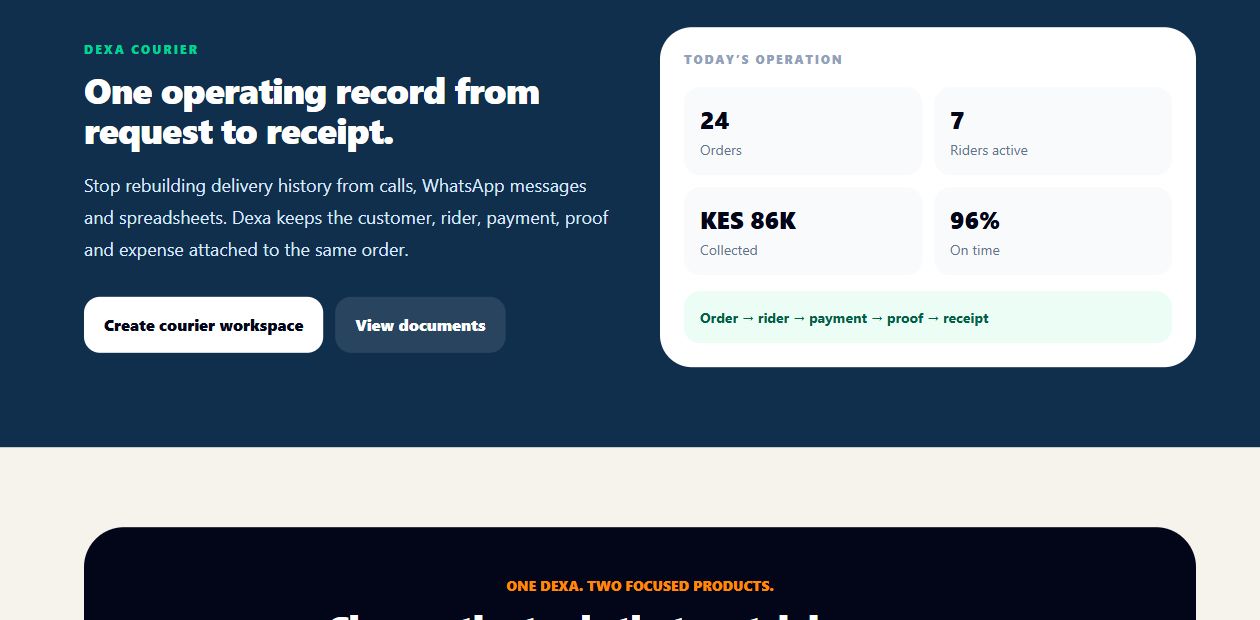
What a courier management system should manage
- Order intake: Customer, pickup, destination, contact, pricing, payment, and instructions.
- Pricing and zones: Distance, weight, service level, and zone-based rates.
- Dispatch and assignment: Assign or reassign to the right rider by zone and capacity.
- Rider tracking: Status from pickup to delivery with clear ownership.
- Proof of delivery: Signature, code, photo, and exceptions attached to the order.
- Payments and COD: Cash, M-Pesa, invoices, receipts, and reconciliation.
- Customer updates: SMS, email, or WhatsApp messages triggered by status.
- Reporting: Volume, on-time performance, failed attempts, collections, and profitability.
Follow one order from request to receipt
The strongest test of a courier system is a single delivery. Capture the request, create the order, assign a rider, update progress, attach proof of delivery, record payment, and produce the receipt or report. Every stage should keep the same reference so nothing is rebuilt.
Then test an exception: reassignment, a failed attempt, a changed destination, a payment difference, or missing proof. Courier operations are defined as much by exceptions as by successful trips.
Proof of delivery closes disputes
A delivery should not be “complete” merely because a rider says so. The right evidence depends on the service: recipient name, signature, one-time code, photo, timestamp, quantities, or an authorised exception. The evidence must stay attached to the order where operations and customer service can retrieve it. Review electronic proof of delivery for the full evidence workflow.
Cash on delivery and M-Pesa reconciliation
Pay-on-delivery is common in Kenya and easy to lose track of. The system should record the amount collected, the method, the reference, and the receipt against the order, then reconcile cash and M-Pesa per rider. Shortages and uncollected orders should surface the same day, not at month end.
Independent riders and courier companies need different tools
An independent rider needs a professional customer channel, repeat-booking workflow, and a clear record of completed work. A courier company needs broader dispatch, staff access, client accounts, order limits, reports, and often API access. Confirm which operating model the software supports before comparing price.
How to compare courier management systems
- Speed: Can riders complete each delivery quickly on a phone?
- Offline support: Does it keep working when the network drops?
- Payments: Are COD and M-Pesa handled and reconciled cleanly?
- Customer communication: Can updates be sent automatically?
- Integrations: Can it connect to e-commerce, accounting, and messaging?
- Plan limits: How do riders, clients, staff, and API limits change with price?
Rollout and adoption
Start with one zone, team, or client group. Train riders on real deliveries and dispatchers on real exceptions. Run the old process alongside the new one briefly, then expand once data quality and adoption are stable.
Frequently asked questions
Can a courier system handle high parcel volumes per rider per day?
Yes, if the mobile flow is designed for speed with minimal typing. Test it with a real rider on a busy route.
Does it support failed attempts and re-delivery?
Good systems record failed attempts with a reason and evidence, then route them into re-delivery or return workflows.
Can customers track their deliveries?
Yes. Status updates can trigger SMS, email, or WhatsApp notifications, and customers can receive a clear reference.
Can it integrate with our online shop?
Where documented APIs exist, orders from e-commerce and other systems can flow into the courier platform automatically.
Next step: review courier dispatch software and the mobility and logistics category, read the Dexa courier case study, and contact Zamacore to scope your courier system.