Staff Attendance System Kenya: Powerful, Cost-Saving Workforce Control Guide for 2026
A staff attendance system Kenya is no longer just a “nice-to-have” HR tool—it has become a financial control system for businesses that want to reduce wage leakages, eliminate manual errors, and monitor workforce productivity in real time. Whether you run a retail shop in Nairobi CBD, a construction company in Kiambu, or a remote field team across counties, the way you track attendance directly affects your monthly payroll accuracy and profitability.
A modern staff attendance system Kenya replaces manual registers and buddy-punching with biometric verification, mobile check-ins, GPS tracking, and cloud dashboards. This shift is not cosmetic—it has measurable financial impact. For example, a company with 25 employees paying an average of KES 25,000 monthly salary is already managing a payroll of KES 625,000 per month. Even a 5% attendance error or time theft gap means KES 31,250 lost monthly, or KES 375,000 annually. A properly implemented staff attendance system Kenya closes that gap almost entirely.
Businesses using digital attendance tools in Kenya are increasingly adopting solutions from platforms like ZamaCore which focus on workforce automation, payroll accuracy, and HR digitization. You can explore more solutions at https://zamacore.com/
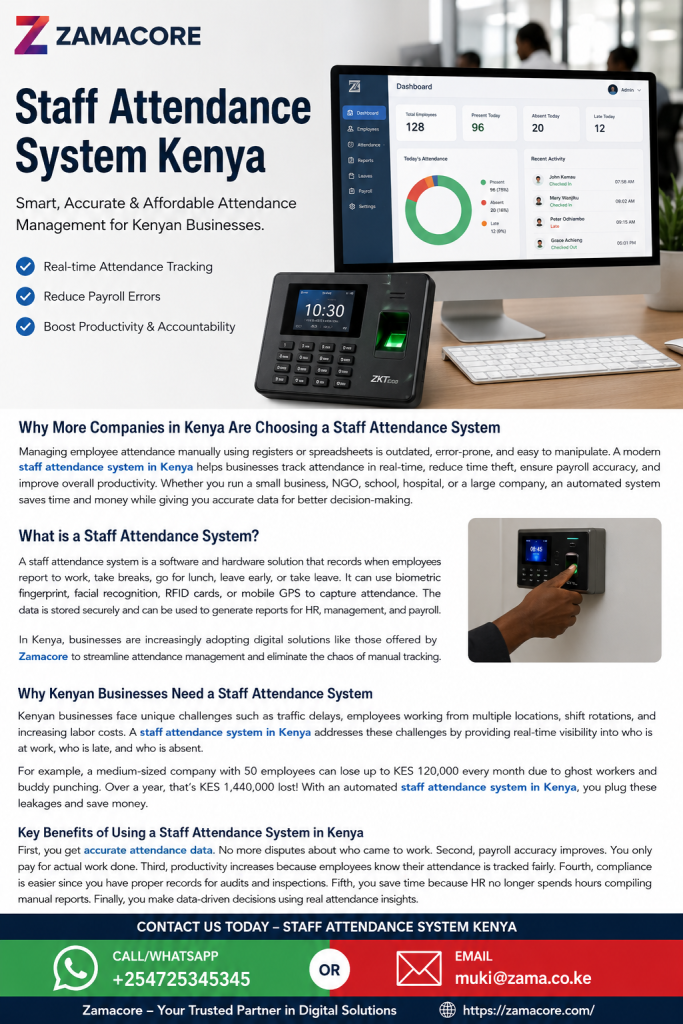
A staff attendance system Kenya also improves compliance with labor reporting requirements and reduces disputes between employers and employees. Instead of arguing over hours worked, managers rely on timestamped, tamper-proof records.
How a Staff Attendance System Kenya Works in Real Business Environments
A staff attendance system Kenya works by capturing employee presence using biometric scanners, mobile apps, RFID cards, or GPS-enabled devices. Each method fits different business environments.
For office staff, biometric fingerprint or facial recognition systems are common. For field teams like sales agents or delivery riders, mobile GPS check-ins are more practical. For hybrid teams, a combination of both is used.
When an employee clocks in, the system records time, location, and identity. This data is instantly sent to a dashboard where HR or management can monitor attendance in real time. A staff attendance system Kenya also integrates with payroll systems, meaning salary calculations are based on verified attendance data, not manual estimates.
For example, if an employee earns KES 1,000 per day and misses 3 undocumented days per month due to manual tracking errors, that is KES 3,000 per employee lost or misallocated monthly. For 20 employees, that becomes KES 60,000 monthly leakage—something a staff attendance system Kenya eliminates.
Many Kenyan SMEs also integrate attendance systems with payroll tools and SaaS platforms such as Zivo / ZChat for internal communication and shift coordination, ensuring attendance data is tied to operational workflows.
Financial Reality: What Businesses Actually Gain
The strongest argument for adopting a staff attendance system Kenya is financial recovery, not just convenience.
Let’s take a realistic SME example:
A logistics company in Nairobi with 40 employees pays an average of KES 30,000 per month. Monthly payroll = KES 1,200,000.
If just 3% inefficiency exists due to inaccurate attendance tracking, time inflation, or buddy punching, that equals KES 36,000 monthly loss. Annually, that is KES 432,000.
Now consider a basic staff attendance system Kenya costing KES 50,000 setup and KES 3,000 monthly maintenance (KES 36,000 annually). Total annual cost = KES 86,000.
Net annual savings = approximately KES 346,000.
This is why businesses increasingly see a staff attendance system Kenya not as an expense, but as a cost-control investment.
Companies also reduce HR administrative workload. A payroll officer who previously spent 2–3 days manually calculating attendance can now complete payroll in hours.
Key Features You Should Expect in a Staff Attendance System Kenya
A professional staff attendance system Kenya should include:
- Biometric or mobile check-in verification
- GPS tracking for field staff
- Shift scheduling and overtime calculation
- Real-time attendance dashboards
- Payroll integration
- Leave management automation
- Exportable HR reports
These features are essential for businesses scaling beyond 10 employees. Without them, attendance tracking becomes inconsistent and vulnerable to manipulation.
Modern platforms like Pawa also extend functionality into digital workforce systems, including WiFi-based authentication and employee network tracking in certain setups.
Real Risks of a Staff Attendance System Kenya (And How to Avoid Them)
While a staff attendance system Kenya is highly beneficial, it is not risk-free if poorly implemented.
One major risk is employee resistance. Staff may feel monitored or distrust biometric systems. This is common in companies transitioning from manual systems. The solution is transparency—clearly communicate that the system protects both employer and employee by ensuring fair pay.
Another risk is system downtime. If the system fails, attendance tracking may be disrupted. Businesses should always choose cloud-based solutions with offline backup modes.
Data privacy is also important. A staff attendance system Kenya collects sensitive biometric or location data. Companies must ensure compliance with data protection laws and use encrypted systems.
Lastly, poor configuration can lead to payroll errors. For example, incorrect overtime rules may inflate wages. Proper setup and training are essential.
Is a Staff Attendance System Kenya Worth It?
Yes—but only when your workforce size and payroll complexity justify it.
For small businesses under 5 employees, manual tracking may still work. However, once you exceed 10–15 employees, the financial leakage from manual systems becomes significant.
A staff attendance system Kenya becomes highly valuable when:
- Employees work shifts
- Field teams are involved
- Overtime is frequent
- Payroll disputes are common
In these cases, the system pays for itself within months.
The honest verdict is simple: if payroll accuracy matters to your business survival, then a staff attendance system Kenya is not optional—it is essential infrastructure.
Implementation Strategy for Kenyan Businesses
Deploying a staff attendance system Kenya should be gradual.
Start with one department before scaling company-wide. Train employees on usage and set clear attendance policies. Ensure HR understands how to interpret reports correctly.
Integration with payroll should be tested for at least one full salary cycle before full rollout.
Companies using solutions from ZamaCore often combine attendance tracking with broader HR systems to ensure smooth workflow automation.
Internal and External Learning Resources
To understand workforce digitization better, you can explore:
- https://www.kra.go.ke
- (Kenya Revenue Authority compliance updates)
- https://www.ilo.org
- (International Labour Organization workforce standards)
- https://www.microsoft.com
- (cloud workforce tools and integration systems)
- https://aws.amazon.com
- (cloud infrastructure supporting HR systems)
- https://www.oracle.com
- (enterprise HR systems)
- https://www.sap.com
- (global HR and payroll automation tools)
- https://zamacore.com
- (Kenyan workforce SaaS solutions)
- https://pawa.co.ke
- (digital business infrastructure systems)
These resources help contextualize how a staff attendance system Kenya fits into global HR technology trends.
FAQ: Staff Attendance System Kenya
1. What is a staff attendance system Kenya used for?
It is used to track employee working hours, reduce payroll errors, and improve workforce accountability.
2. How much does a staff attendance system Kenya cost?
Costs range from KES 30,000 to KES 150,000 depending on features and size of workforce.
3. Can it work for remote employees?
Yes, mobile GPS-based systems are widely used in Kenya for field teams.
4. Does it reduce payroll fraud?
Yes, it significantly reduces buddy punching and manual manipulation of attendance records.
5. Is it suitable for small businesses?
Yes, especially once staff numbers exceed 10 employees.
Scaling a Staff Attendance System Kenya Across Growing Businesses
As a business grows, the complexity of managing employees increases exponentially. A staff attendance system Kenya becomes more valuable not just for tracking time, but for standardizing operations across departments, branches, and even counties.
Consider a retail business expanding from one shop in Nairobi to five branches across Nairobi, Mombasa, and Kisumu. Without a centralized attendance system, each branch manager may maintain separate records, often in inconsistent formats. This leads to payroll disputes, inflated overtime claims, and lack of visibility at head office level.
With a properly deployed staff attendance system Kenya, all branches feed data into a single dashboard. Management can instantly compare attendance patterns across locations. For example, if Branch A consistently reports 98% attendance while Branch B reports 85%, leadership can investigate operational inefficiencies or staffing issues.
This visibility translates directly into cost control. If each branch employs 12 staff at an average salary of KES 28,000, each branch represents KES 336,000 monthly payroll. Across 5 branches, that is KES 1,680,000 monthly payroll exposure. Even a 4% inconsistency in attendance reporting equals KES 67,200 monthly risk exposure—money that a staff attendance system Kenya helps recover or prevent from leaking.
Businesses that scale successfully often integrate attendance systems with broader platforms such as Pawa for digital infrastructure and centralized management, ensuring systems grow alongside operations rather than breaking under scale.
Industry-Specific Use Cases of Staff Attendance System Kenya
A staff attendance system Kenya is not a one-size-fits-all tool. Its value varies depending on industry application.
In construction companies, workers often operate at different sites daily. Manual attendance tracking leads to inflated labor claims or unverified overtime. A mobile GPS-enabled staff attendance system Kenya ensures workers are physically present at the designated site before clock-in is accepted.
For example, if a construction firm employs 50 workers paid KES 1,200 per day, total daily labor cost is KES 60,000. If only 2 workers falsely claim attendance for 10 days a month, that is KES 24,000 monthly loss. A system that validates presence reduces or eliminates this leakage entirely.
In hospitality businesses such as hotels and restaurants, shift rotation is frequent. A staff attendance system Kenya ensures accurate tracking of morning, afternoon, and night shifts, preventing double claims or unauthorized overtime.
In schools and educational institutions, attendance systems help track both staff and auxiliary workers like cleaners and support staff. Integration with payroll ensures that part-time and full-time staff are compensated correctly.
In logistics and delivery companies, real-time tracking is critical. A staff attendance system Kenya ensures that drivers and riders are logged in before dispatch, reducing idle time and improving delivery efficiency.
Each of these industries benefits differently, but the underlying financial logic remains the same: reduce time leakage, improve accountability, and increase payroll accuracy.
Integration With Payroll and HR Systems
A major strength of a staff attendance system Kenya is its ability to integrate with payroll systems. Without integration, attendance data still requires manual transfer, which reintroduces errors.
Integrated systems automatically convert attendance data into salary calculations. For example:
- Hours worked
- Overtime hours
- Late arrivals
- Early departures
All of these are converted into payroll inputs.
Let’s assume an employee earns KES 500 per hour. If the system records 160 hours in a month instead of manually estimated 170 hours, the difference is 10 hours or KES 5,000. Across 30 employees, that is KES 150,000 monthly accuracy improvement.
This is where a staff attendance system Kenya transitions from a tracking tool into a financial control system.
Modern Kenyan businesses are increasingly pairing attendance systems with HR automation platforms like Zivo / ZChat for communication workflows, ensuring that attendance updates trigger notifications, shift changes, and HR approvals automatically.
Behavioral Impact on Employees
One of the most overlooked benefits of a staff attendance system Kenya is behavioral change.
When employees know attendance is tracked digitally and transparently, punctuality improves naturally. This reduces lateness-related productivity loss.
For instance, if a company has 20 employees and each arrives 15 minutes late daily, that is 5 hours of lost productivity per day. At an average productivity cost of KES 300 per hour, that equals KES 1,500 daily loss or KES 45,000 monthly loss.
After implementing a staff attendance system Kenya, lateness typically reduces significantly due to accountability.
Additionally, employees feel more fairly treated. Instead of subjective manual attendance records, they rely on transparent digital logs. This reduces HR disputes and improves workplace trust.
Advanced Analytics and Decision-Making
A modern staff attendance system Kenya does more than track attendance—it generates analytics that inform business decisions.
These analytics include:
- Peak absenteeism days
- Departmental attendance trends
- Overtime cost breakdowns
- Productivity vs attendance correlation
For example, if a business notices that absenteeism spikes every Monday, management can investigate operational causes such as scheduling issues or employee fatigue.
If overtime costs consistently exceed KES 80,000 monthly, leadership can decide whether to hire additional staff or redistribute workloads.
Without a staff attendance system Kenya, these insights remain hidden, and decisions are made blindly.
Over time, businesses using attendance analytics often reduce labor inefficiencies by 10%–20%, which directly improves profitability.
Common Mistakes Businesses Make
Despite its benefits, many businesses fail to fully benefit from a staff attendance system Kenya due to implementation mistakes.
One major mistake is overcomplicating the rollout. Introducing too many features at once confuses employees and HR staff. The best approach is phased adoption.
Another mistake is ignoring training. Employees must understand how to use biometric or mobile systems properly. Without training, false absences or missed clock-ins can occur.
Some businesses also fail to define clear attendance policies. A staff attendance system Kenya is only as effective as the rules behind it. For example, defining grace periods, overtime thresholds, and break policies is essential.
Lastly, some companies choose systems based only on price rather than scalability. A cheap system may fail under growing workforce demands, leading to future migration costs.
Long-Term ROI of a Staff Attendance System Kenya
The long-term return on investment of a staff attendance system Kenya is often underestimated.
Beyond direct payroll savings, businesses gain:
- Reduced HR workload
- Faster payroll processing
- Lower dispute resolution costs
- Improved employee discipline
- Better compliance records
If we quantify HR time savings alone:
A payroll officer earning KES 50,000 monthly who saves 40% of their time due to automation effectively frees KES 20,000 worth of productivity monthly.
Combined with payroll accuracy improvements, most businesses recover their investment in a staff attendance system Kenya within 3–6 months.
Over 3 years, the cumulative savings can exceed KES 1 million for medium-sized companies.
Future of Staff Attendance System Kenya
The future of workforce management in Kenya is moving toward AI-driven automation.
A staff attendance system Kenya will soon include predictive analytics such as:
- Predicting absenteeism risk
- Identifying burnout patterns
- Suggesting optimal staffing levels
- Automating shift allocation
Integration with AI-based HR platforms will further reduce manual intervention.
Companies like ZamaCore are already moving toward ecosystem-based HR systems where attendance, payroll, communication, and performance are fully interconnected.
This means that in the near future, attendance systems will not just track employees—they will actively optimize workforce efficiency.
Final Extended Verdict
A staff attendance system Kenya is no longer optional for serious businesses aiming to scale efficiently. It is a foundational layer of operational control that directly influences profitability.
The real value is not in tracking time—it is in controlling payroll leakage, improving discipline, and enabling data-driven decisions.
Businesses that delay adoption often end up spending more later on correcting payroll inefficiencies than they would have spent implementing a system early.
Final CTA
If your business is still relying on manual registers or unverified spreadsheets, you are likely already losing money every month without realizing it.
Upgrade to a modern staff attendance system Kenya today and bring full control to your workforce operations: