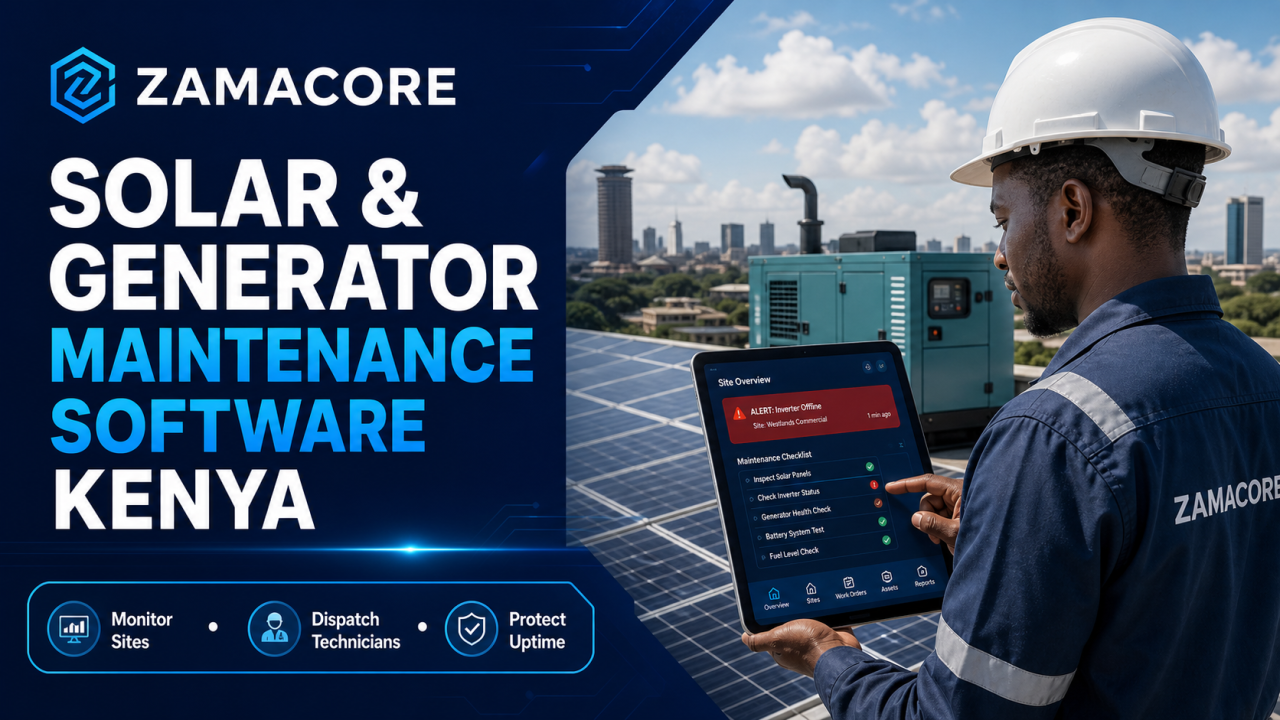
Solar Maintenance Software Kenya gives solar EPCs, generator dealers, energy-service companies, estates and organisations with distributed backup power one controlled way to replace installation sheets, WhatsApp fault reports and separate technician records. The purchase is justified when the platform shortens response time, prevents leakage, protects customer trust, and gives managers evidence they can act on.
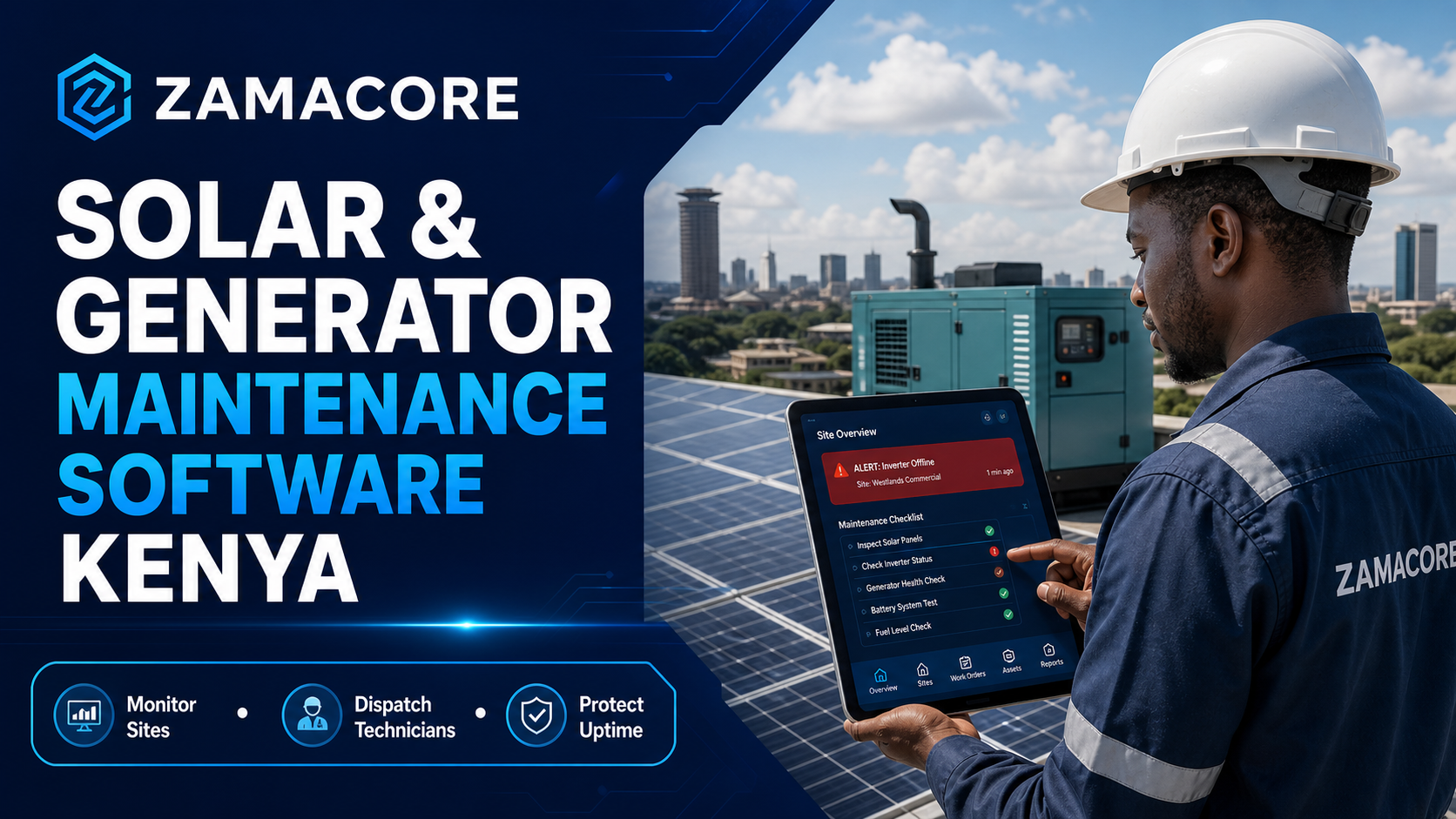
Energy-service companies support equipment distributed across many customer sites. Profit depends on preventing failure, arriving with the right skills and parts, and proving contract work clearly.
The daily operating problem
A site may contain panels, inverters, batteries, controllers, generators, ATS equipment and meters supplied at different times. Without one asset and service record, teams repeat diagnosis and cannot connect recurring alarms to installation, environment, usage or component history.
Delayed response causes downtime and lost customer confidence. Uncontrolled fuel, batteries, parts and technician travel erode maintenance-contract margin.
Warning signs the current process has outgrown spreadsheets and messaging apps
- Site equipment and warranty details are incomplete.
- Preventive visits depend on personal reminders.
- Technicians travel without fault codes, manuals or compatible parts.
- Generator fuel and runtime records cannot be reconciled.
- Battery or inverter replacements lack serial-number history.
- Customers dispute whether contracted service was completed.
These symptoms should be measured before software is selected. The baseline makes it possible to distinguish a genuine operational improvement from a system that merely digitises the same delays.
How the complete workflow should operate
Commission the site
Register customer, coordinates, system design, assets, serial numbers, warranties, settings and baseline readings.
Schedule planned service
Create inspection, cleaning, testing, oil, filter, battery and safety tasks by time or runtime.
Receive alarms and faults
Capture symptoms or monitoring alerts, assess severity and check history before dispatch.
Complete and evidence work
Record readings before and after, actions, parts, photographs, signatures and recommendations.
Report performance
Provide customer service reports, open risks, SLA performance, energy or runtime trends and renewal needs.
Essential capabilities buyers should compare
- Customer site and energy-asset registry
- Commissioning and warranty records
- Preventive maintenance calendars and checklists
- Alarm, fault and breakdown ticketing
- Technician skills, dispatch and mobile job cards
- Generator runtime, fuel and service consumption
- Solar readings, battery health and inverter history
- Parts, serial-number replacement and warranty claims
- Customer portal, service reports and approvals
- SLA, contract profitability and renewal dashboard
Every capability must have a named user, a rule, an exception path, an accountable owner and a measurable result. A feature that cannot be demonstrated using a realistic transaction should not determine the purchasing decision.
Who should use the system?
Operations monitors sites; dispatch assigns technicians; engineers diagnose; technicians capture readings; stores supplies compatible parts; customers approve access and completion; contract managers review SLAs and renewals.
Management dashboards that support decisions
Track sites offline, critical alarms, planned visits due, response and restoration time, recurring faults, fuel variance, battery and component replacements, parts availability, contract cost and customer reports awaiting issue.
Summary figures should drill down to the responsible branch, customer, supplier, asset, job, document or user. Reports without traceable source records create arguments instead of accountability.
Integrations to plan early
Integrate remote monitoring where vendors expose supported interfaces, plus inventory, field service, accounting, M-Pesa and customer portals. Monitoring data needs alarm ownership and response rules.
Integration discovery must identify the master system for each record, supported interfaces, validation rules, duplicate prevention, failure alerts and reconciliation. A live API demonstration is more reliable than a general promise that two platforms can connect.
Mobile and offline requirements
Mobile forms must work at rooftops, rural installations and generator rooms with weak connectivity. They should compress photographs and preserve measurements safely.
Security, permissions and audit trail
Access should follow responsibility and location. The platform should record creation, assignment, approval, changes, cancellation, completion and export of sensitive records. High-risk actions may require a second approval. Backups, recovery tests, secure connections, device and session controls, and staff-exit procedures belong in the implementation plan.
Software can support organisational policy, but it does not automatically guarantee legal, tax, privacy, health, employment or sector compliance. The client should confirm applicable requirements with qualified advisers and translate them into testable controls.
A practical implementation roadmap
- Baseline: measure the present delay, error, cost, leakage, complaints and reporting effort.
- Discovery: observe real users, documents, approvals, exceptions and hand-offs.
- Scope: select one complete, high-value workflow for the first release.
- Data: clean the customer, supplier, asset, item, employee, project or location records needed by that workflow.
- Prototype: validate screens, terminology and permissions with daily users.
- Pilot: launch with one branch, team, customer group, route or project.
- Review: compare results with the baseline and correct adoption or process gaps.
- Roll out: expand only after the first operating unit can complete the workflow reliably.
How to measure return on investment
- Preventive visits completed on time
- Alarm-to-acknowledgement and restoration time
- Repeat fault rate
- Generator fuel variance and runtime per service
- Component replacements under warranty
- Technician travel and first-time-fix rate
- Maintenance contract gross margin
Time saved is useful, but the commercial case should also calculate revenue accelerated, repeat work avoided, stock or asset losses prevented, downtime reduced, customer retention protected and management decisions made earlier.
Questions to ask shortlisted software companies
- Can the system represent multi-component solar and generator sites?
- How are vendor-specific alarms and fault codes handled?
- Can checklists change by model and service type?
- How are readings validated and compared with the previous visit?
- Can serial-number replacements trigger warranty workflows?
- Will customers receive branded service and SLA reports?
Target keyword coverage for this solution
The following searches describe related parts of the same buyer journey. They belong on one authoritative page instead of being divided into thin, competing articles.
- Generator Maintenance Management System Kenya — a buyer-intent phrase covered by this complete solution
- Solar Installation Management Software Kenya — a buyer-intent phrase covered by this complete solution
- Solar Maintenance Software Kenya — a buyer-intent phrase covered by this complete solution
Build this system with ZamaCore
ZamaCore develops ERP modules, operational portals, mobile workflows, dashboards, automation and integrations for Kenyan organisations. We begin with the business loss or service problem, then define the smallest complete workflow capable of producing a measurable result.
Explore our custom software development and ERP solutions, or request a workflow assessment. Bring representative forms, reports, spreadsheets and approval steps so the first discussion focuses on the real operation.
Frequently asked questions
Can ZamaCore provide a price before discovery?
A preliminary range may be possible, but a responsible proposal requires users, locations, workflows, data, integrations, security, acceptance tests and support expectations.
Should the organisation implement every module immediately?
No. A controlled pilot limits disruption and produces evidence before wider investment.
Can the system integrate with accounting, ERP, M-Pesa or existing portals?
Often yes, subject to supported interfaces, account access, data ownership, security and reconciliation requirements.
What causes operational software projects to fail?
Common causes include unclear ownership, copying a broken process, poor data, weak user involvement, uncontrolled scope, inadequate testing and no post-launch support plan.