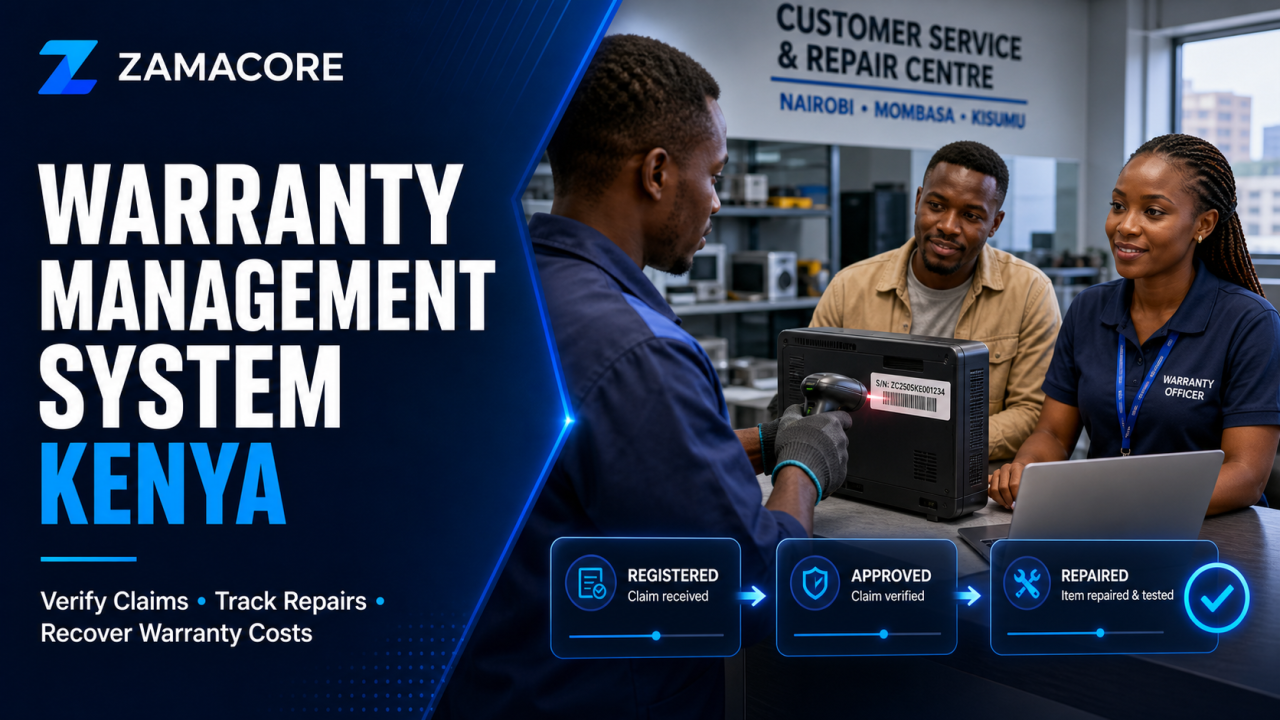
Warranty Management System Kenya gives manufacturers, importers, distributors, dealers and service centres one controlled way to replace paper warranty cards, disconnected repair logs and informal approvals. The purchase is justified when the platform shortens response time, prevents leakage, protects customer trust, and gives managers evidence they can act on.
A warranty promise becomes expensive when the seller cannot confirm eligibility, retrieve product history, control parts or recover valid costs from a manufacturer. The customer experiences delay while departments debate responsibility.
The daily operating problem
A customer may present a receipt, serial number or warranty card, but the distributor cannot see the sale, installation, prior repair or authorised service provider. A product moves between dealer, workshop and supplier without one case record.
Businesses approve ineligible claims, reject valid customers, lose defective units, consume parts without recovery and miss recurring product faults that purchasing teams should see.
Warning signs the current process has outgrown spreadsheets and messaging apps
- Warranty eligibility depends on finding a paper receipt.
- The same serial number can appear in unrelated repair records.
- Dealers promise replacements without an authorised decision.
- Defective products move without custody evidence.
- Technician labour and parts are not attached to a claim.
- Supplier reimbursement claims are submitted late or incompletely.
These symptoms should be measured before software is selected. The baseline makes it possible to distinguish a genuine operational improvement from a system that merely digitises the same delays.
How the complete workflow should operate
Register the product
Capture serial number, model, sale, customer, dealer, installation and warranty terms.
Open and validate the claim
Record symptoms and evidence, then check dates, exclusions, ownership and previous service.
Diagnose and authorise
Assign an approved technician or centre, capture diagnosis and approve repair, replacement, rejection or paid service.
Control parts and custody
Track defective units, replacement units, parts, movement, return-to-vendor and disposal.
Close and recover cost
Notify the customer, capture acceptance and prepare manufacturer or supplier recovery evidence.
Essential capabilities buyers should compare
- Serial-number and product registration
- Configurable warranty terms and eligibility rules
- Customer, dealer and service-centre claim portals
- Diagnostic checklist and evidence attachments
- Repair, replacement, rejection and goodwill approval
- Technician, workshop and turnaround tracking
- Spare-parts consumption and defective-unit custody
- Supplier recovery and reimbursement files
- Customer notifications and escalation
- Failure-rate, cost and model-quality analytics
Every capability must have a named user, a rule, an exception path, an accountable owner and a measurable result. A feature that cannot be demonstrated using a realistic transaction should not determine the purchasing decision.
Who should use the system?
Customer care opens claims; warranty officers validate coverage; technicians diagnose; stores controls parts and units; managers approve exceptions; finance tracks recovery; product teams analyse failure patterns.
Management dashboards that support decisions
Monitor open claims by age, eligibility outcome, repair turnaround, parts delay, repeat failure, cost per model, dealer performance, supplier recovery and customer acceptance.
Summary figures should drill down to the responsible branch, customer, supplier, asset, job, document or user. Reports without traceable source records create arguments instead of accountability.
Integrations to plan early
Integrate POS or ERP sales records, product and serial masters, service jobs, parts inventory, supplier records, accounting and customer messaging.
Integration discovery must identify the master system for each record, supported interfaces, validation rules, duplicate prevention, failure alerts and reconciliation. A live API demonstration is more reliable than a general promise that two platforms can connect.
Mobile and offline requirements
Customer and technician forms should capture photographs, serial numbers, documents and signatures reliably on ordinary phones while protecting personal data.
Security, permissions and audit trail
Access should follow responsibility and location. The platform should record creation, assignment, approval, changes, cancellation, completion and export of sensitive records. High-risk actions may require a second approval. Backups, recovery tests, secure connections, device and session controls, and staff-exit procedures belong in the implementation plan.
Software can support organisational policy, but it does not automatically guarantee legal, tax, privacy, health, employment or sector compliance. The client should confirm applicable requirements with qualified advisers and translate them into testable controls.
A practical implementation roadmap
- Baseline: measure the present delay, error, cost, leakage, complaints and reporting effort.
- Discovery: observe real users, documents, approvals, exceptions and hand-offs.
- Scope: select one complete, high-value workflow for the first release.
- Data: clean the customer, supplier, asset, item, employee, project or location records needed by that workflow.
- Prototype: validate screens, terminology and permissions with daily users.
- Pilot: launch with one branch, team, customer group, route or project.
- Review: compare results with the baseline and correct adoption or process gaps.
- Roll out: expand only after the first operating unit can complete the workflow reliably.
How to measure return on investment
- Claim acknowledgement and closure time
- Valid claims approved correctly
- Repeat failure within warranty
- Parts and labour cost per model
- Defective units with complete custody
- Supplier recovery percentage and age
- Customer complaints after closure
Time saved is useful, but the commercial case should also calculate revenue accelerated, repeat work avoided, stock or asset losses prevented, downtime reduced, customer retention protected and management decisions made earlier.
Questions to ask shortlisted software companies
- How are different products, dealers and warranty terms configured?
- Can eligibility use verified sales and installation records?
- How are lost receipts or transferred ownership handled?
- Can defective and replacement units be traced physically?
- Does the system produce supplier recovery evidence?
- Can product managers identify recurring failure patterns?
Target keyword coverage for this solution
The following searches describe related parts of the same buyer journey. They belong on one authoritative page instead of being divided into thin, competing articles.
- Warranty Management System Kenya — a buyer-intent phrase covered by this complete solution
- Warranty Claim Management Software Kenya — a buyer-intent phrase covered by this complete solution
- After-Sales Service Management Software Kenya — a buyer-intent phrase covered by this complete solution
- Product Repair Tracking System Kenya — a buyer-intent phrase covered by this complete solution
Build this system with ZamaCore
ZamaCore develops ERP modules, operational portals, mobile workflows, dashboards, automation and integrations for Kenyan organisations. We begin with the business loss or service problem, then define the smallest complete workflow capable of producing a measurable result.
Explore our custom software development and ERP solutions, or request a workflow assessment. Bring representative forms, reports, spreadsheets and approval steps so the first discussion focuses on the real operation.
Frequently asked questions
Can ZamaCore provide a price before discovery?
A preliminary range may be possible, but a responsible proposal requires users, locations, workflows, data, integrations, security, acceptance tests and support expectations.
Should the organisation implement every module immediately?
No. A controlled pilot limits disruption and produces evidence before wider investment.
Can the system integrate with accounting, ERP, M-Pesa or existing portals?
Often yes, subject to supported interfaces, account access, data ownership, security and reconciliation requirements.
What causes operational software projects to fail?
Common causes include unclear ownership, copying a broken process, poor data, weak user involvement, uncontrolled scope, inadequate testing and no post-launch support plan.
Additional operational requirement
- Appliance Repair Management Software Kenya — this requirement is addressed by the workflow and controls described in this guide.