GPS Attendance App Kenya: Powerful Smart Workforce Tracking Solution for 2026 Growth & Cost Savings
A gps attendance app Kenya is quickly becoming one of the most practical workforce management tools for businesses that rely on field teams, mobile employees, delivery staff, and remote workers. Unlike traditional clock-in systems that depend on manual entry or biometric devices fixed in one location, GPS-based attendance verifies where an employee actually is when marking attendance. This removes guesswork and reduces payroll fraud, which is one of the biggest hidden costs in many Kenyan businesses.
The demand for a gps attendance app Kenya has grown because companies are under pressure to control operational costs while improving accountability. In industries like construction, logistics, cleaning services, security companies, sales teams, and NGO field operations, salary leakage can silently consume between 3% and 12% of monthly payroll if attendance tracking is weak. For example, a company paying a combined monthly wage bill of KES 2,000,000 could lose between KES 60,000 and KES 240,000 monthly due to inaccurate attendance reporting, buddy punching, or manual manipulation.
A modern gps attendance app Kenya solves this problem by combining mobile GPS tracking, geofencing, and real-time dashboards. This ensures that attendance is not just recorded, but verified with location proof. Solutions like those built into modern SaaS platforms such as https://zamacore.com
are increasingly being adopted by Kenyan SMEs and mid-sized companies because they reduce administrative overhead while improving transparency.
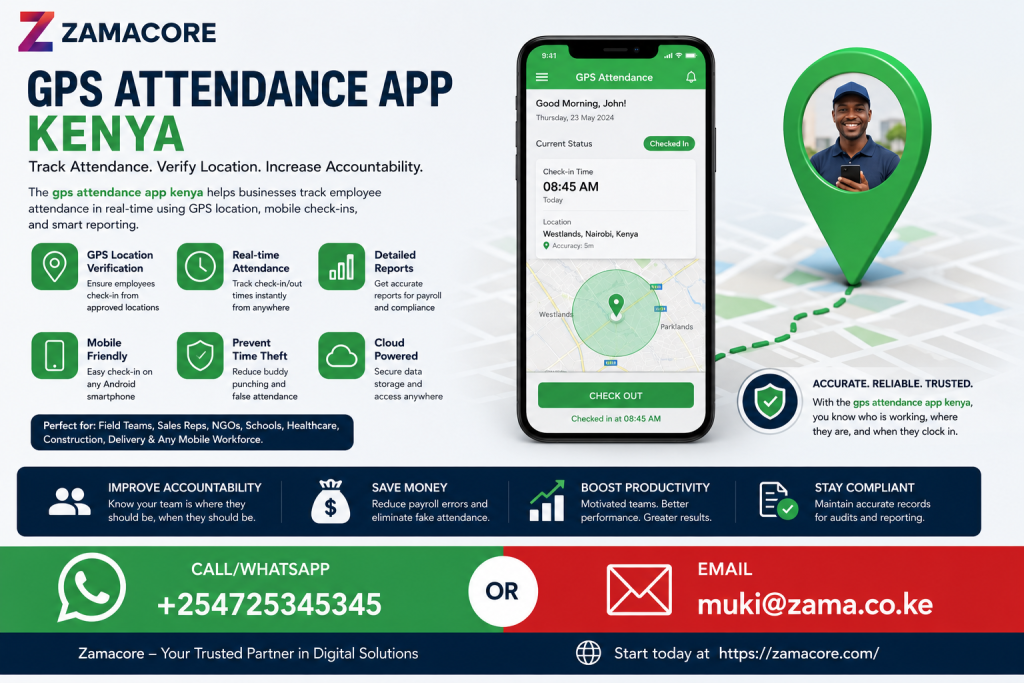
How a GPS Attendance App Kenya Actually Works in Real Business Environments
A gps attendance app Kenya works by using a mobile device’s GPS signal to confirm an employee’s physical location at the time of clock-in and clock-out. Employers can set predefined “allowed zones” such as offices, construction sites, client locations, or delivery routes. If an employee attempts to clock in outside these zones, the system automatically flags or rejects the entry.
For instance, a sales company with 20 field agents might previously rely on manual WhatsApp check-ins. If even 15% of those entries are inaccurate or delayed, supervisors end up approving incorrect attendance records. If each agent earns KES 40,000 monthly, that’s KES 800,000 total payroll exposure. A gps attendance app Kenya reduces this risk by enforcing real-time location verification, ensuring only legitimate work hours are recorded.
Modern systems also include offline syncing. This is important in rural Kenya where internet coverage is inconsistent. Employees can still clock in, and the gps attendance app Kenya syncs data once the device reconnects. This prevents data loss while maintaining accuracy.
Business Value: Real KES-Based Impact of GPS Attendance App Kenya
One of the biggest advantages of a gps attendance app Kenya is cost control. Let’s take a cleaning company with 50 employees earning an average of KES 18,000 monthly. That’s a payroll of KES 900,000 per month.
If manual attendance errors or false reporting inflate payroll by just 5%, the company loses KES 45,000 monthly or KES 540,000 annually. A properly configured gps attendance app Kenya can reduce this leakage to under 1%, saving around KES 360,000 per year.
Another example is a delivery company operating 30 riders. If each rider completes 8 trips daily, but only 7 are actually completed, the missing trip per rider represents lost revenue. At KES 150 per delivery, that is:
- 30 riders × 1 missing trip × 150 KES × 26 working days = KES 117,000 monthly loss
A gps attendance app Kenya does not directly track deliveries, but it ensures rider presence and route compliance, which reduces ghost activity and improves operational efficiency.
Key Features of a Modern GPS Attendance App Kenya
A high-quality gps attendance app Kenya is not just a clock-in tool. It is a workforce intelligence system that includes multiple layers of verification and analytics.
First, geofencing allows businesses to define exact working zones. For example, a security company can restrict guards to specific building locations. If a guard leaves the designated zone, the system can alert supervisors instantly.
Second, real-time dashboards help HR managers monitor attendance across multiple locations. Instead of waiting for end-of-month reports, decisions can be made instantly.
Third, automated payroll integration reduces human error. A gps attendance app Kenya can feed accurate attendance data into payroll systems, eliminating manual spreadsheet calculations that often cause salary disputes.
Platforms like https://zamacore.com
also integrate attendance data with broader HR systems such as leave tracking, performance monitoring, and shift scheduling, making them more powerful than standalone apps.
Risks of Using GPS Attendance App Kenya and How to Manage Them
Even though a gps attendance app Kenya provides strong benefits, it is not risk-free. One of the main risks is privacy concerns among employees. Some staff may feel that GPS tracking is excessive surveillance. This can reduce morale if not communicated properly. The solution is transparency: companies should clearly explain what is tracked, when tracking is active, and how data is used strictly for work purposes.
Another risk is GPS spoofing, where technically skilled users attempt to fake their location. While modern gps attendance app Kenya solutions use anti-spoofing mechanisms, businesses should still combine GPS verification with additional checks such as selfie verification or device binding.
Battery consumption is another concern. Continuous GPS usage can drain mobile devices faster, especially for field workers. A well-designed system optimizes tracking intervals to balance accuracy and battery usage.
Is GPS Attendance App Kenya Worth It?
From a business perspective, a gps attendance app Kenya is worth it when workforce mobility and payroll size reach a point where manual tracking becomes unreliable. For small teams under 5 employees working in one office, the benefit may be limited. However, once a company grows beyond 10–15 employees with field operations, the return on investment becomes clear.
If a business spends KES 20,000–KES 50,000 monthly on a quality system but saves even KES 100,000–KES 300,000 in payroll leakages and inefficiencies, the system pays for itself within the first month of correction. That is why many SMEs in Kenya are shifting toward digital workforce systems like those offered at https://zamacore.com
.
External References for Workforce Management Standards
To understand global best practices behind a gps attendance app Kenya, it is useful to look at international standards and documentation:
- https://www.iso.org
- (workforce and data standards)
- https://www.shrm.org
- (HR management practices)
- https://www.oracle.com/human-capital-management/
https://www.microsoft.com/en-us/microsoft-365/business
These references show how workforce tracking is evolving globally toward automation and data-driven HR systems.
Advanced Use Cases of a GPS Attendance App Kenya in Real Businesses
As companies scale, a gps attendance app Kenya stops being just an attendance tracker and becomes a full workforce intelligence system. The real value appears when businesses begin to integrate location data with operational performance.
For example, a mid-sized logistics company in Nairobi with 40 drivers may previously rely on dispatch call logs and WhatsApp confirmations. This system often leads to inconsistencies, such as drivers reporting completed deliveries while still en route. If even 10% of deliveries are misreported and each delivery is worth KES 180, the monthly leakage can exceed KES 86,000. A properly deployed gps attendance app Kenya reduces this by verifying physical presence at delivery zones before marking tasks as complete.
Another example is a field marketing agency managing brand promoters across supermarkets. If 25 promoters are paid KES 1,500 per day, the daily payroll is KES 37,500. Over a 26-day month, that is KES 975,000. If just 5 promoters fail to report correctly but still get paid, the company loses KES 7,500 daily or KES 195,000 monthly. A gps attendance app Kenya ensures promoters must physically check in at assigned store locations before payroll is approved.
These real-world applications show that GPS-based systems are not theoretical tools but practical financial control mechanisms.
How GPS Attendance App Kenya Improves Payroll Accuracy
Payroll errors are one of the most expensive hidden problems in SMEs. A gps attendance app Kenya reduces these errors by removing manual calculations and replacing them with automated tracking.
Consider a company with 60 employees earning an average salary of KES 25,000. Monthly payroll equals KES 1,500,000. If manual attendance errors lead to just 3% overpayment, the business loses KES 45,000 monthly or KES 540,000 annually.
In many Kenyan businesses, overtime abuse is also common. Employees may inflate overtime hours when supervisors are not physically present. A gps attendance app Kenya solves this by logging:
- Exact clock-in time
- Exact clock-out time
- GPS location during shift
- Movement history during working hours
This ensures overtime claims are backed by real activity, not estimates.
Platforms like https://zamacore.com
integrate these features into broader workforce management systems, ensuring payroll is directly tied to verified attendance data.
Productivity Improvements from GPS Attendance App Kenya
Beyond payroll savings, productivity improvements are a major benefit of a gps attendance app Kenya. When employees know their location is being verified, discipline naturally improves.
A cleaning company with 30 staff members previously reported frequent late arrivals. On average, each employee lost 20 minutes daily due to lateness or unstructured reporting. That equals 600 lost minutes daily across the team, or 10 working hours.
If the business values an hour of labor at KES 200, the daily loss is KES 2,000, translating to KES 52,000 monthly. After implementing a gps attendance app Kenya, lateness reduced significantly because employees were required to check in within geofenced zones.
Another productivity gain comes from reduced supervisor workload. Instead of physically verifying attendance across multiple sites, managers can use dashboards to confirm staff presence in real time. This can save 2–3 hours daily for supervisors, which translates into better resource allocation and reduced management fatigue.
Integration of GPS Attendance App Kenya with HR Systems
A modern gps attendance app Kenya is not a standalone tool. It integrates with broader HR ecosystems including payroll systems, leave management tools, and performance tracking systems.
For example, when integrated with payroll, attendance data automatically calculates:
- Total hours worked
- Late deductions
- Overtime payments
- Absenteeism penalties
This eliminates the need for manual spreadsheet handling, which is often prone to human error.
If a payroll officer spends 10 hours per month correcting attendance sheets and earns KES 60,000 monthly, that is approximately KES 3,000 worth of time spent on manual correction. A gps attendance app Kenya reduces this to near zero by automating the entire process.
Integration also helps HR departments identify long-term patterns such as chronic lateness, absenteeism trends, and departmental inefficiencies.
Industry-Specific Value of GPS Attendance App Kenya
Different industries experience different levels of value from a gps attendance app Kenya.
In construction, workers are spread across multiple sites. A contractor managing 100 workers across 5 locations can lose significant time verifying attendance manually. If supervisors spend 1 hour per site daily, that is 5 hours of administrative overhead. At KES 300 per hour supervisory cost, that equals KES 1,500 daily or KES 39,000 monthly wasted time.
In retail chains, store managers often manipulate attendance logs for casual staff. A gps attendance app Kenya ensures staff are physically present at specific branch locations before marking attendance.
In NGOs, field officers reporting from rural areas often lack proper accountability systems. GPS verification ensures donor funds are tied to real field activity, improving compliance and reporting accuracy.
Risks and Limitations of GPS Attendance App Kenya (Deeper Analysis)
While earlier risks were discussed, it is important to go deeper into operational and technical limitations of a gps attendance app Kenya.
One major limitation is GPS signal drift in dense urban environments. In areas like Nairobi CBD with tall buildings, GPS accuracy may vary by 10–30 meters. This can sometimes incorrectly flag employees as outside geofenced zones. The mitigation strategy is to use hybrid tracking systems combining GPS, Wi-Fi positioning, and mobile tower triangulation.
Another limitation is device dependency. A gps attendance app Kenya relies on employee smartphones. If a device is lost, damaged, or switched off, attendance gaps may occur. Businesses should implement backup verification methods such as supervisor approval workflows or secondary login devices.
There is also the risk of data overload. Large organizations may generate thousands of location logs daily, making analysis complex. This is why cloud-based dashboards are essential for filtering actionable insights instead of raw data overload.
Cost vs Benefit Analysis of GPS Attendance App Kenya
To understand financial impact, consider a business with 100 employees and a monthly payroll of KES 3,000,000.
If inefficiencies such as:
- Late arrivals
- Fake overtime
- Buddy punching
- Absenteeism
- Manual reporting errors
cause just a 4% loss, the business loses KES 120,000 monthly.
If a gps attendance app Kenya costs KES 150 per employee per month, total cost is:
100 × 150 = KES 15,000 monthly
Even if implementation and training cost an additional KES 50,000 upfront, the system pays for itself in less than 2 months if it prevents payroll leakage of KES 120,000 monthly.
This is why adoption is increasing rapidly across Kenyan SMEs.
Future of Workforce Tracking and GPS Attendance App Kenya
The future of gps attendance app Kenya systems is moving toward AI-driven workforce optimization. Instead of just tracking location, future systems will predict productivity patterns, recommend shift changes, and automatically optimize workforce allocation.
We are already seeing early versions of this in SaaS ecosystems like https://zamacore.com
, where attendance data feeds into broader operational intelligence systems.
In the next few years, businesses will move from reactive attendance tracking to predictive workforce management, where systems anticipate staffing shortages and automatically adjust schedules.
Final Verdict on GPS Attendance App Kenya
A gps attendance app Kenya is one of the most practical digital transformations a business can implement today. It directly impacts payroll accuracy, operational efficiency, and workforce accountability.
While it requires proper onboarding, employee communication, and system configuration, the financial benefits far outweigh the costs for most medium and large teams.
For businesses struggling with attendance disputes, payroll inconsistencies, or field workforce management challenges, adopting a gps attendance app Kenya is not just beneficial—it is becoming essential.
To implement a scalable solution tailored for Kenyan businesses, platforms like https://zamacore.com
FAQ
1. Is GPS attendance legal in Kenya?
Yes, it is legal as long as employees are informed and data is used for workplace management.
2. Does a gps attendance app Kenya work without internet?
Yes, most systems store data offline and sync when connectivity is restored.
3. Can employees fake GPS location?
Some can attempt it, but modern systems use anti-spoofing and device verification to reduce fraud.
4. What industries benefit most?
Construction, logistics, security, field sales, cleaning services, and NGOs benefit the most.
5. How much does it cost?
Depending on features, most systems range from KES 50–KES 300 per employee per month.
Conclusion
A gps attendance app Kenya is no longer a luxury tool but a practical necessity for companies managing mobile or distributed teams. It reduces payroll leakage, improves accountability, and provides real-time visibility into workforce activity. While there are risks such as privacy concerns and system misuse, these can be managed with proper policies and the right technology setup.
Businesses that adopt a gps attendance app Kenya early gain a competitive advantage through better cost control and operational discipline. Platforms like https://zamacore.com